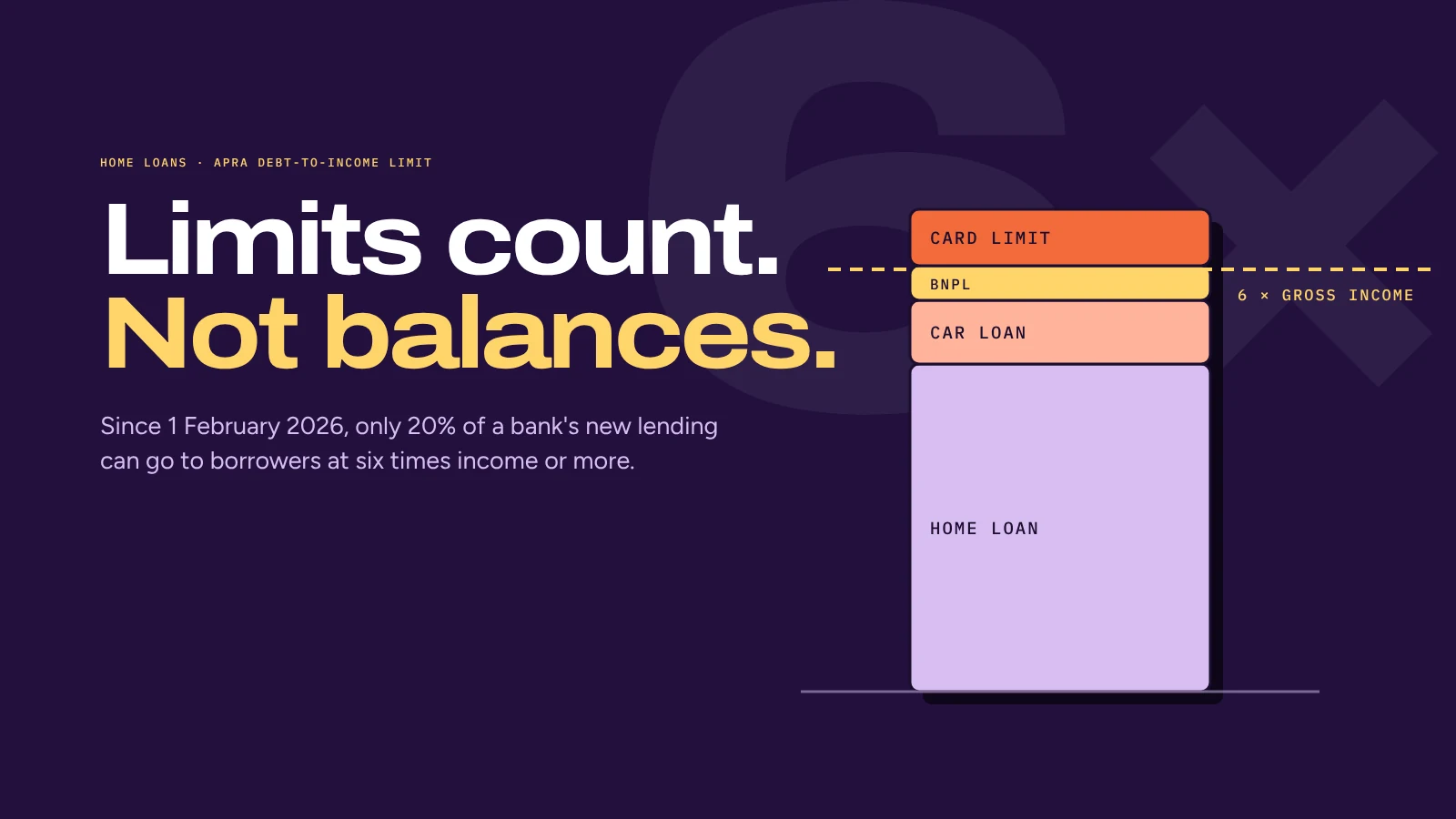
There's a number that could decide your next home loan, and most borrowers have never heard of it. It's six.
Since 1 February 2026, APRA has limited how many loans banks can write to people whose total debts are six times their gross income or more. Here's how your ratio is calculated and who the rule actually touches.
What does the rule say?
APRA, the banking regulator, announced the limit on 27 November 2025 and it started on 1 February 2026. It covers every authorised deposit-taking institution that writes home loans, which means banks, credit unions and building societies.
- No more than 20% of a lender's new owner-occupier lending can go to borrowers with a debt-to-income ratio (DTI) of six or more.
- Separately, no more than 20% of its new investor lending can be at six or more.
- It's measured by the dollar value of new loans. The big banks are measured every quarter, and smaller lenders on a rolling 12 months.
It applies to new loans only. If you already have a mortgage, nothing changes for you today.
How is your DTI worked out?
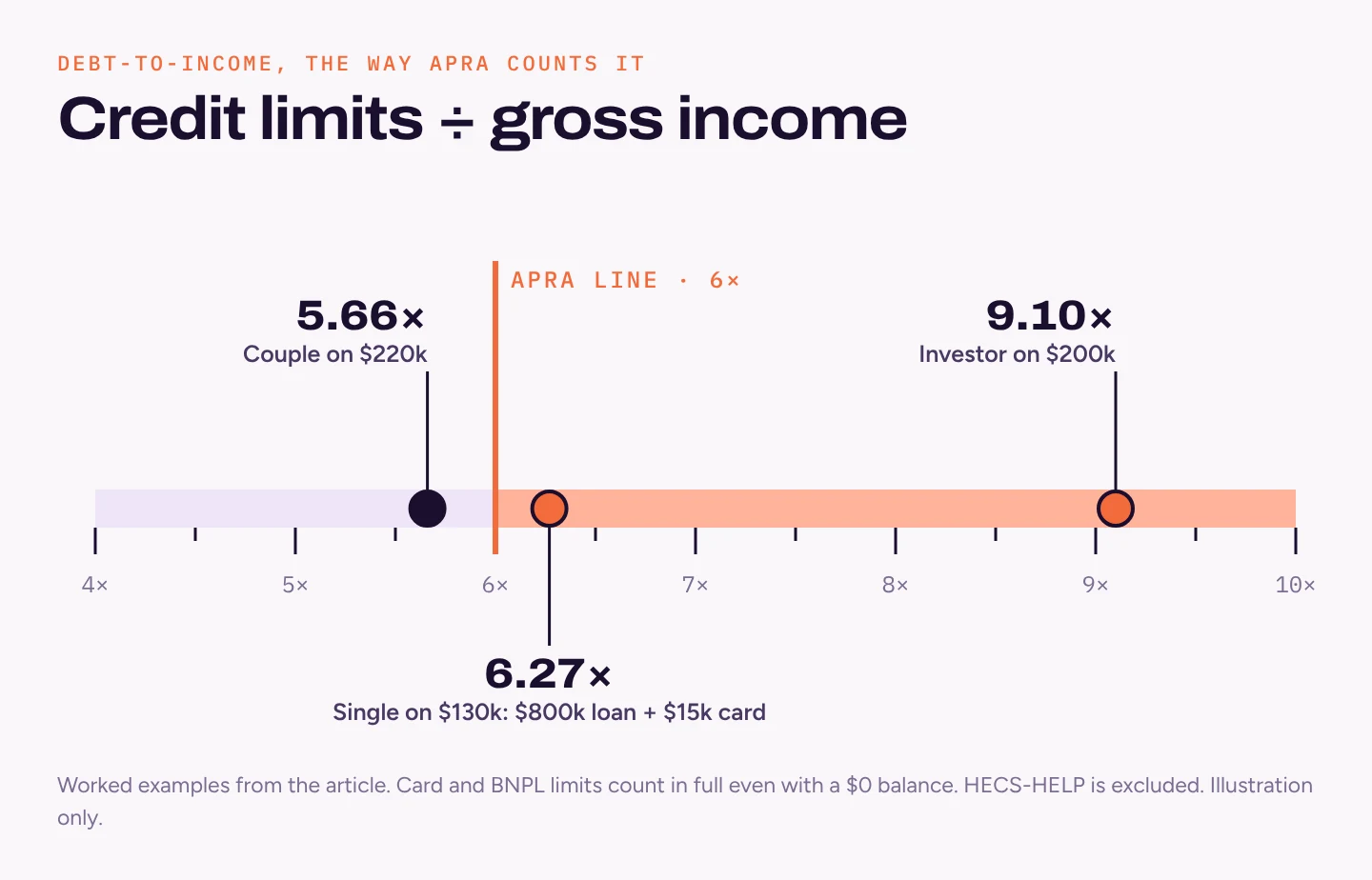
APRA defines it as the credit limits of all your debts divided by your gross income. Limits, not balances, and that's where people get caught.
These count as debt:
- the new home loan and any other mortgages you hold
- personal loans and car loans
- credit cards, at the full limit even if you pay them off every month
- buy now pay later accounts
- margin loans and any other debts the lender knows about
HECS-HELP debt is left out of APRA's measure, although the repayments still reduce what a lender will let you borrow. Money in an offset account isn't subtracted from the loan.
Income is your gross income before tax, not counting compulsory super.
A few worked examples
Here's where the six-times line sits at different incomes:
- $100,000 income: $600,000 of total credit limits
- $150,000 income: $900,000
- $250,000 income: $1,500,000
Let's say you earn $130,000 on your own and want an $800,000 loan. You also have a $15,000 credit card you barely use. That's $815,000 divided by $130,000, or 6.27 times. Cancel the card and you're at 6.15. Still over the line.
A couple on $220,000 combined with a $1.2 million loan, a $25,000 car loan and $20,000 of card limits sits at 5.66. Under it.
An investor on $200,000 who already holds a $650,000 home loan, a $550,000 investment loan and a $20,000 card is at 6.10 before buying anything. Add a $600,000 investment loan and it's 9.10.
Who does it actually affect?
Mostly investors. In the June 2026 quarter, 8.9% of new investor lending was at six times or more, down from 10.8% in the March quarter. For owner-occupiers the share was 3.7%.
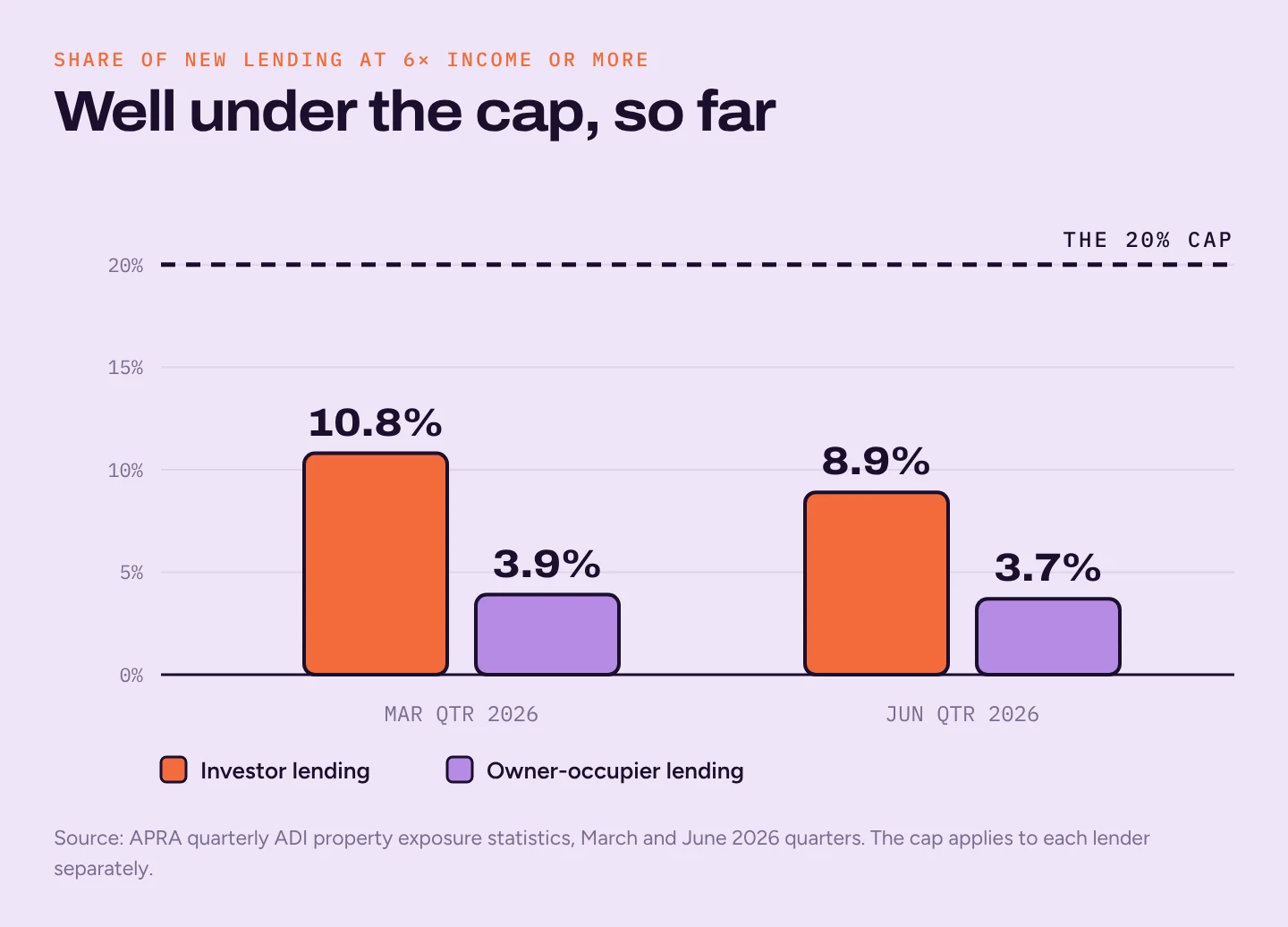
Both are well under the 20% cap. In May, APRA described the limits as guardrails for now and said they weren't holding back lending overall.
Some loans are exempt:
- loans to build a new home
- loans to buy a newly built home
- owner-occupier bridging loans, which helps people buying before they sell
Refinancing isn't on that list. Non-bank lenders aren't covered either, and they hold less than 5% of Australian mortgages.
One caution on the investor numbers. Investor loan commitments fell 8.6% in the June quarter, but four rate rises and the May 2026 Budget changes to negative gearing on established homes (which still need to pass Parliament) were working at the same time. The cap isn't the whole story.
Where it bites in practice
A lender that's close to its 20% can decline a high-DTI application even when you pass its serviceability test. It can also offer a smaller loan instead.
Brokers have reported that some lenders have quietly set their own internal limits below six for investors. Lenders don't publish these numbers, and they change from quarter to quarter. Knowing which lender has room this quarter is a big part of what I check on a file that's anywhere near the line.
Ways people bring their ratio down
- Cutting card limits they don't use. A $20,000 limit adds 0.13 to the ratio of someone on $150,000.
- Closing buy now pay later accounts.
- Paying out a small car or personal loan before applying.
- Looking at a new build, which sits outside the cap.
- Comparing a non-bank lender, weighing its rate and fees against the extra room.
Each of these has a trade-off. Closing a card leaves less backup for emergencies, for example, and a non-bank loan can cost more.
Quick answers
Does the limit apply to me if I already have a loan?
No. It only counts new loans funded from 1 February 2026. It can come up again if you refinance or borrow more, because refinances aren't exempt.
Is six times income the most a bank will lend?
No. Banks can still write loans above six times, as long as those loans stay under 20% of their new lending. Whether a particular lender will do it depends on how close it is to the limit at the time.
Does the 5% Deposit Scheme get around it?
The scheme isn't on APRA's exemption list, so a scheme loan counts like any other unless it's for a newly built home. Most first home buyers borrow well under six times anyway.
Check before you sign
If your numbers are anywhere near six times, work it out before you make an offer. The borrowing power calculator gives a rough borrowing figure, and our investment loans page explains how we structure portfolios.
Or book a free 30-minute chat. I'll work out your DTI the way APRA defines it and tell you which lenders have room for it right now.
Sources
- APRA: letter to ADIs on debt-to-income limits, 27 November 2025
- APRA: information paper on DTI limits
- APRA: property exposure statistics, June 2026 quarter
- APRA: macroprudential settings update, 28 May 2026
- ABS: lending indicators, June quarter 2026
Last reviewed 22 October 2026. This is general information only. It doesn't take your objectives, financial situation or needs into account. Lender policies change often.
Want this applied to your numbers?
Articles are general information. A 30-minute chat with Suvidh and the team turns it into a plan for your situation: borrowing power, structure and the lender that fits.
Book a free chatRun the calculatorsWritten by the Cinch Loans team · Reviewed by Suvidh Arora, Chief solutions officer · About us
Keep reading
More from Cinch Insights.
Plain-English articles on home loans, refinancing, rates and the property market, written for Australian borrowers rather than for lenders.
Home loans
October 22, 2026
APRA's debt-to-income limit explained: the 6x rule | Cinch Loans
Since 1 February 2026, banks can only write 20% of new loans at six times income or more. How your ratio is worked out, who the rule actually affects, and how people bring theirs down.