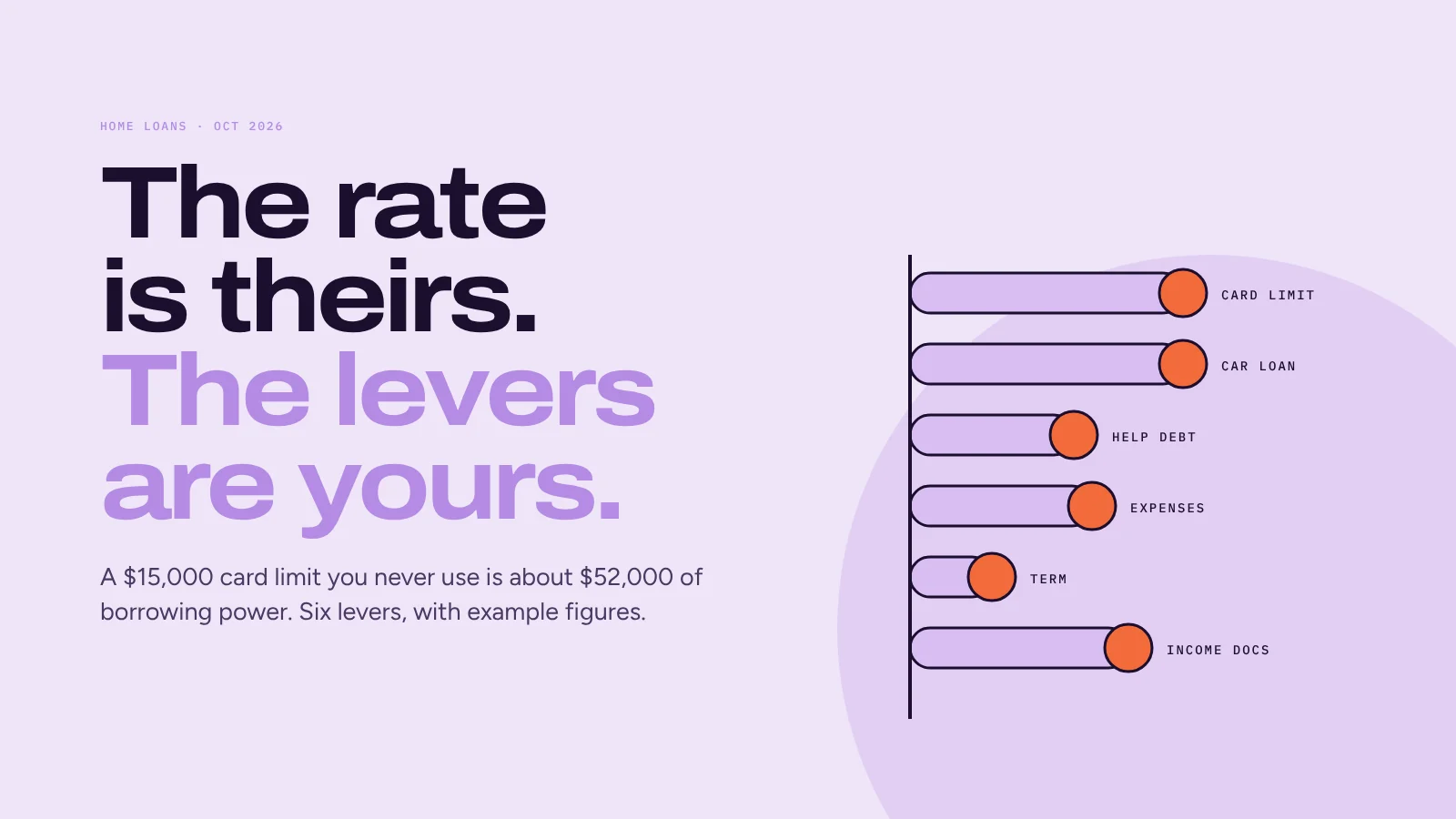
"How much can I borrow?" has one honest answer: it depends which lender, which month, and what's on your credit file. In 2026 the month has mattered more than usual.
Four rate rises have taken something like $90,000 off a typical household's maximum loan, on Cotality's estimate. That number is out of your hands. What's in your hands is a list of smaller levers that most people never pull, and together they can move a borrowing figure by more than a rate rise does.
Here's how a lender actually builds the number, and where the levers are.
How the number gets built
Every lender runs the same four steps, with its own settings:
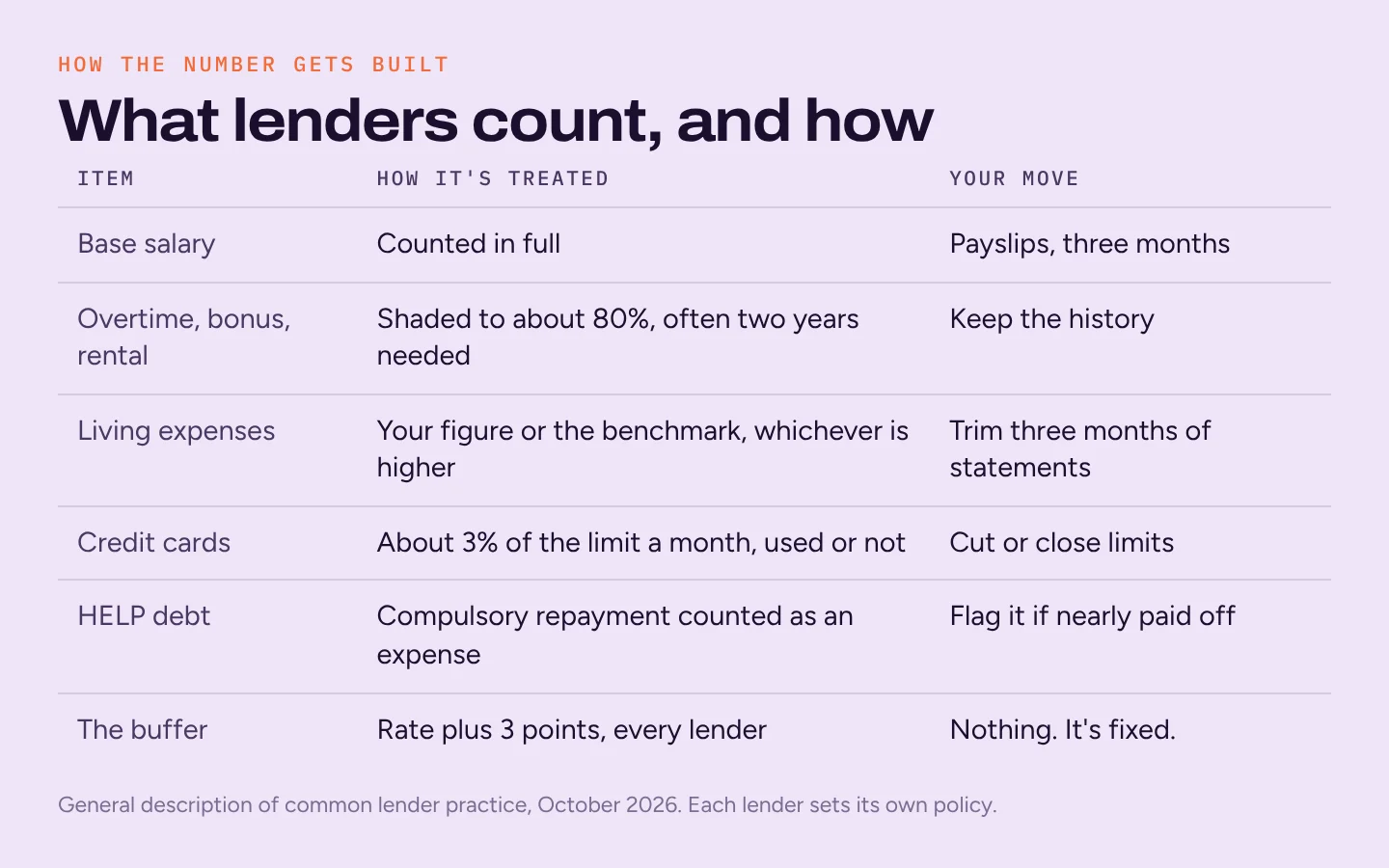
- Income, after "shading". Base salary counts in full. Overtime, bonuses, commission and rental income are usually counted at 80% or less, and some lenders want two years of it.
- Living expenses. You declare them; the lender compares your figure with a benchmark for your household and uses whichever is higher. Declaring less than the benchmark changes nothing.
- Other commitments. Loan repayments at their actual amount, credit cards at a percentage of the limit whether you use it or not, HELP repayments, child support.
- The buffer. Whatever's left is tested against the loan at the lender's rate plus 3 percentage points. At 6.75%, you're assessed at 9.75%.
At 9.75% over 30 years, every $859 a month of surplus supports about $100,000 of loan. That ratio is what makes the levers below worth real money.
The levers, with example figures
Let's say a couple on $150,000 combined with no other debts has a surplus the lender puts at $3,500 a month, which supports a loan of about $407,000. These are example figures; your lender's settings will differ.
1. Close the credit card you don't use
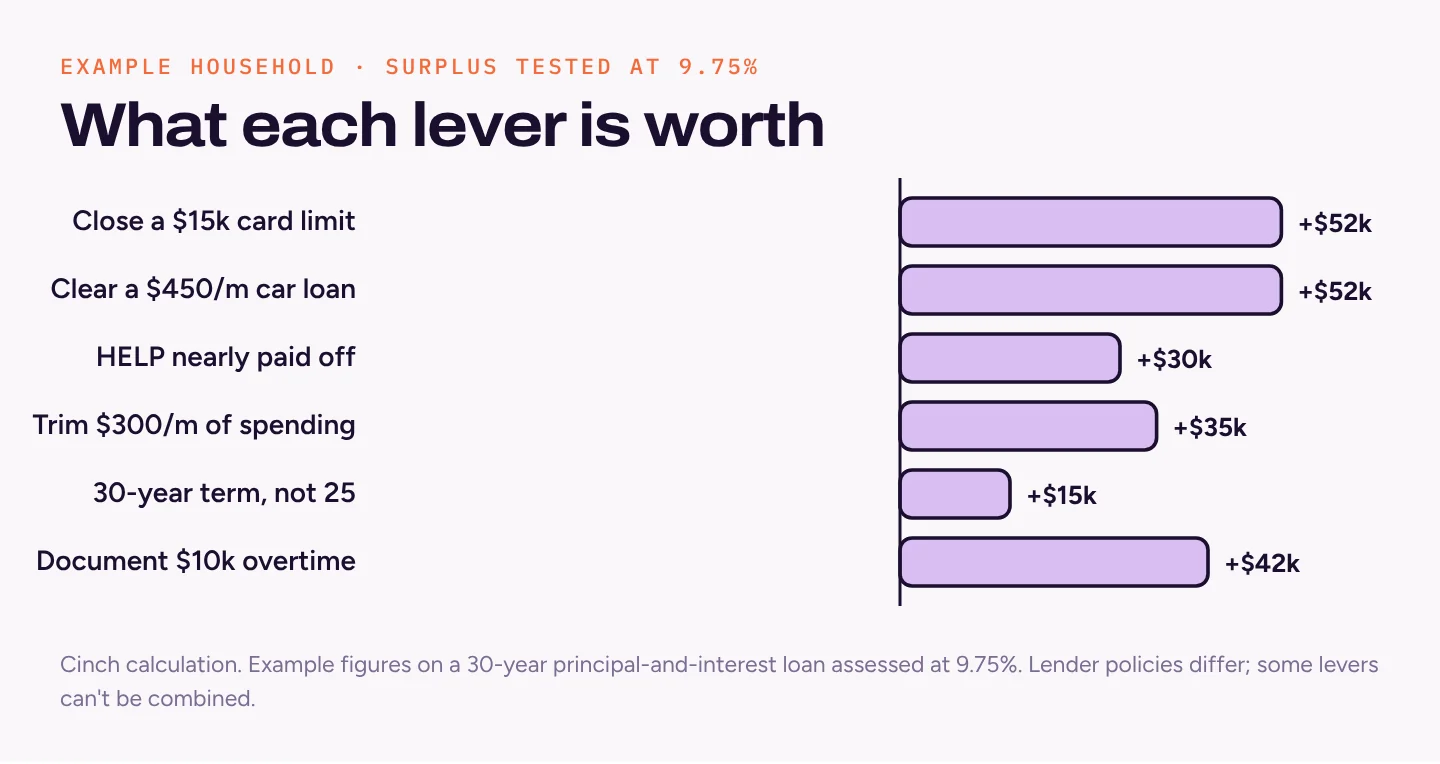
A $15,000 limit with nothing owing is assessed at roughly 3% of the limit a month, about $450. That's around $52,000 of borrowing power. Cut the limit to $3,000 and most of it comes back. This is the cheapest lever on the list and the one I see skipped most.
2. Clear or refinance the car loan
A $450-a-month car loan is the same $52,000. If it has a year to run, a lender may still count it. Paying it out from savings can cost you deposit but buy you loan; whether that trade works depends on how close you are to the number you need.
3. Know how your HELP debt is treated
A HELP debt doesn't count in APRA's debt-to-income calculation, but the compulsory repayment counts as an expense. In 2026–27 that's 15 cents in every dollar above $69,528, so someone on $90,000 repays about $3,070 a year, or $256 a month, which is roughly $30,000 of borrowing power. A lender can, by exception, ignore the repayment if the debt will be cleared within about a year. If you're close to paying it off, say so.
4. Check what you're declaring
Lenders compare your declared spending with a benchmark and use the higher. If your real spending is above the benchmark, the bank statements will show it, and you'll be assessed on it. Three months of trimmed discretionary spending before you apply is worth more than any amount of tidying up afterwards, because it's the statements that get read.
5. Choose the term with your eyes open
A 30-year term supports a bigger loan than 25 years, about 4% more at the assessment rate. It also costs more interest over the life of the loan. Taking 30 years and paying it like 25 gives you both, provided you keep the discipline.
6. Count every dollar of income you can document
Regular overtime with two years of payslips. Rental income on a property you already own. A second job with a history. A bonus with three years of letters. Each one is shaded, but shaded income beats no income, and the paperwork is usually the only thing standing between you and it.
The levers that don't work
A bigger deposit doesn't lift your borrowing power; it lifts your purchase price. A guarantor doesn't either; it removes the deposit problem and LMI, and the full loan is still tested against your income. Fixing your rate changes the assessment only slightly, because the buffer is added to whatever rate you take.
And "shopping around" works, but less than people think. Lenders differ most on how they treat income types and existing debts, so the gains come from matching your file to the lender whose policy suits it, not from a rate table.
Where to start
The borrowing power calculator uses an assessment rate like a lender's, so it's a fair starting point. Our home loans page covers what we ask for and why. If you'd like the levers run on your actual file, book a free 30-minute chat. Bring the card limits; they're the first thing I'll ask about.
Sources
- APRA: serviceability buffer held at 3 points, May 2026
- Aussie: HECS-HELP changes and borrowing power, 2026–27 thresholds
- ATO: study and training loan repayment thresholds
- Moneysmart: how much can I borrow
Last reviewed 25 October 2026. This is general information only. It doesn't take your objectives, financial situation or needs into account. All dollar figures are examples; lender policies differ and change.
Want this applied to your numbers?
Articles are general information. A 30-minute chat with Suvidh and the team turns it into a plan for your situation: borrowing power, structure and the lender that fits.
Book a free chatRun the calculatorsWritten by the Cinch Loans team · Reviewed by Suvidh Arora, Chief solutions officer · About us
Keep reading
More from Cinch Insights.
Plain-English articles on home loans, refinancing, rates and the property market, written for Australian borrowers rather than for lenders.
Home loans
October 25, 2026
How to increase borrowing power in 2026: the levers that work | Cinch Loans
Four rate rises took about $90,000 off a typical household's maximum loan. Card limits, car loans, HELP repayments and declared spending can move it back by more than a rate rise does.