Cars & vehicles
One in four new cars is electric. Novated lease or car loan before the FBT rules change?
EVs outsold diesel for the first time in September. The FBT exemption that drove it starts winding back in April 2027, with leases grandfathered. How the two ways to finance a car compare, and who each suits.
24 October 2026
6 min read
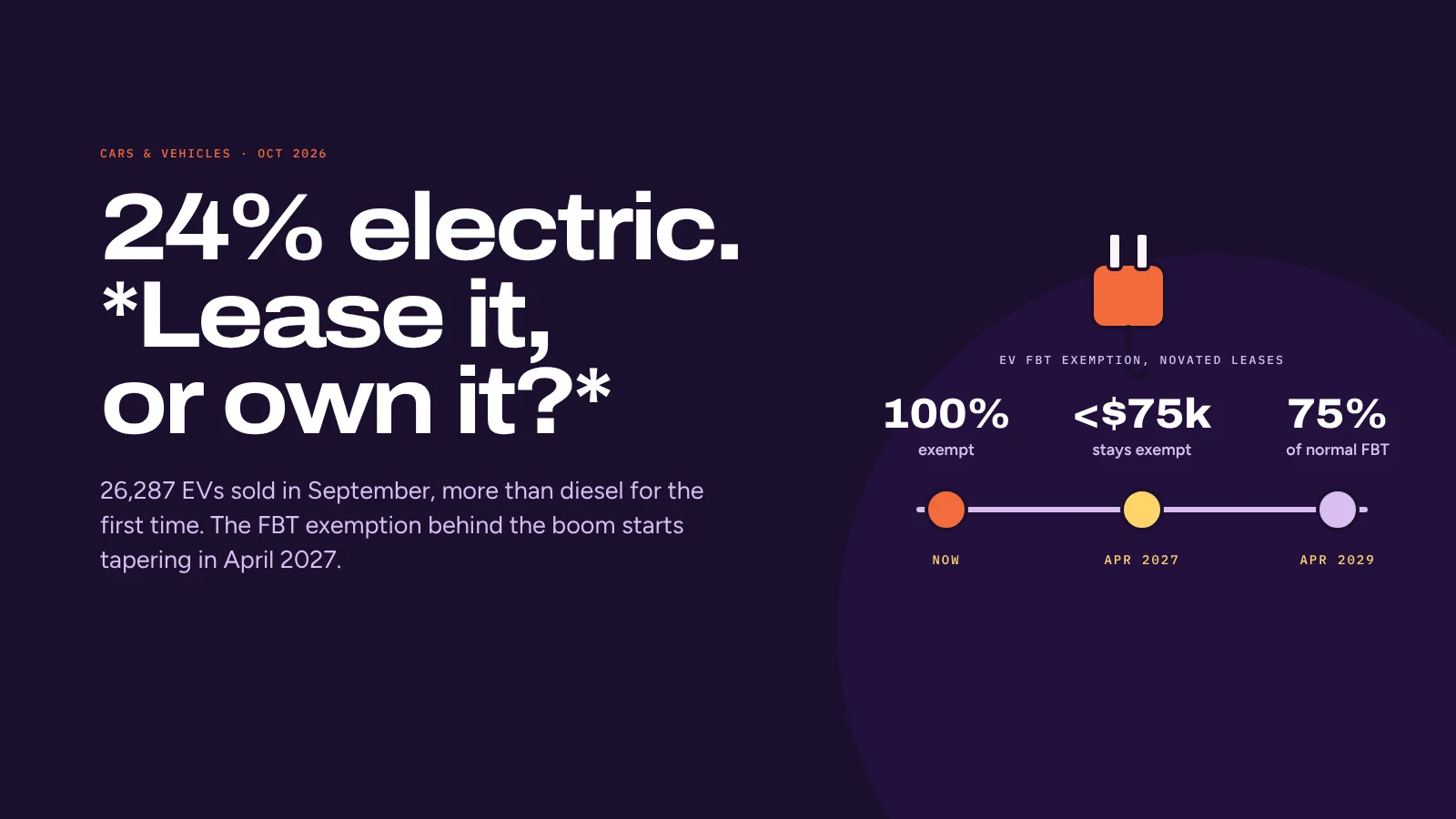
In September, Australians bought more electric cars than diesel ones. That has never happened before.
26,287 battery-electric vehicles sold in the month, 24.2% of the market and more than double the share of a year ago. Add plug-in hybrids and ordinary hybrids and half of all new cars sold had a battery in them somewhere. Only the Ford Ranger outsold the Tesla Model Y, and four of the five best-selling EVs were from Chinese brands most people hadn't heard of two years ago.
A big reason is the fringe benefits tax exemption for EVs on a novated lease, which has made an electric car cheaper per week than a petrol one for a lot of salaried workers. That exemption starts winding back in April 2027. So the question I'm getting most from clients buying a car right now is: novated lease or a car loan?
Here's how the two work, what's changing, and who each one suits.
What's changing with FBT
Under a novated lease your employer pays for the car out of your salary, partly before tax. Normally that attracts fringe benefits tax. Since 2022, eligible EVs have been exempt from it, and that exemption is the whole reason the weekly cost works out so well.
The May Budget set out a phase-down:
- Until 31 March 2027: EVs under the luxury car tax threshold stay fully exempt.
- From 1 April 2027: the full exemption continues only for EVs costing under $75,000. EVs above that are taxed at 75% of the normal FBT rate.
- From 1 April 2029: all EVs are taxed at 75% of the normal rate.
- EVs above the luxury car tax threshold ($91,387) already pay full FBT, and still will.
The important detail is that leases are grandfathered from the date they're entered into. Sign a five-year lease on a $60,000 EV in March 2027 and the exemption runs for the whole lease. Sign it in May 2027 and you're still exempt, because it's under $75,000. Sign a lease on an $85,000 EV after April 2027 and the discount is 25%, not 100%.
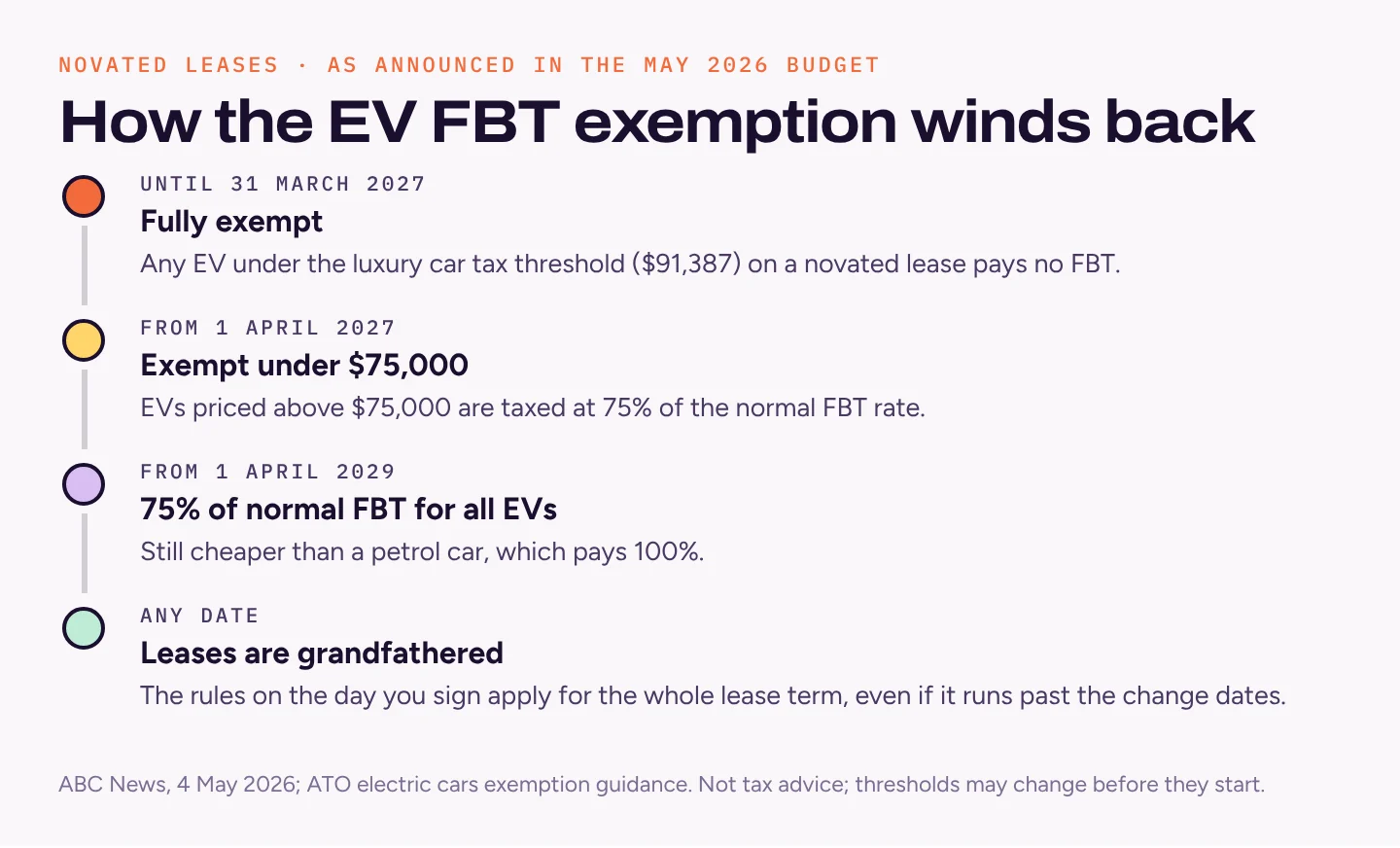
The ABC's rough example from the Budget coverage: a $50,000 petrol car on a novated lease attracts about $9,800 a year in FBT. A $50,000 EV, once the 2029 rules apply, about $7,300. Today the EV figure is zero.
Novated lease: how it works
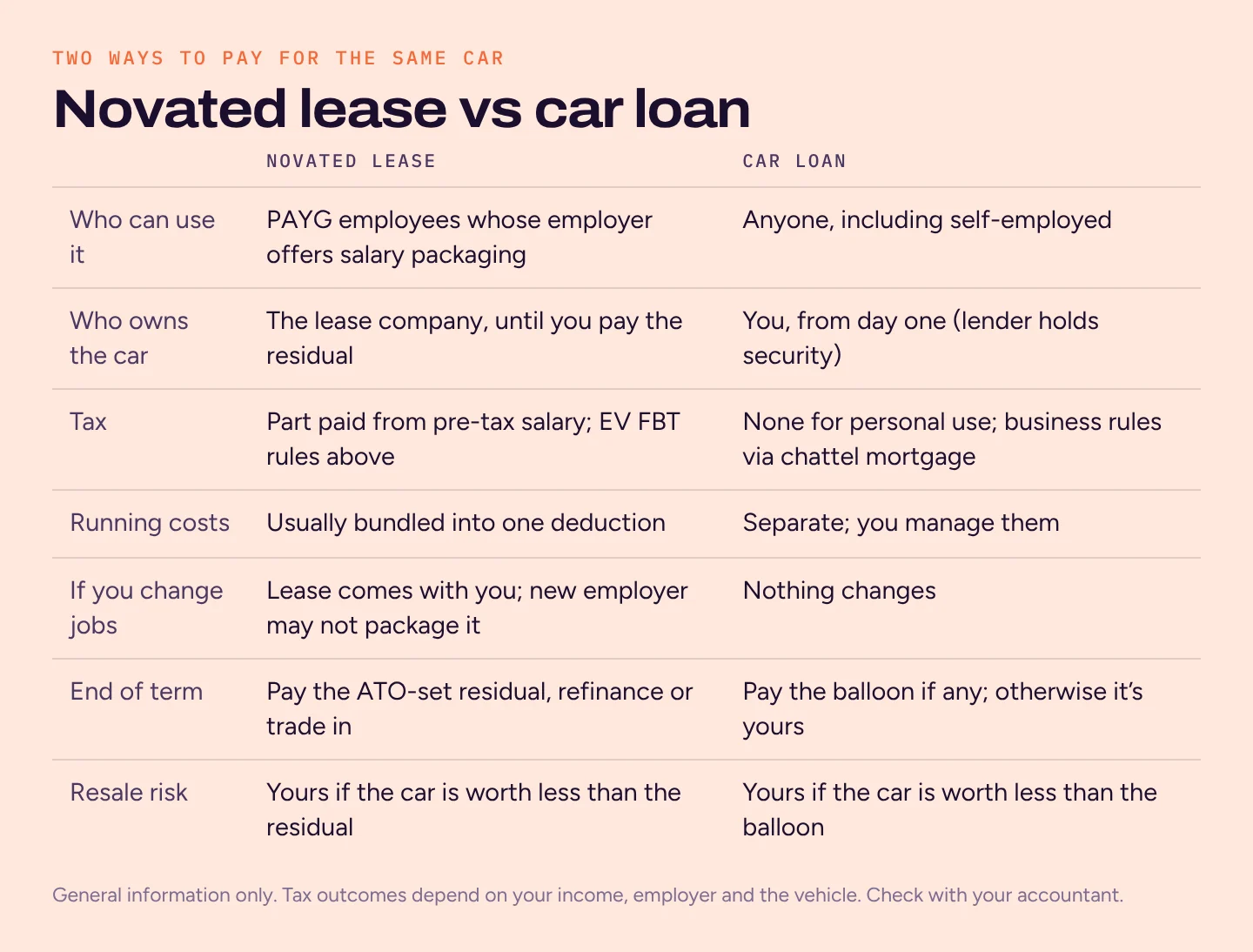
Your employer leases the car and deducts the payments from your pay. Part of the payment comes from pre-tax salary, which lowers your taxable income. Running costs are usually bundled in: registration, insurance, servicing, tyres, charging or fuel.
At the end of the term there's a residual value set by ATO guidelines. You pay it out, refinance it, or trade the car in and start again.
It works well for people on a salary with a stable employer and a marginal tax rate of 30% or higher, who want one weekly figure covering everything. It works badly if you change jobs mid-lease, because the lease comes with you and your new employer may not offer salary packaging. It also isn't available if you're self-employed or a sole trader.
Car loan: how it works
You borrow the money, buy the car, and own it from day one with the lender holding security over it. Fixed rate for the term, usually one to seven years. You can choose a balloon payment at the end to lower the monthly repayment, or pay it off completely.
There's no tax benefit for a personal-use car. What you get instead is simplicity: the car is yours, there's no residual to settle, you can sell it when you like after paying out the loan, and nothing changes if you change jobs.
For a self-employed buyer or a business, a car loan written as a chattel mortgage brings the GST and depreciation treatment that applies to any business asset. That's a separate conversation and one for your accountant.
Two things about the cars themselves
First, prices are falling. Sub-$40,000 EVs from BYD and Geely are arriving every quarter and Tesla has cut the price of its cheapest Model 3 by $9,000. Good news for buyers, less good for anyone who bought the same car 18 months ago and is now trying to work out what it's worth.
Second, that uncertainty about resale value is the real risk in both structures. On a novated lease, the residual is fixed, so if the car is worth less than the residual at the end, the gap is yours. On a car loan with a balloon, same thing. The protection is a shorter term, a smaller balloon, or choosing a model with an established resale record.
Which one, then?
If you're a PAYG employee, your employer offers salary packaging, you're confident about the next three to five years with them, and you want an EV under $75,000, the novated lease case is strong and stays strong beyond April 2027. If any of those conditions is shaky, or you're self-employed, a car loan is simpler and you'll never be surprised by a job change.
Either way, get the car price and the finance quote separately. Dealer finance on EVs has been competitive this year, but "competitive" and "cheapest for you" aren't the same thing.
Our asset and vehicle finance page covers car loans for individuals and businesses. The loan repayment calculator will give you a monthly figure for any amount and term. If you've got a quote from a dealer or a lease company, book a free 30-minute chat and I'll tell you how it compares.
Sources
- carsales: VFACTS, one in four new cars sold is now electric, September 2026
- ABC News: electric vehicle tax discount to be wound back
- ATO: electric cars exemption
- Moneysmart: car loans
Last reviewed 24 October 2026. This is general information only and isn't tax advice. It doesn't take your objectives, financial situation or needs into account. FBT rules and thresholds are as announced in the May 2026 Budget and may change before they start.
Want this applied to your numbers?
Articles are general information. A 30-minute chat with Suvidh and the team turns it into a plan for your situation: borrowing power, structure and the lender that fits.
Book a free chatRun the calculatorsWritten by the Cinch Loans team · Reviewed by Suvidh Arora, Chief solutions officer · About us
Keep reading
More from Cinch Insights.
Plain-English articles on home loans, refinancing, rates and the property market, written for Australian borrowers rather than for lenders.
Cars & vehicles
October 24, 2026
EV novated lease vs car loan: FBT exemption changes from April 2027 | Cinch Loans
EVs outsold diesel for the first time in September. The FBT exemption that drove it starts winding back in April 2027, with leases grandfathered. How the two ways to finance a car compare, and who each suits.