First home buyers
The deposit is solved. Borrowing power isn't: the 2026 first home buyer problem
More than 100,000 buyers have used the 5% Deposit Scheme, yet first home buyer loans are down 20%. Four rate rises took almost $90,000 off borrowing power. Here are the four ways around it.
24 October 2026
6 min read
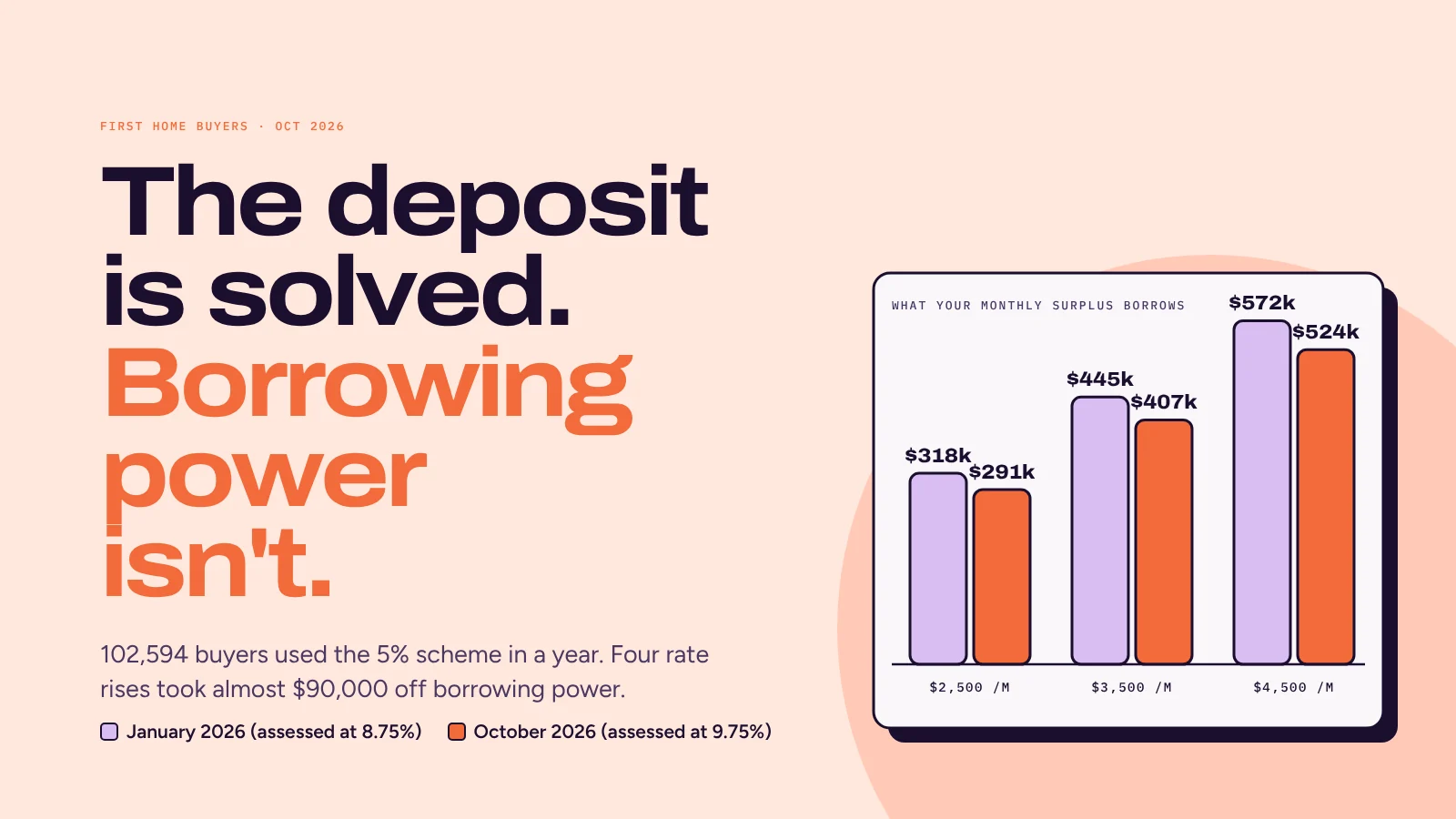
A couple sat in my office last week with a 5% deposit saved, scheme pre-approval sorted, and a lender's borrowing figure that was $60,000 short of the townhouse they wanted.
That's the 2026 first home buyer problem in one sentence. The deposit is the easy part now. Borrowing power is the wall.
Here's why it happened, how big the gap is, and the four ways I see people getting around it.
The deposit problem has been solved
Since the 5% Deposit Scheme opened up on 1 October 2025, 102,594 first home buyers have used it. Victoria led every state with 33,413. About one in two first home buyers nationally now uses a government scheme of some kind.
The scheme does exactly what it says: you put in 5%, the government guarantees the next 15%, and the lender doesn't charge lenders mortgage insurance. On a median-priced home that saves about $23,700. There are no income caps and no limit on places.
So why are first home buyer loan numbers falling? Equifax counted first home buyer mortgage demand down 20.1% in the year to August, worse than the 14.1% drop for the market overall.
Because the loan still has to be serviced
A guarantee replaces insurance. It doesn't change the lender's maths on whether you can afford the repayments.
And that maths has moved a long way this year. The Reserve Bank has lifted the cash rate four times since February, from 3.60% to 4.60%. Lenders test you at their actual rate plus a 3 percentage point buffer, so a loan at 6.75% is assessed as if it cost 9.75%.
Cotality's estimate is that those four rises have taken almost $90,000 off a typical household's maximum loan. REA Group's affordability index puts it another way: a household on about $125,000 could afford roughly 12% of the homes sold in 2025–26.
Let's say a lender works out you have $3,500 a month spare for repayments after living costs and other debts. These are example figures only, on a 30-year principal-and-interest loan:
- In January 2026, assessed at 8.75%, that supported a loan of about $445,000.
- In October 2026, assessed at 9.75%, it supports about $407,000.
Same savings, same income, same job. About $38,000 less house.
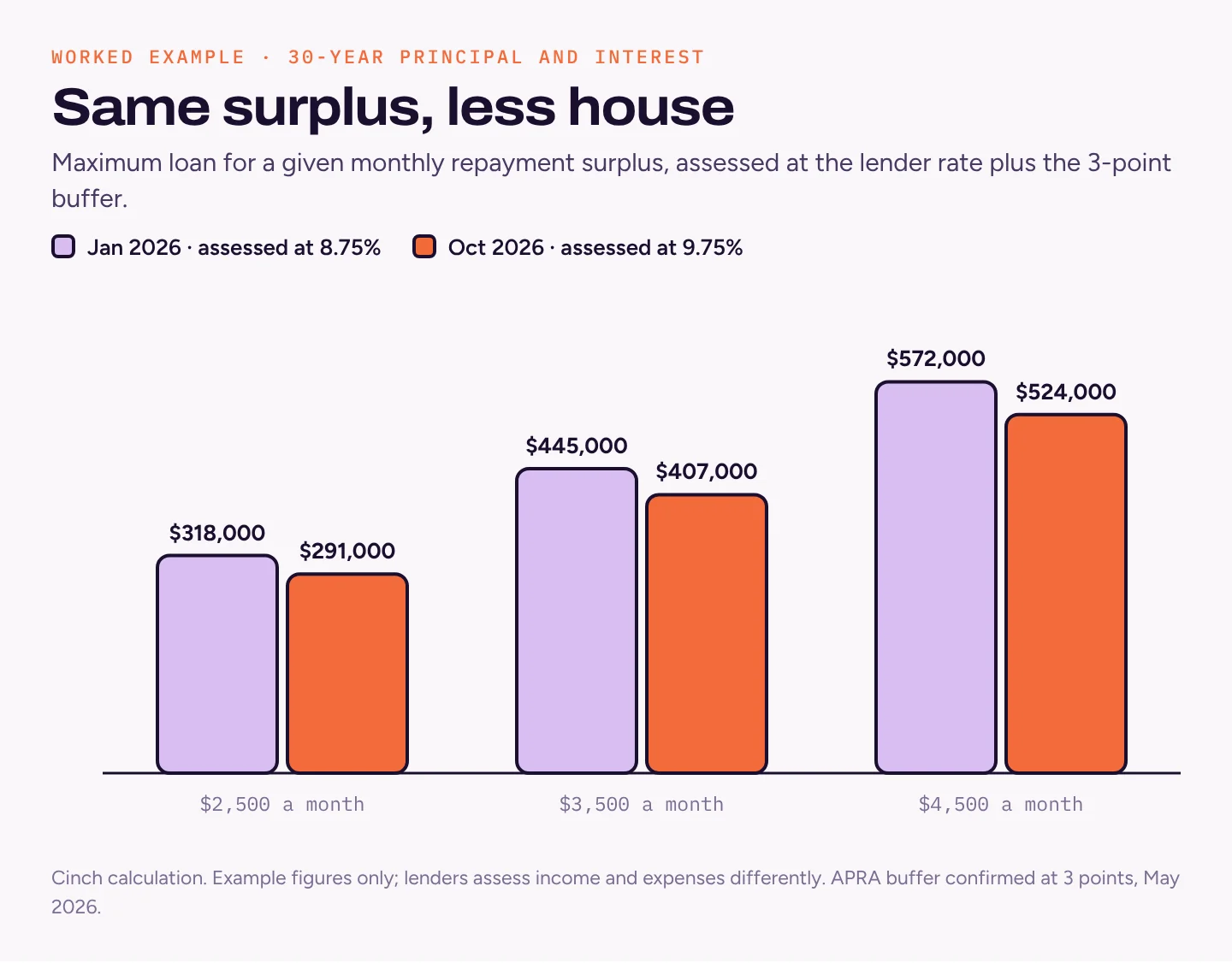
Falling prices haven't closed the gap either. National values are down 5.2% from their March peak, but borrowing power fell faster than prices did, and the cheaper end of the market is where first home buyers compete hardest.
Four ways around the wall
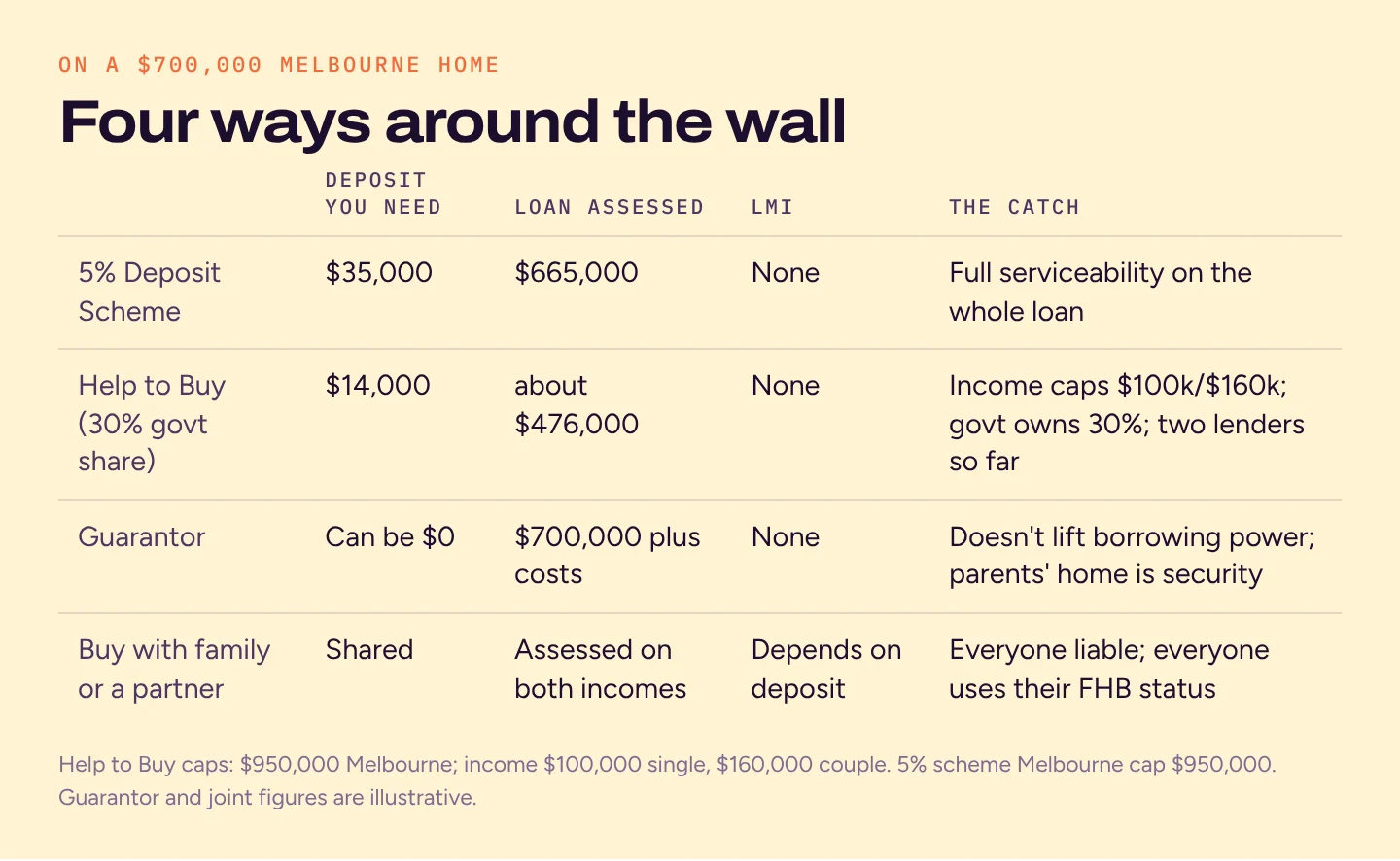
None of these is a magic fix. Each one trades something away. Here's how they compare on a $700,000 Melbourne home.
1. Clean up what the lender counts against you
This is the cheapest lever and the one most people skip. A credit card with a $10,000 limit and a $0 balance still costs you borrowing power, because lenders assess the limit, not the balance. Close it or cut the limit. A $450-a-month car loan can knock around $50,000 off what you can borrow. If you're a year from clearing it, that year might be worth waiting.
HECS repayments count as an expense too. Lenders have softened on this in 2025–26, but they haven't stopped counting it.
2. Help to Buy
This is the one getting more interest in my conversations since the hikes. The government takes an equity share of up to 30% in an existing home (40% for a new build) and you borrow the rest with a 2% deposit. In Melbourne the price cap is $950,000, and the income caps are $100,000 for singles and $160,000 for couples.
The reason it helps with serviceability is simple: the loan is smaller. On a $700,000 existing home, a 30% government share means you're borrowing about $476,000 rather than $665,000.
The catch: the government owns part of your home until you buy it back, at the market value at the time. Only two lenders are offering it so far, and more than 2,300 of the 10,000 places for this year were already approved by mid-year, so they can run out.
3. A guarantor
A parent uses equity in their own home as extra security. That can take your deposit requirement to zero and remove LMI without using the scheme at all.
What it doesn't do is make you able to afford a bigger loan. The lender still tests the full amount against your income, so a guarantor solves the deposit problem a second time, not the borrowing power problem. Your parents also have their home on the line until you've built enough equity to release them, which is usually a few years.
4. Buy with someone
Siblings, a partner you're not yet living with, a parent going on the title. Two incomes assessed together is the one move on this list that lifts the borrowing figure itself.
It needs a co-ownership agreement drawn up by a lawyer before you sign a contract, covering who pays what, what happens if someone wants out, and how the sale price gets split. Everyone on the loan is liable for all of it, and everyone on the title uses up their first home buyer status.
What I'd do first
Get a real borrowing figure before you fall for a property, and get it from a lender's actual calculator rather than a website estimate. The gap between the two is where most of the heartbreak lives.
Then check the stamp duty. Victoria's first home buyer duty concession stops at $750,000, well below the scheme's $950,000 cap, so a buyer at $800,000 pays full duty of around $43,000. That number has to come out of savings and it isn't covered by the guarantee.
The borrowing power calculator will give you a starting point, and our first home buyer page covers how we run the scheme against a standard loan. If you'd rather talk it through, book a free 30-minute chat. I'll tell you plainly whether the gap is $20,000 or $120,000, because the plan is very different for each.
Sources
- Broker Daily: 5% Deposit Scheme hits a milestone, but buyers hit a wall
- firsthomebuyers.gov.au: Australian Government 5% Deposit Scheme
- Housing Australia: Help to Buy
- APRA: serviceability buffer held at 3 points, May 2026
- State Revenue Office Victoria: first home buyer duty concession
Last reviewed 24 October 2026. This is general information only. It doesn't take your objectives, financial situation or needs into account. Scheme rules, price caps and lender policies change.
Want this applied to your numbers?
Articles are general information. A 30-minute chat with Suvidh and the team turns it into a plan for your situation: borrowing power, structure and the lender that fits.
Book a free chatRun the calculatorsWritten by the Cinch Loans team · Reviewed by Suvidh Arora, Chief solutions officer · About us
Keep reading
More from Cinch Insights.
Plain-English articles on home loans, refinancing, rates and the property market, written for Australian borrowers rather than for lenders.
First home buyers
October 24, 2026
First home buyers 2026: the deposit is solved, borrowing power isn't | Cinch Loans
More than 100,000 buyers have used the 5% Deposit Scheme, yet first home buyer loans are down 20%. Four rate rises took almost $90,000 off borrowing power. Here are the four ways around it.