First home buyers
Help to Buy in Victoria, explained: 2% down, the government takes 30%, and the catches
The one government scheme that shrinks the loan rather than the deposit. Income caps of $103,000 and $165,000, a $950,000 Melbourne cap, four lenders, and what the equity share costs you later.
25 October 2026
6 min read

Help to Buy is the scheme people ask me about in a lowered voice, as if there must be a catch. There are a few, and I'll get to them. But for a Melbourne buyer whose problem is the size of the loan rather than the size of the deposit, it's the only government scheme that attacks the right problem.
Here's how it works in Victoria as at October 2026, with the numbers, the trade-offs and who it suits.
The idea in one paragraph
You put in a deposit of at least 2%. The Commonwealth takes an equity share in the home, up to 30% for an existing property or 40% for a new build, and you borrow the rest from a participating lender. You pay no rent or interest on the government's share while you live there. When you sell, or when you choose to buy it back, the government gets its percentage of the value at the time, not the dollars it put in.
It opened on 5 December 2025 with 10,000 places a year, and more than 7,200 applications had been lodged by the start of October. Housing Australia has confirmed another 10,000 places for 2026–27.
Who can use it in Victoria
- Australian citizens aged 18 or over, applying alone or with one other eligible person. Permanent residents don't qualify.
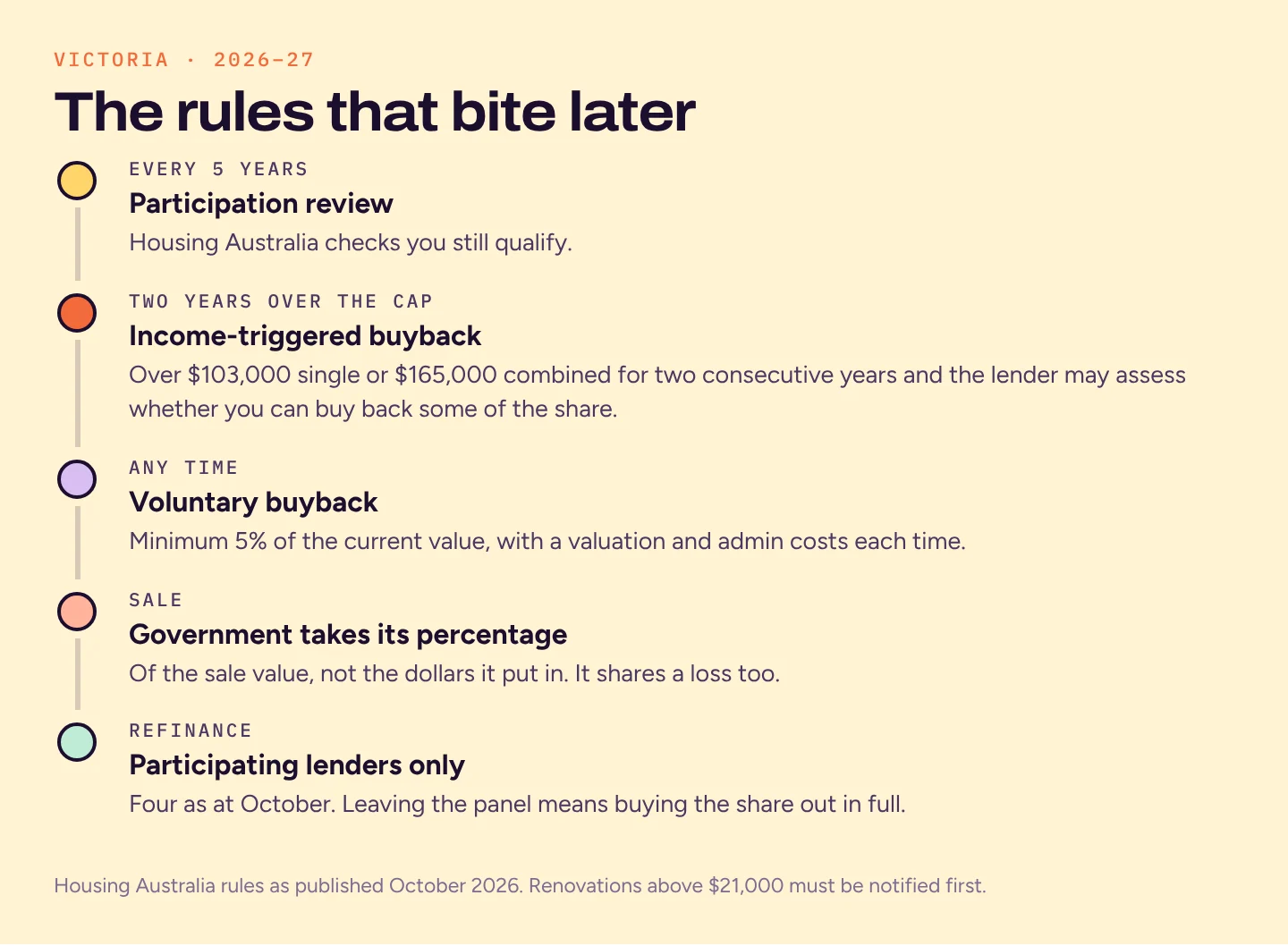
- Taxable income of $103,000 or less for a single applicant, or $165,000 or less combined for a couple or a single parent, on your most recent notice of assessment. There's no discretion for a one-off good year.
- You don't own any other property, here or overseas. You don't have to be a first home buyer.
- You'll live in the home, and you aren't using another government scheme on the same purchase.
- The price is under the cap: $950,000 in Melbourne and Geelong, $650,000 in the rest of Victoria.
The lender still assesses you on the loan you're taking. The government share makes that loan smaller, which is the whole point, but it doesn't change the buffer or the expense rules.
What it does to the numbers
Let's say you're buying an existing $700,000 home in Melbourne. These are example figures on a 30-year principal-and-interest loan at 6.75%, and the maximum government share isn't automatic; you're expected to contribute what you can reasonably afford.
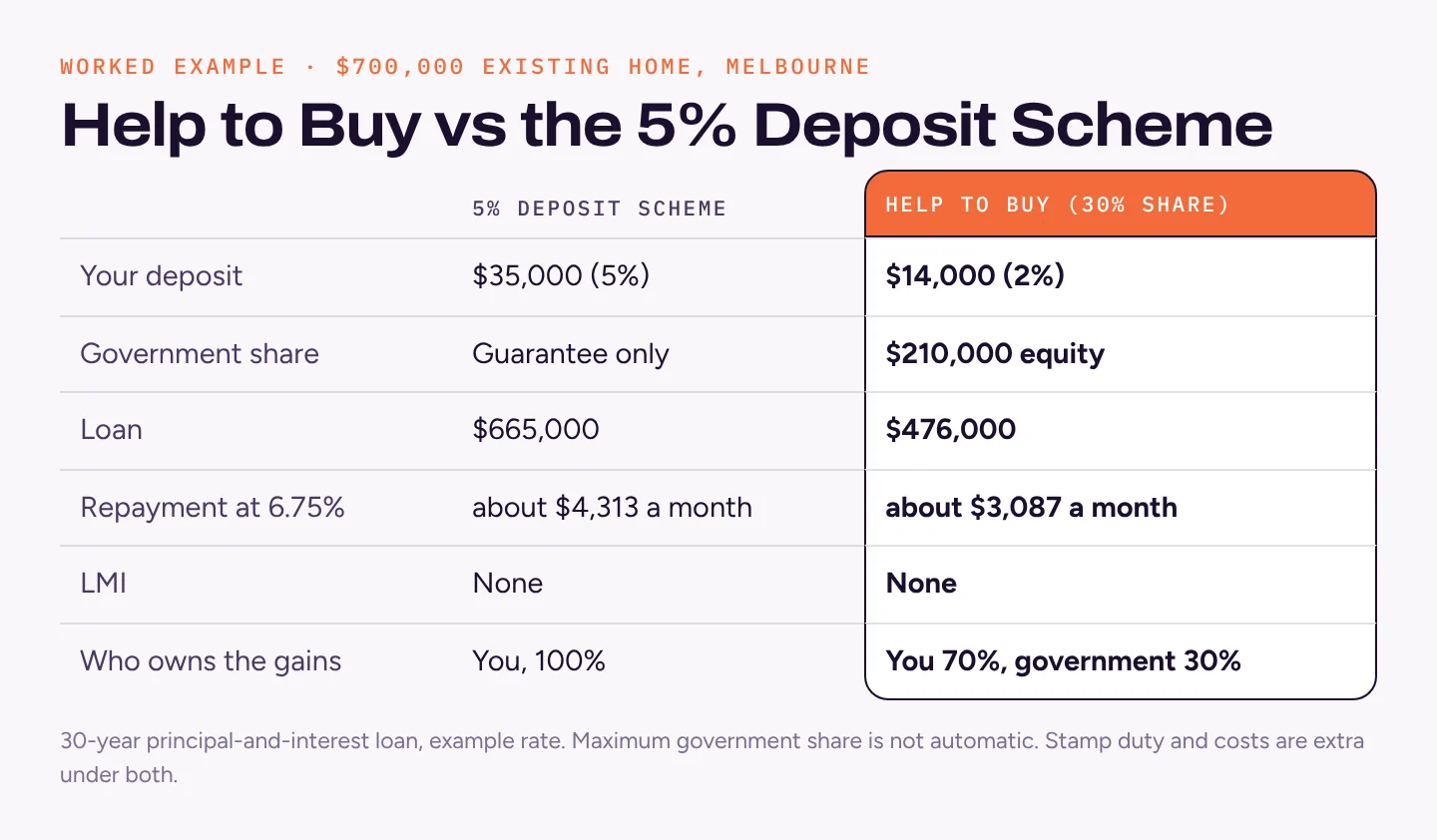
Under the 5% Deposit Scheme you'd need $35,000 down and borrow $665,000, about $4,313 a month. Under Help to Buy with a 30% share, you'd need $14,000 down and borrow $476,000, about $3,087 a month. That's $1,226 a month less, and a loan that passes a serviceability test the bigger one might fail.
Neither scheme charges lenders mortgage insurance. Stamp duty, conveyancing and inspections come out of your pocket under both, and in Victoria a $700,000 first home attracts a reduced duty of around $24,700.
The catches
You own 70%, so you get 70%
If that home is worth $800,000 in five years, the government's 30% is now $240,000 and your share of the gain is $70,000, not $100,000. If it's worth $650,000, the government's share has shrunk to $195,000 with it. It shares the downside as well as the upside, which is the part people forget.
Buying it back costs money
You can buy back the government's share in chunks of at least 5% of the home's current value, rounded to the nearest $1,000. Each buyback needs a valuation, and you pay the valuation and administration costs. Most people do it at a refinance or a sale rather than piece by piece.
Your income is reviewed
Housing Australia reviews your participation at least every five years. If your taxable income goes over the cap for two consecutive financial years, your lender may assess whether you can afford to buy back some or all of the share. You're not expected to repay what you can't afford, but a pay rise can start that conversation.
You can only refinance within the scheme
Refinancing between participating lenders is allowed. Refinancing to any other lender means buying out the government's share in full. The panel is small: four lenders as at October, one of which only takes applications through its own branches. The others accept broker applications, with one still rolling out its broker channel in phases.
Renovations above $21,000 need a heads-up
Because the government owns part of the home, improvements above the 2026–27 threshold have to be notified first, and a valuation may follow.
Who it suits, and who it doesn't
It suits a single on a steady salary, or a couple under the combined cap, who could service a $480,000 loan comfortably but not a $665,000 one. It also suits anyone who'd rather own less of a home now than keep renting while prices and rates move around them.
It doesn't suit someone whose income is about to jump past the cap, who plans to sell within a few years, or who wants to keep every dollar of capital growth. For those buyers, the 5% Deposit Scheme on a cheaper property, or a guarantor, is usually the better fit.
And it isn't a queue-jump. Conditional approval reserves a place for 90 days, with one extension of 90 days, and applications go through the lender, not Housing Australia. With places filling through the year, the lender work has to be done before you start looking seriously.
Where to start
Run your income and a price through the borrowing power calculator to see which loan size you're near. Our first home buyer page covers how we run the two schemes side by side. If you'd like the comparison done on your numbers, book a free 30-minute chat, and I'll tell you plainly which scheme fits, or whether neither does.
Sources
- Housing Australia: Help to Buy
- Home Loan Experts: Help to Buy rules and caps, updated 16 October 2026
- MPA: Help to Buy opens to more brokers, 2 October 2026
- State Revenue Office Victoria: first home buyer duty concession
Last reviewed 25 October 2026. This is general information only. It doesn't take your objectives, financial situation or needs into account. Scheme caps, places and lender participation change.
Want this applied to your numbers?
Articles are general information. A 30-minute chat with Suvidh and the team turns it into a plan for your situation: borrowing power, structure and the lender that fits.
Book a free chatRun the calculatorsWritten by the Cinch Loans team · Reviewed by Suvidh Arora, Chief solutions officer · About us
Keep reading
More from Cinch Insights.
Plain-English articles on home loans, refinancing, rates and the property market, written for Australian borrowers rather than for lenders.
First home buyers
October 25, 2026
Help to Buy Victoria 2026: income caps, price caps, buyback and who it suits | Cinch Loans
The one government scheme that shrinks the loan rather than the deposit. Income caps of $103,000 and $165,000, a $950,000 Melbourne cap, four lenders, and what the equity share costs you later.