Business & asset finance
The $20,000 instant asset write-off is permanent. Here’s how that changes equipment finance
Parliament made the $20,000 write-off permanent from 1 July 2026 and brought back loss carry-back. Why the June rush is over, why ownership now matters more, and how a chattel mortgage compares with a lease.
24 October 2026
5 min read
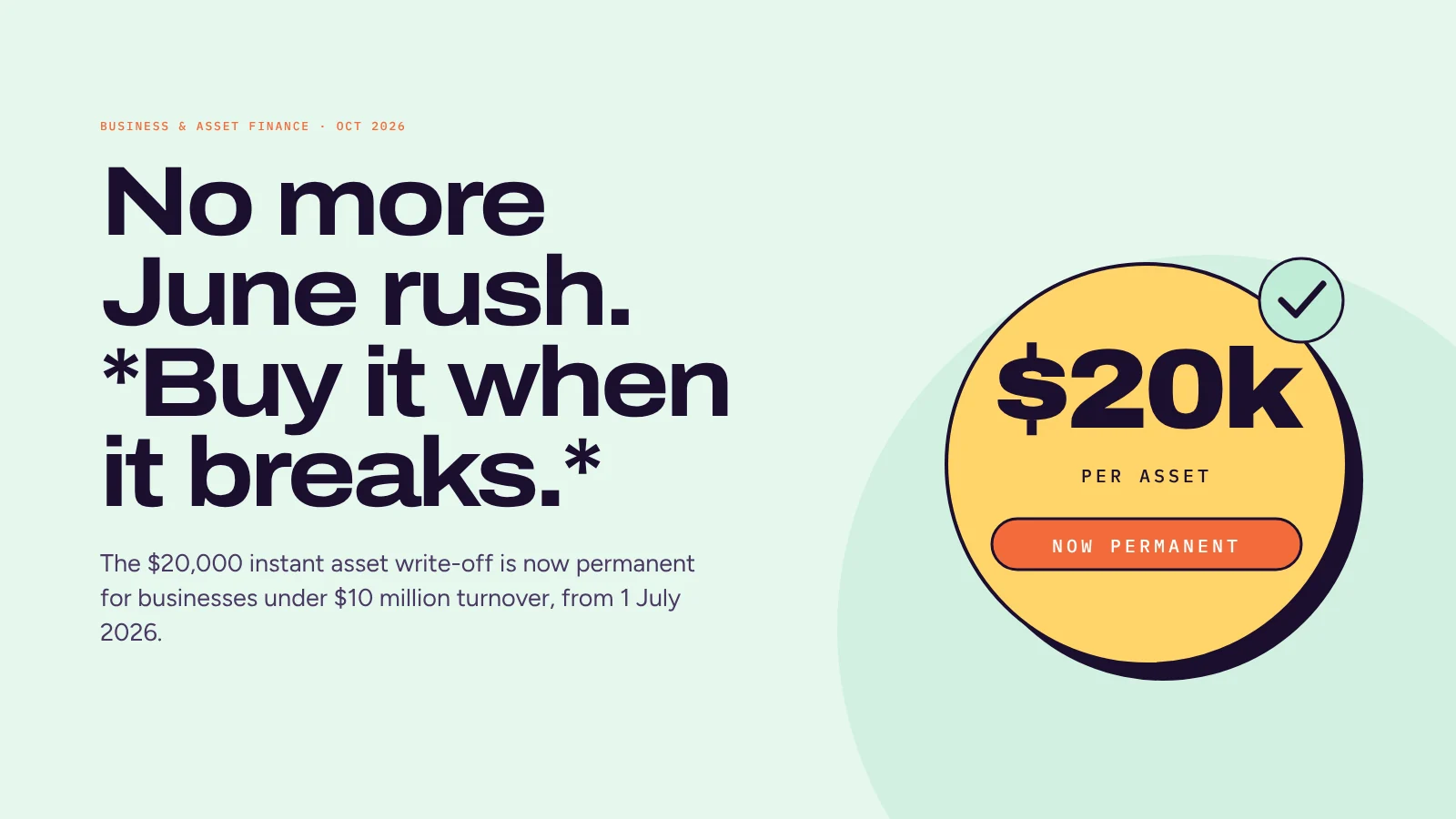
For most of the past decade, the instant asset write-off has been a June phenomenon. The threshold changed almost every year, Parliament extended it at the last minute, and small business owners bought equipment in a hurry because nobody knew what the rule would be in July.
That's over. On 19 August 2026 the Senate passed the Treasury Laws Amendment (Tax Reform No. 2) Bill, and the $20,000 instant asset write-off is now permanent from 1 July 2026.
Here's what the rule is, what it isn't, and how it changes the way you'd finance a piece of equipment. I'm a finance broker, not an accountant, so the tax side here is the outline. Your accountant fills in the rest.
The rule in one paragraph
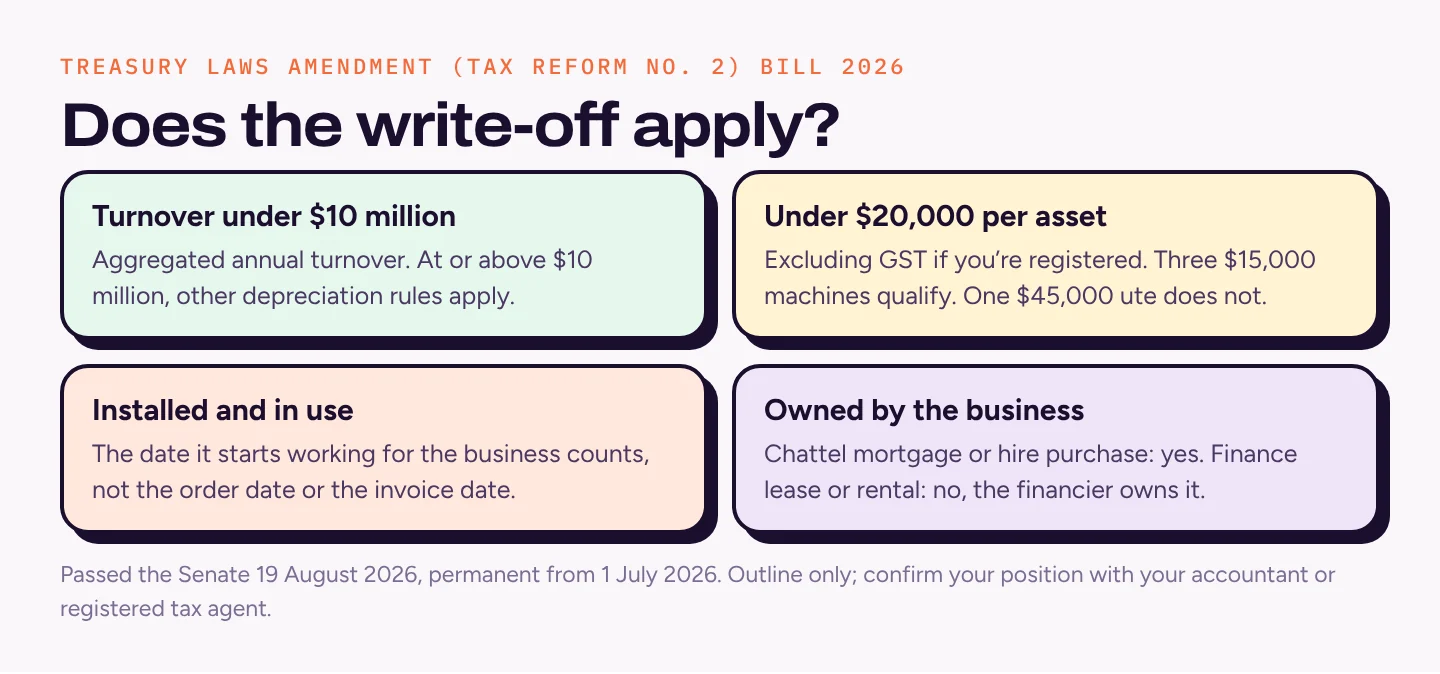
If your business has aggregated turnover under $10 million, you can deduct the full cost of an eligible asset in the year you first use it or install it ready for use, as long as that asset cost less than $20,000 excluding GST (if you're GST-registered). The threshold applies per asset, so three $15,000 machines are three write-offs. One $45,000 ute isn't. It gets depreciated under the normal small business rules instead.
The same Bill brought back loss carry-back for companies, for tax years starting on or after 1 July 2026. A company that makes a loss can offset it against tax paid in the previous two years and get a refundable offset. That one's for your accountant, but it matters if you're financing equipment in a year that's gone badly.
Why permanence changes the finance decision
Three ways.
1. The June rush is gone
You can buy in October because October is when the old compressor died, not because the deadline is coming. That matters more than it sounds. Equipment bought in a rush gets financed in a rush, and the finance deals that come bundled with a dealer's end-of-financial-year sale are not always the sharpest ones.
2. Ownership matters more
The write-off is only available if your business owns the asset. That makes the choice of finance product part of the tax outcome:
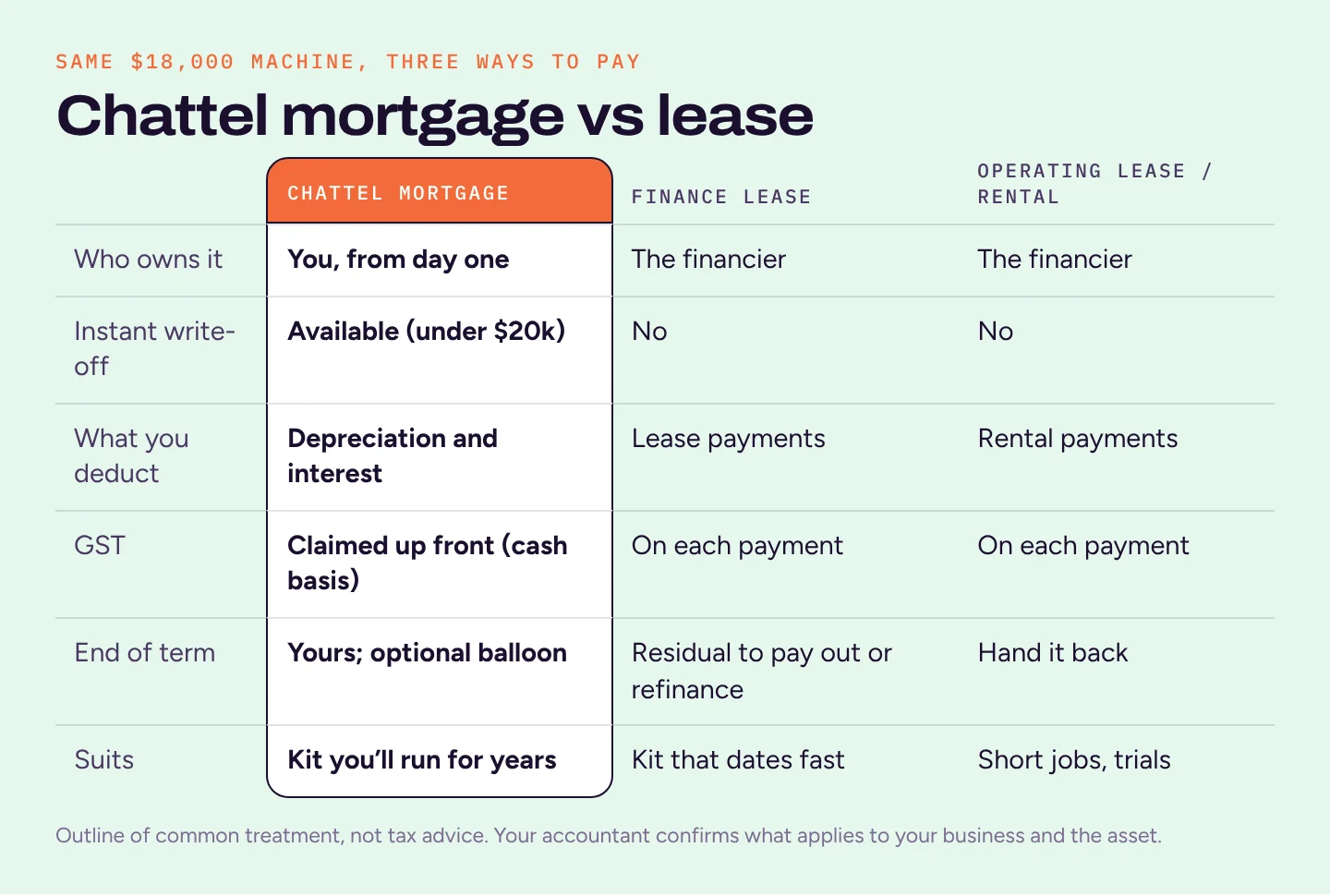
- A chattel mortgage (or hire purchase) means you own the asset from day one and the lender holds security over it. The write-off is available, you claim the GST on the purchase price up front on your next BAS if you're on cash accounting, and the interest is deductible.
- A finance lease means the lender owns the asset and you rent it. No write-off, because it isn't yours. You deduct the lease payments instead, and the GST on each payment.
- An operating lease or rental is the same, with the asset going back at the end.
None of those is automatically better. Leasing suits equipment that goes out of date fast, where you'd rather hand it back than own it. A chattel mortgage suits the things you'll run for ten years. But if the write-off is part of why you're buying, a lease quietly removes it.
3. Rising rates make the structure matter
Equipment finance is nearly always fixed for the term, which in 2026 is a feature. A chattel mortgage written today holds its rate while home loans keep moving. The things to watch are the term and the balloon.
Let's say you finance an $18,000 piece of equipment over three years at 8.5% with no balloon. These are example figures. The repayment is about $568 a month, and you own it outright at the end. Stretch the same amount to five years with a 30% balloon and the monthly figure drops to around $300, but you owe $5,400 at the end and you've paid more interest. The lower payment looks better on the quote. It isn't always better in the business.
What doesn't qualify
- Businesses with turnover of $10 million or more. Other depreciation rules apply.
- Assets costing $20,000 or more each. The whole asset goes into the pool, not the first $20,000 of it.
- Assets you've bought but haven't installed and started using by 30 June. The date you order doesn't matter; the date it's working does.
- Assets your business leases rather than owns, as above.
- The private-use portion of a mixed-use asset. A ute you drive on weekends is only partly deductible.
What I'd check before signing
Ask the dealer for the cash price and the finance quote separately. A "0% finance" deal is usually a higher cash price. Ask whether the quote is a chattel mortgage or a lease, because the salesperson often doesn't say and the paperwork is where you find out. And ask your accountant one question before you sign: "Does the write-off matter to me this year?" If the answer is yes, own the asset. If it's no, the cheapest total cost wins.
Our asset and machinery finance page covers the lenders and structures we work with, from a single van to a fit-out. The loan repayment calculator will show the monthly figure for any amount and term. If you've got a quote in hand, book a free 30-minute chat and I'll tell you whether it's a good one.
Sources
- Treasurer: next tranche of tax reforms pass the Parliament, 19 August 2026
- ATO: instant asset write-off for eligible businesses
- business.gov.au: types of business finance
Last reviewed 24 October 2026. This is general information only and isn't tax advice. It doesn't take your objectives, financial situation or needs into account. Check eligibility and timing with your accountant or registered tax agent.
Want this applied to your numbers?
Articles are general information. A 30-minute chat with Suvidh and the team turns it into a plan for your situation: borrowing power, structure and the lender that fits.
Book a free chatRun the calculatorsWritten by the Cinch Loans team · Reviewed by Suvidh Arora, Chief solutions officer · About us
Keep reading
More from Cinch Insights.
Plain-English articles on home loans, refinancing, rates and the property market, written for Australian borrowers rather than for lenders.
Business & asset finance
October 24, 2026
$20,000 instant asset write-off now permanent: what it means for equipment finance | Cinch Loans
Parliament made the $20,000 write-off permanent from 1 July 2026 and brought back loss carry-back. Why the June rush is over, why ownership now matters more, and how a chattel mortgage compares with a lease.