Property market
Investors are leaving. What that does to rents, prices and the people still buying
New investor loans fell 8.6% in the June quarter after the Budget rewrote negative gearing and the CGT discount. Who's filling the gap, why rent growth is slowing now, and why the squeeze comes later.
25 October 2026
6 min read
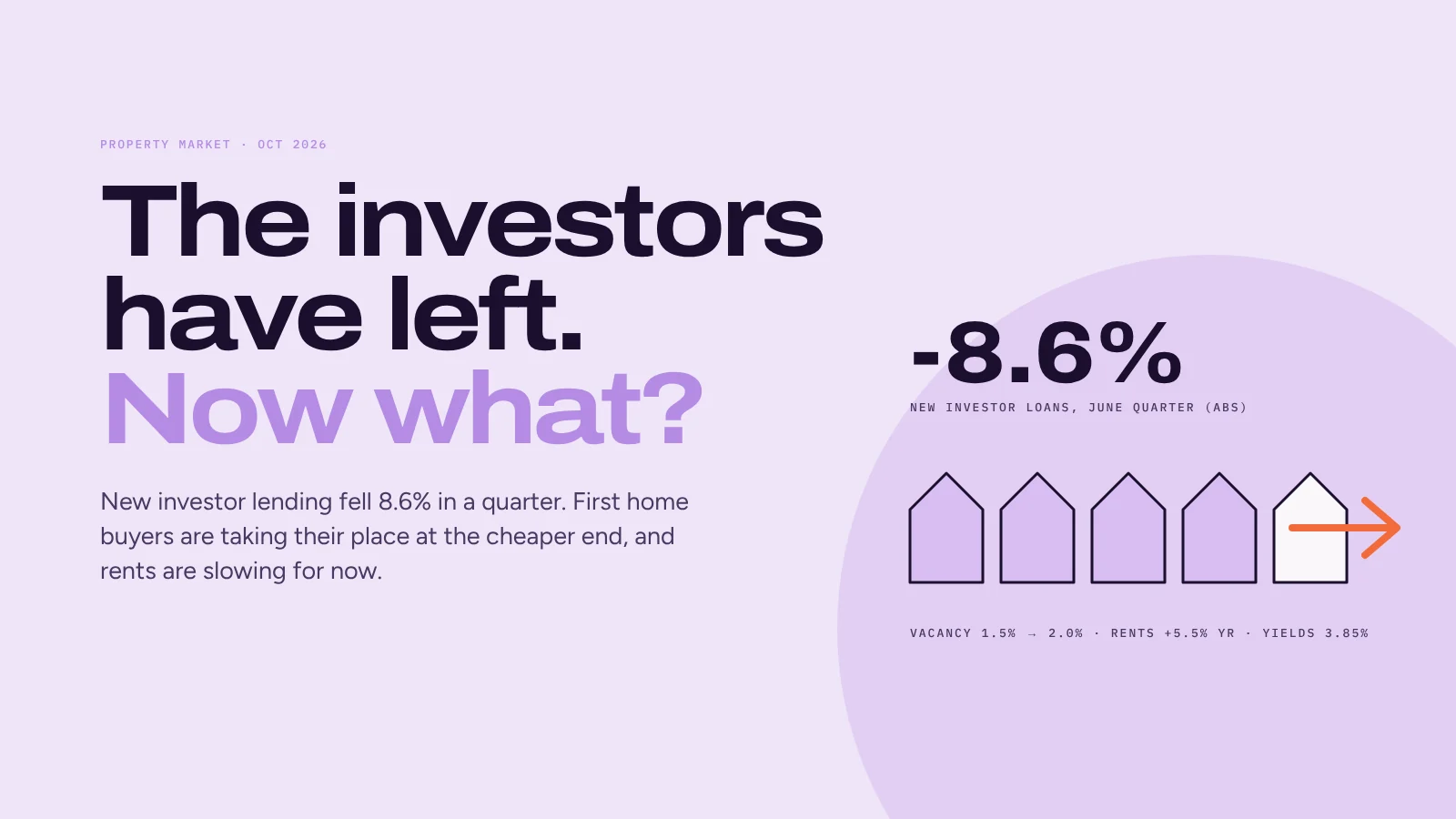
Investors have stopped buying. Not slowed. Stopped, in the words of the industry body that represents them.
New investor loan commitments fell 8.6% in the June quarter, the sharpest drop since 2022 and, in Canstar's reading of the same figures, the biggest in dollar terms since 2015. The chair of the Property Investment Professionals of Australia put it more bluntly in August: established investors have "largely left the market" since Budget night, and "maybe 2% still exist". That was before the September rate rise.
Here's what changed, who's filling the gap, and what it does to rents and prices over the next couple of years.
What changed on 12 May
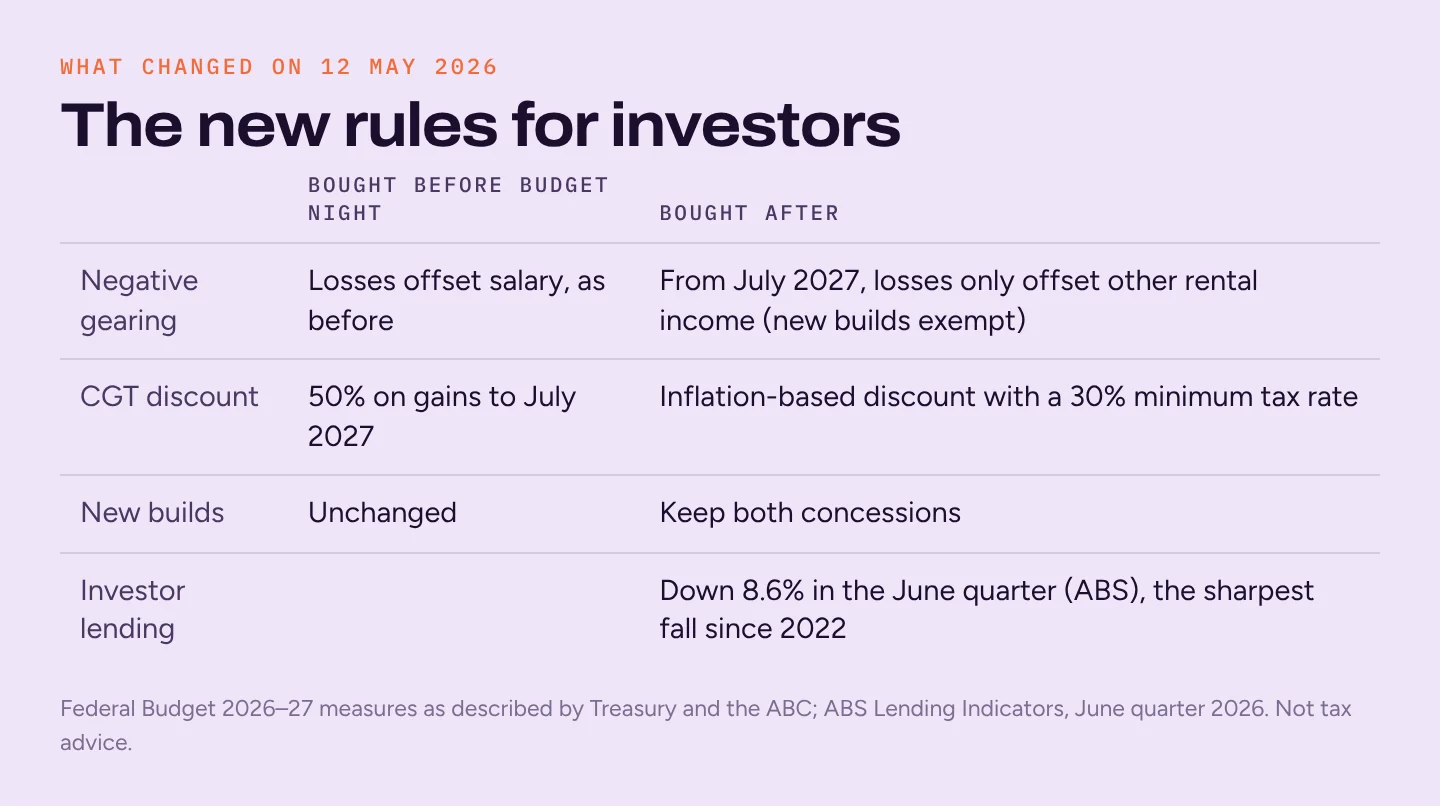
The Federal Budget rewrote the two tax rules investors had built their numbers on, for properties bought after 7:30pm on Budget night.
- Negative gearing. From July 2027, a loss on a rental property bought after Budget night can only be set against income from other residential rentals, or carried forward. It can't reduce tax on your salary. New builds are exempt. Properties bought before Budget night keep the old rules for as long as you own them.
- The capital gains tax discount. Instead of a flat 50%, gains on post-Budget purchases get a discount tied to inflation over the holding period, taxed as income with a 30% minimum rate. Gains accrued before July 2027 keep the 50% discount.
Treasury's own forecasts: about 75,000 homes shift from investors to first home buyers over a decade, house price growth two percentage points slower than otherwise, rents about $2 a week higher, and supply 35,000 homes lower from these measures alone, offset by other housing policies.
The reason investors left so fast isn't sentiment. It's maths. Without negative gearing, the holding cost of an existing property at today's rates comes out of after-tax income, and a lot of purchases that were marginal at 3.60% cash rate don't work at 4.60% with no deduction.
Who's filling the gap
First home buyers, mostly. The 5% Deposit Scheme had 102,594 users in its first expanded year, and about one in two first home buyers now uses a government scheme. In the price bands where investors and first-timers used to compete, the investors are gone and the first-timers have a guarantee behind them.
That's part of why national values are down 5.2% from their March peak with six straight monthly falls, and why the fall is concentrated in Sydney and Melbourne, where investor share was highest. Cotality names the drop in investor demand after the Budget as one of its four reasons for the slide.
Two groups haven't left. Buyers of new builds, who keep both the deduction and a choice of CGT discount, and self-managed super funds, which have their own rules. If you're in either camp, the sums are different from everyone else's and worth running properly.
What it does to rents
The story splits here.
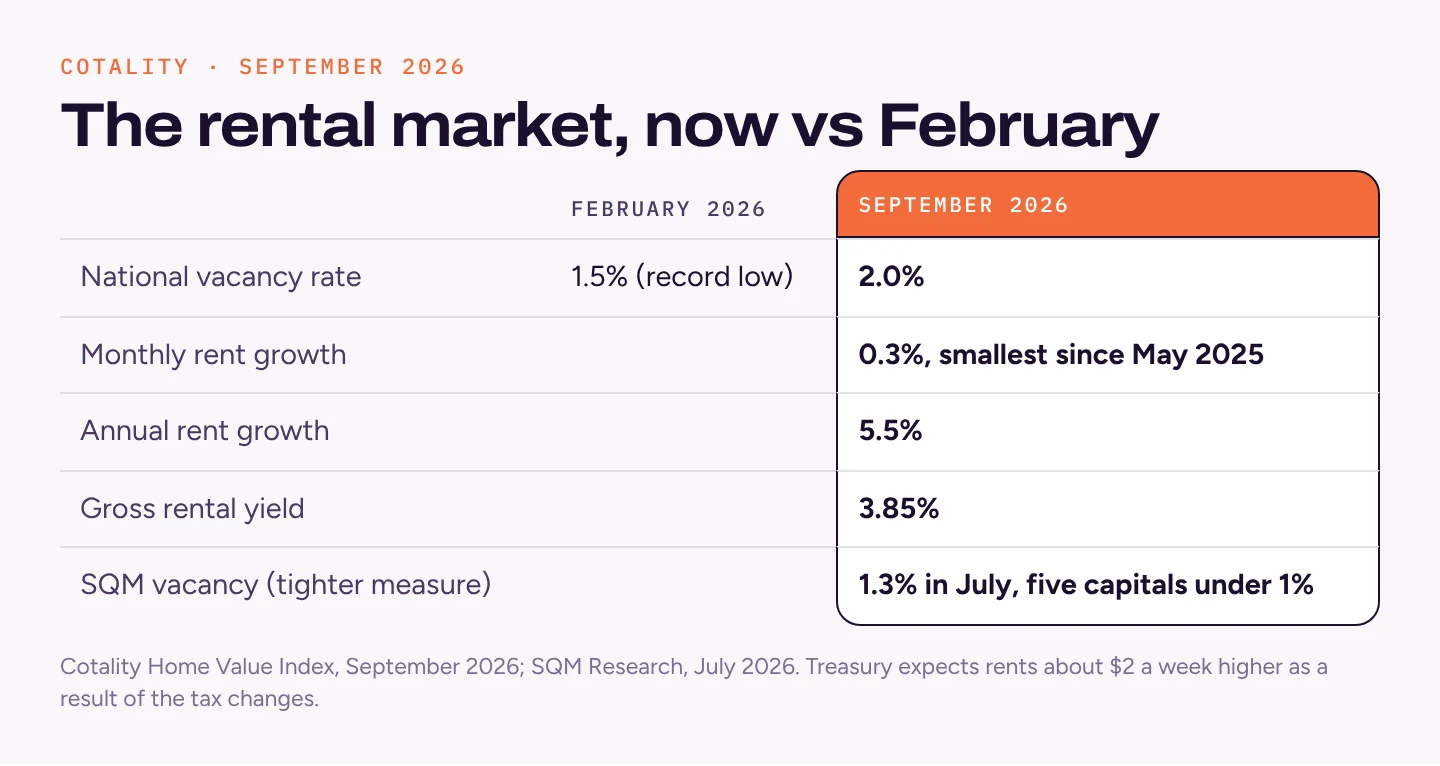
Right now, rent growth is slowing. National rents rose 0.3% in September, the smallest monthly rise since May 2025, and 5.5% over the year. Cotality's vacancy rate has risen to 2.0% from a record-low 1.5% in February. Gross yields have climbed to 3.85% as prices fell faster than rents.
The worry is the next two years. Fewer investors buying existing homes means fewer existing homes added to the rental pool, at the same time as very little new housing is being built. The investors' body expects the squeeze to land first in inner and middle-ring suburbs, pushing tenants outward. SQM's tighter measure still had vacancy at 1.3% in July, with five capitals under 1%.
So a tenant in Blackburn or Box Hill probably sees slower rent rises for the next six to twelve months, then a tighter market than today unless building picks up. A tenant who was thinking about buying has the best conditions in years to do it: less competition from investors, more stock, longer selling times, and a scheme behind them.
If you already own an investment property
You're grandfathered. The old negative gearing rules apply as long as you hold it, and gains accrued to July 2027 keep the 50% discount. Three things to think about:
- Selling resets the clock. If you sell and buy another existing property, the new one is under the new rules. The cost of changing horses has gone up.
- Interest-only periods ending. With the cash rate at 4.60%, rolling to principal and interest on $600,000 lifts the repayment from about $3,375 to about $3,892 a month, and extending interest-only means a fresh serviceability test. Start that conversation six months out.
- Valuation drift. Investor-heavy unit markets have fallen hardest, which pushes loan-to-value ratios up and can close off the refinance options that need under 80%.
Where to start
Our investment loans page covers how lenders treat rental income and interest-only terms now. The loan repayment calculator shows the interest-only to principal-and-interest step. If you own, or you're deciding between a new build and an existing home, book a free 30-minute chat. I'm a finance broker, so the tax side is a conversation for your accountant, but the lending side has changed just as much and that part I can run for you.
Sources
- Australian Broker: investor lending plunges 8.6% as negative gearing changes bite, August 2026
- ABS: Lending Indicators, June quarter 2026
- ABC News: how the Budget's negative gearing and CGT changes work
- Cotality: Home Value Index, September 2026
- SQM Research: vacancy rates
Last reviewed 25 October 2026. This is general information only and isn't tax advice. It doesn't take your objectives, financial situation or needs into account.
Want this applied to your numbers?
Articles are general information. A 30-minute chat with Suvidh and the team turns it into a plan for your situation: borrowing power, structure and the lender that fits.
Book a free chatRun the calculatorsWritten by the Cinch Loans team · Reviewed by Suvidh Arora, Chief solutions officer · About us
Keep reading
More from Cinch Insights.
Plain-English articles on home loans, refinancing, rates and the property market, written for Australian borrowers rather than for lenders.
Property market
October 25, 2026
Investor lending down 8.6%: negative gearing changes and what they mean for rents | Cinch Loans
New investor loans fell 8.6% in the June quarter after the Budget rewrote negative gearing and the CGT discount. Who's filling the gap, why rent growth is slowing now, and why the squeeze comes later.