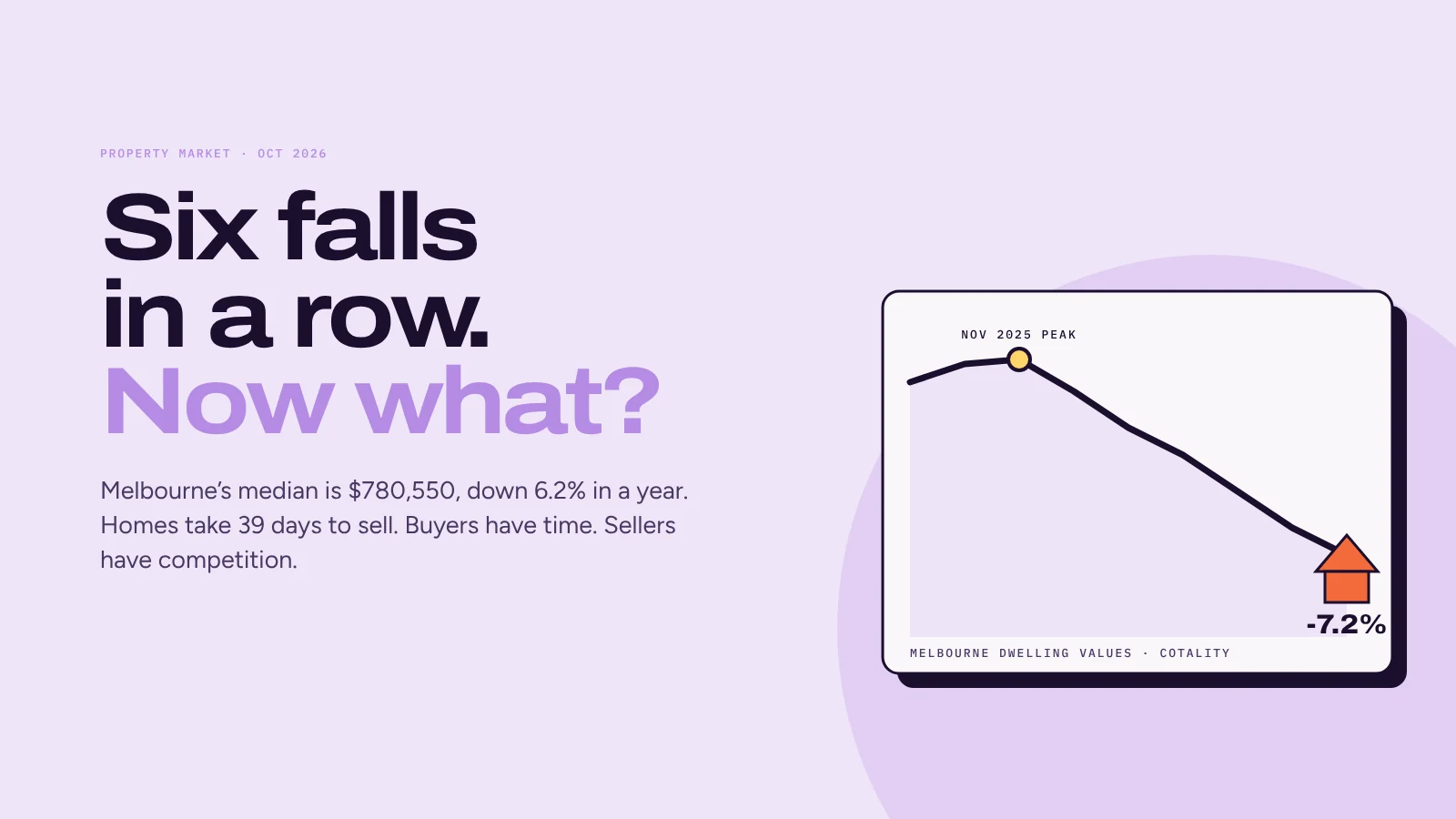
Melbourne home values have now fallen for six months in a row. The median is $780,550, 6.2% lower than a year ago and 7.2% below the peak in November 2025.
Depending on who you ask, that's either the best buying window since 2020 or the start of something worse. I think both camps are missing what's actually changed, which is how the market behaves day to day.
Here's what Cotality's September numbers say, what it feels like at open homes, and how to use it whether you're buying or selling.
The numbers
Nationally, values fell 1.1% in September and 3.7% over the quarter. They're 5.2% below the March 2026 peak and flat over the year. Melbourne fell 0.7% in the month and 3.4% over the quarter.
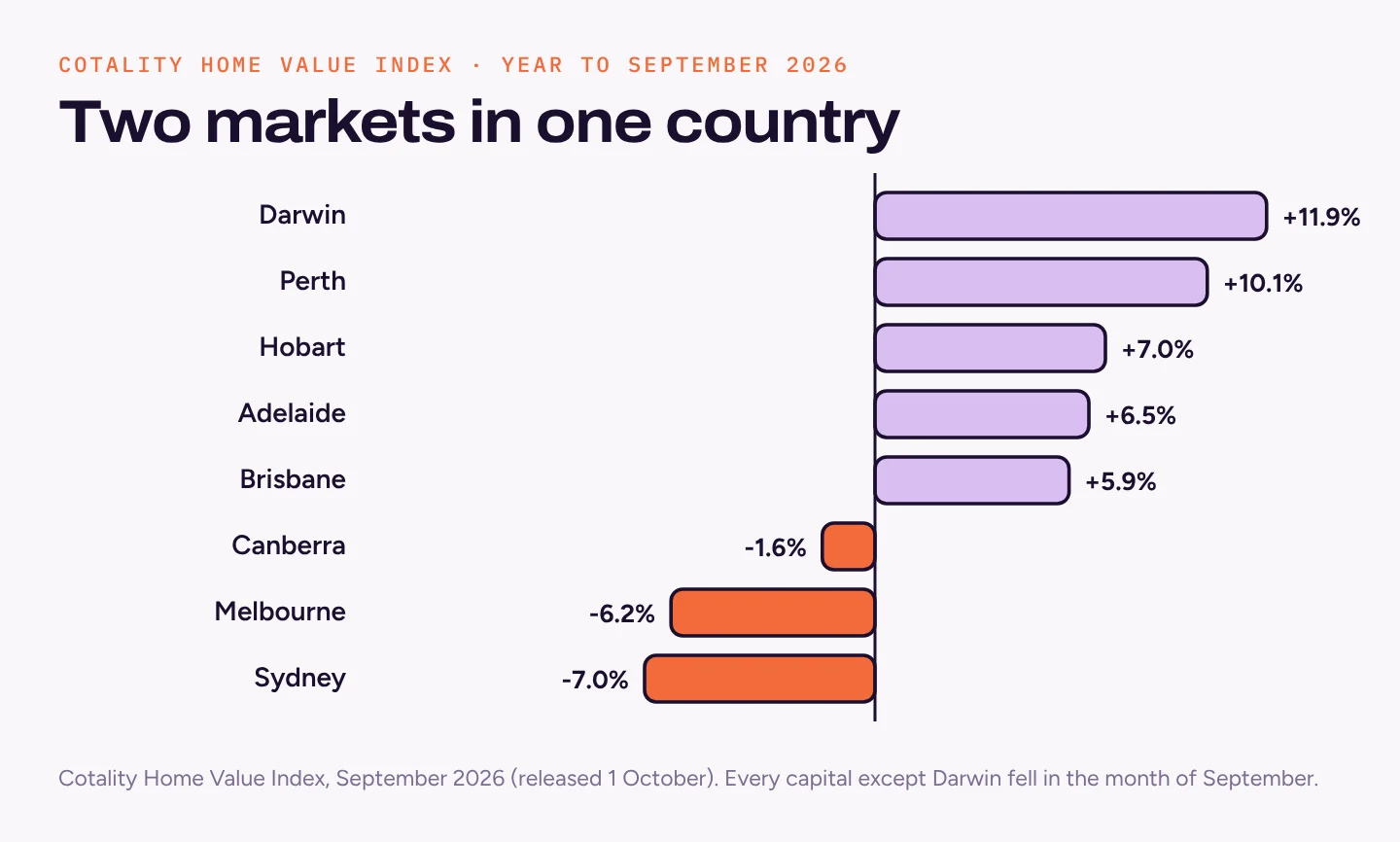
It isn't the same everywhere. Sydney and Melbourne are down 7.0% and 6.2% over the year. Perth is up 10.1%, Darwin 11.9%, Adelaide 6.5% and Brisbane 5.9%, though every capital except Darwin fell in September. The cities that rose fastest in 2024 and 2025 are now the ones falling fastest.
Cotality puts it down to four things: the Reserve Bank's four rate rises, which cut borrowing capacity by almost $90,000 for a typical household; prices that were already high against incomes; a sharp fall in investor buying after the Budget's negative gearing and capital gains tax changes; and weak household confidence.
Its base case is a gradual drift lower, with the risks on the downside. Its reasons not to expect a crash are a tight-enough jobs market and very little new housing being built.
What's changed on the ground
The price falls are what make the headlines. The behaviour changes are what matter if you're transacting.
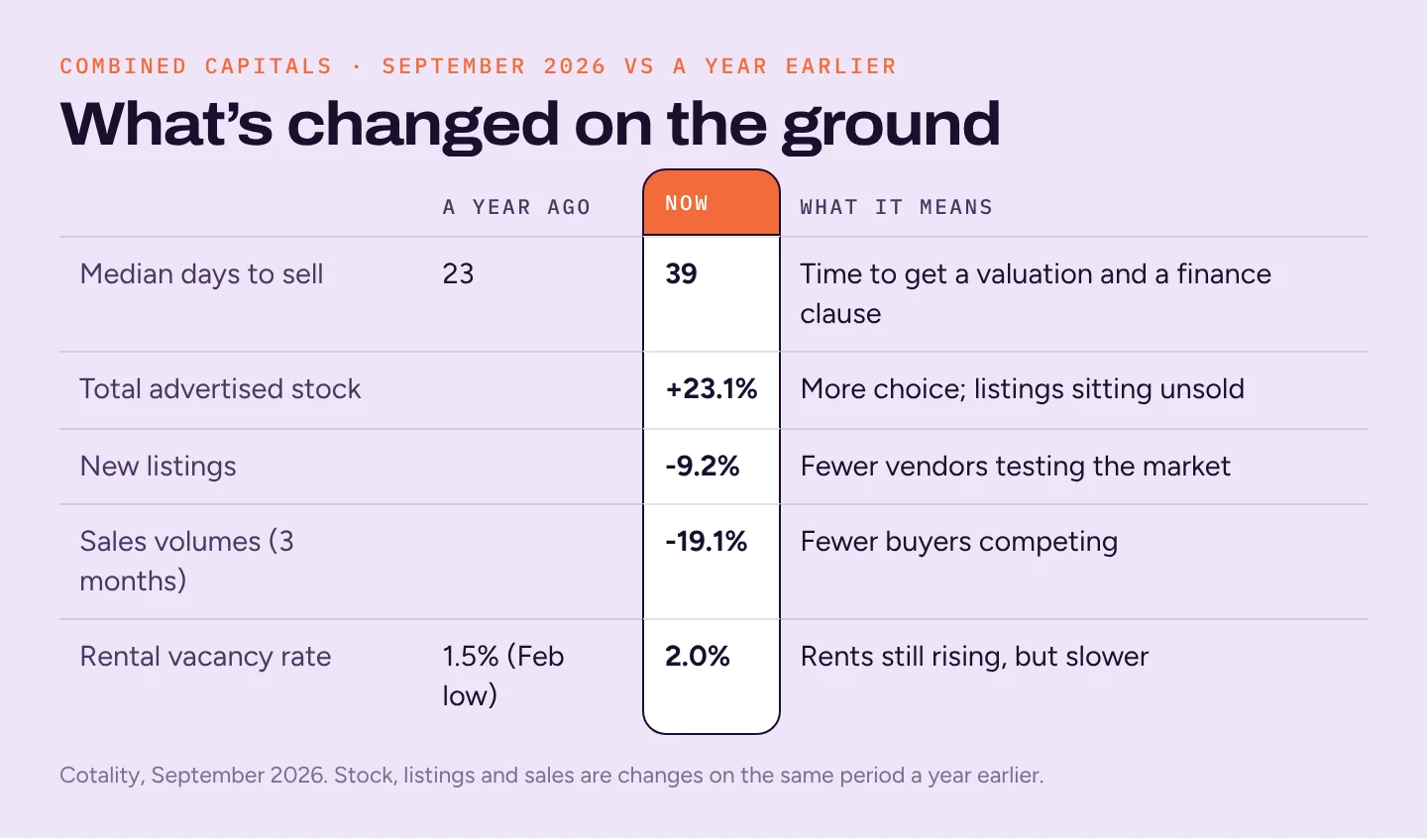
Homes in the capitals are taking 39 days to sell, up from 23 a year ago. There's 23.1% more stock advertised than last October, even though 9.2% fewer new listings came on, because the ones already listed aren't selling. Sales volumes are down 19.1%.
For a buyer, that means choice, time, and vendors who are listening. For a seller, it means the first offer is often the best one, and the property that's been on for eight weeks is the one people start making low offers on.
If you're buying
Three things I'd do differently in this market than in 2025.
Negotiate on terms as well as price
Twelve months ago, a "subject to finance" clause got your offer put at the bottom of the pile. Now vendors are accepting them. Ask for a finance clause, a building and pest inspection, and a settlement date that suits you. Those conditions cost the vendor nothing and protect you from the two things that go wrong most in a falling market: a valuation shortfall and a bank that takes longer than expected.
Expect the valuation to come in low
Lenders' valuers are cautious right now, and in a falling market they tend to value at the last comparable sale rather than your contract price. If you've agreed $800,000 and the valuation comes back at $775,000, the lender lends against $775,000 and you find the difference. With a 5% deposit, that difference can be bigger than your whole deposit. A finance clause gives you a way out. A bigger deposit gives you a way through.
Check your pre-approval date
Most pre-approvals last 90 days. If yours was issued before the September rate rise, the lender will reassess it at the new rate when you find a property, and the figure may come down. Buyers who found that out at auction didn't enjoy it.
The "falling knife" question
People ask me whether they should wait for the bottom. I can't tell you where it is, and nor can anyone else, so I'll give you the trade-off instead.
If you buy a $780,000 home with a 10% deposit and values fall another 5%, you've lost $39,000 of equity on paper. That matters only if you have to sell or refinance before it recovers. It stops mattering if you're staying for seven years.
If you wait a year and values fall 5%, you've saved $39,000. But you've also paid a year of rent, which on a comparable Melbourne home is around $30,000, and borrowing power may have moved against you again if there's another rate rise. Rents rose 5.5% over the past year, though the pace is slowing.
Neither path is free. The right one depends on your timeframe and your buffer, not on a forecast.
If you're selling
Price it to the last three months of sales, not to what the neighbour got in 2025. Buyers in this market have the data and the patience. A property listed too high in October tends to sell for less in January than it would have in November, after two price cuts and a "motivated vendor" line in the ad.
And if you're selling to buy, think about the order. Selling first in a falling market is the lower-risk move, because the thing you're buying is getting cheaper while you wait, not dearer.
Where to start
The purchasing power calculator turns a borrowing figure into a price range once you add stamp duty and costs. Our home loans page covers how pre-approval works and how long it lasts. If you've got a property in mind, book a free 30-minute chat and I'll tell you how the valuation and finance risks look on that specific contract.
Sources
- Cotality: Home Value Index, September 2026 (released 1 October 2026)
- RBA: monetary policy decision, 29 September 2026
- ABC News: how the Budget's negative gearing and CGT changes work
- Moneysmart: buying a house
Last reviewed 24 October 2026. This is general information only. It doesn't take your objectives, financial situation or needs into account. Market figures are Cotality's for September 2026 and will be superseded.
Want this applied to your numbers?
Articles are general information. A 30-minute chat with Suvidh and the team turns it into a plan for your situation: borrowing power, structure and the lender that fits.
Book a free chatRun the calculatorsWritten by the Cinch Loans team · Reviewed by Suvidh Arora, Chief solutions officer · About us
Keep reading
More from Cinch Insights.
Plain-English articles on home loans, refinancing, rates and the property market, written for Australian borrowers rather than for lenders.
Property market
October 24, 2026
Melbourne property prices falling 2026: what buyers and sellers should do | Cinch Loans
Six monthly falls, 39 days to sell instead of 23, and 23% more stock than a year ago. What Cotality’s September numbers mean if you’re buying, selling, or waiting for the bottom.