Refinancing
Mortgage prison, 2026 edition: why you can't refinance the loan you're already paying
Half of all brokers now have clients who can't refinance on serviceability, up from a quarter in February. The 1% buffer pathway some lenders offer, who qualifies, and when staying put is the right call.
24 October 2026
6 min read
You've paid every repayment on time for three years. Your rate has gone up four times. You ask another lender for something sharper and they tell you that you can't afford the loan you're already paying.
That's mortgage prison, and in 2026 it's back in a big way.
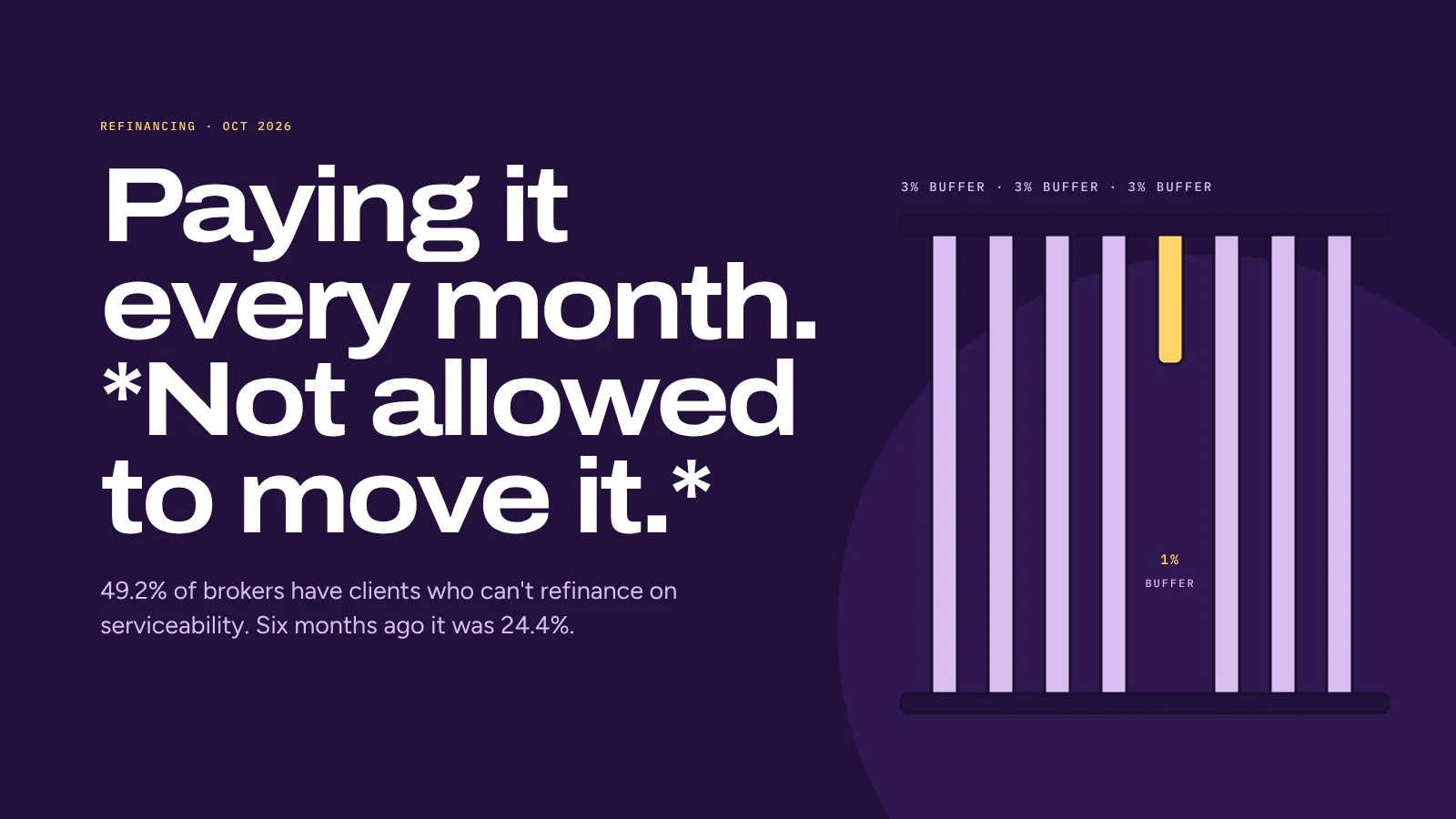
In the MFAA's August survey, 49.2% of brokers said more of their clients were unable to refinance because of serviceability. Six months earlier it was 24.4%. Equifax's September numbers show the result: switching to a new lender was down 8.8% on a year ago, and refinancing with your existing lender was down 28%.
Here's why it happens, the pathway that gets some people out, and when staying put is the smarter move.
Why can't I refinance a loan I'm already paying?
Because the new lender doesn't assess you on what you pay. It assesses you on what you'd pay if rates rose another 3 percentage points. That's APRA's serviceability buffer, and in May 2026 APRA confirmed it's staying.
When you took the loan, rates were lower, so the buffered rate was lower too. Let's say you borrowed $600,000 in 2024 when your rate was 5.75%. The lender tested you at 8.75%, which meant showing you could cover about $4,720 a month. You passed.
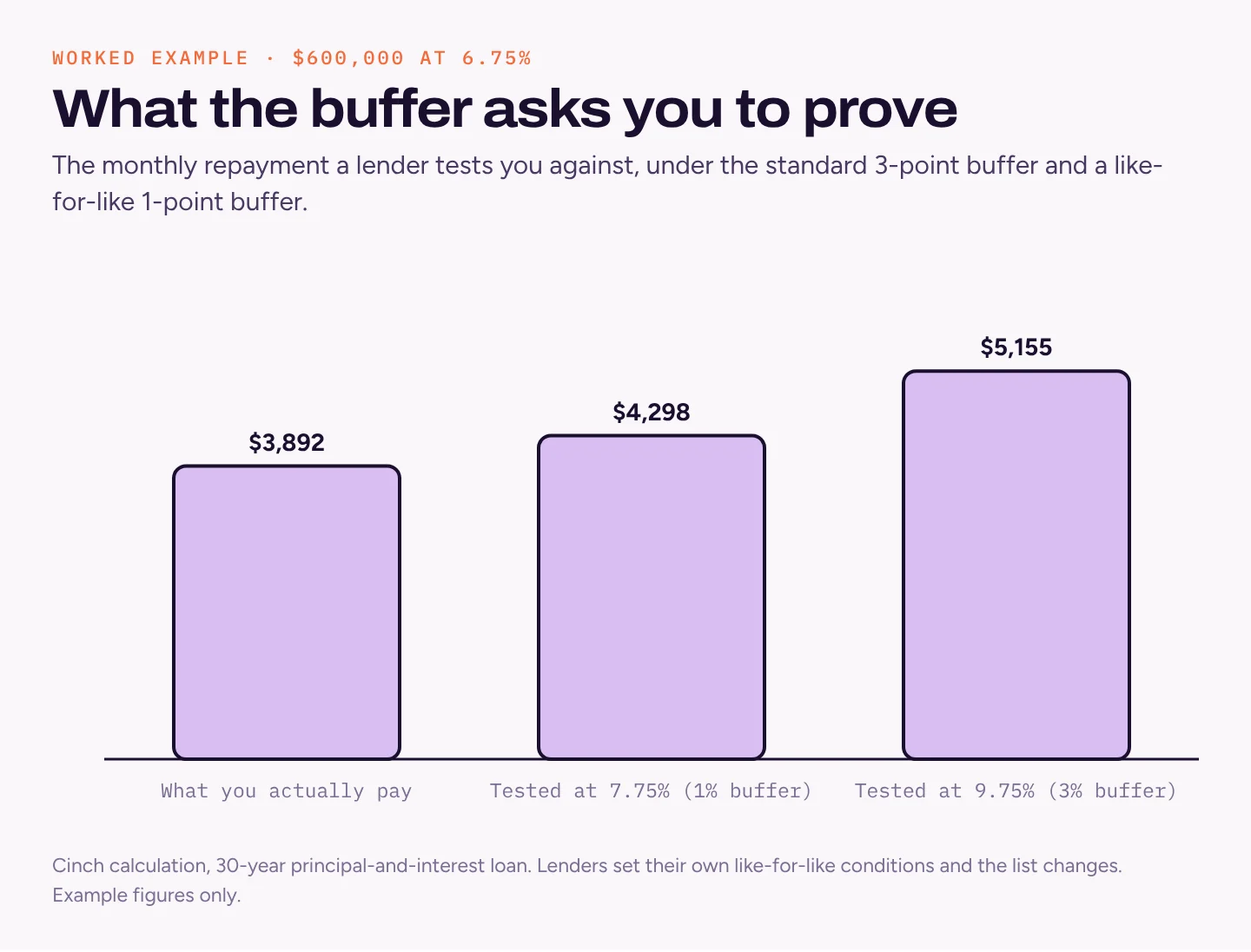
Today your rate is 6.75%. A new lender tests you at 9.75%, which means about $5,155 a month. Your income hasn't moved. Your actual repayment is $3,892, which you've been paying without fail. But on paper, you no longer qualify for your own loan.
Add a softer valuation, a credit card you forgot about, or a partner who's gone part-time, and the file gets harder again. Brokers are also seeing more redundancies and restructures in applications than six months ago.
The like-for-like pathway
APRA's buffer is a guideline for lenders' overall books, not a rule for every single loan. Lenders are allowed exceptions, and a group of them have built a specific one for people in exactly this position.
It's usually called a like-for-like refinance, and some lenders assess it with a 1 percentage point buffer instead of 3. Each lender writes its own version, but the typical conditions look like this:
- You're refinancing the same loan amount or less. No cash out, no topping up for a renovation.
- No debt consolidation. Rolling in a car loan or credit card usually knocks you out of the pathway.
- A clean repayment history, typically 12 months with no missed payments on the home loan.
- Owner-occupied and principal-and-interest, though a few lenders extend it to investors.
- A loan-to-value ratio under 80%, so the new valuation matters.
- The new rate has to be lower than your current one. The whole point is that you're reducing your repayment, not increasing it.
On the $600,000 example, a 1% buffer means being assessed at 7.75% rather than 9.75%. That's about $4,298 a month instead of $5,155. For a lot of households, that's the difference between a yes and a no.
The list of lenders offering this changes often and isn't advertised in rate tables. It's one of the things a broker earns their keep on.
When staying put is the better move
I'll say something that doesn't get said enough by people in my industry: sometimes you shouldn't refinance.
If the only lender who'll take you is a higher-cost specialist lender, you'd be moving to a worse rate to escape a bad one. One broker put it well in Australian Broker this week: the worst position isn't a high rate, it's a high rate you can't leave. Signing up for a second one doesn't help.
And your current lender knows you're stuck too, which is why their retention teams have become more generous. In the past six months I've seen existing lenders offer discounts and waive annual fees to keep borrowers who called with a competitor's offer in hand.
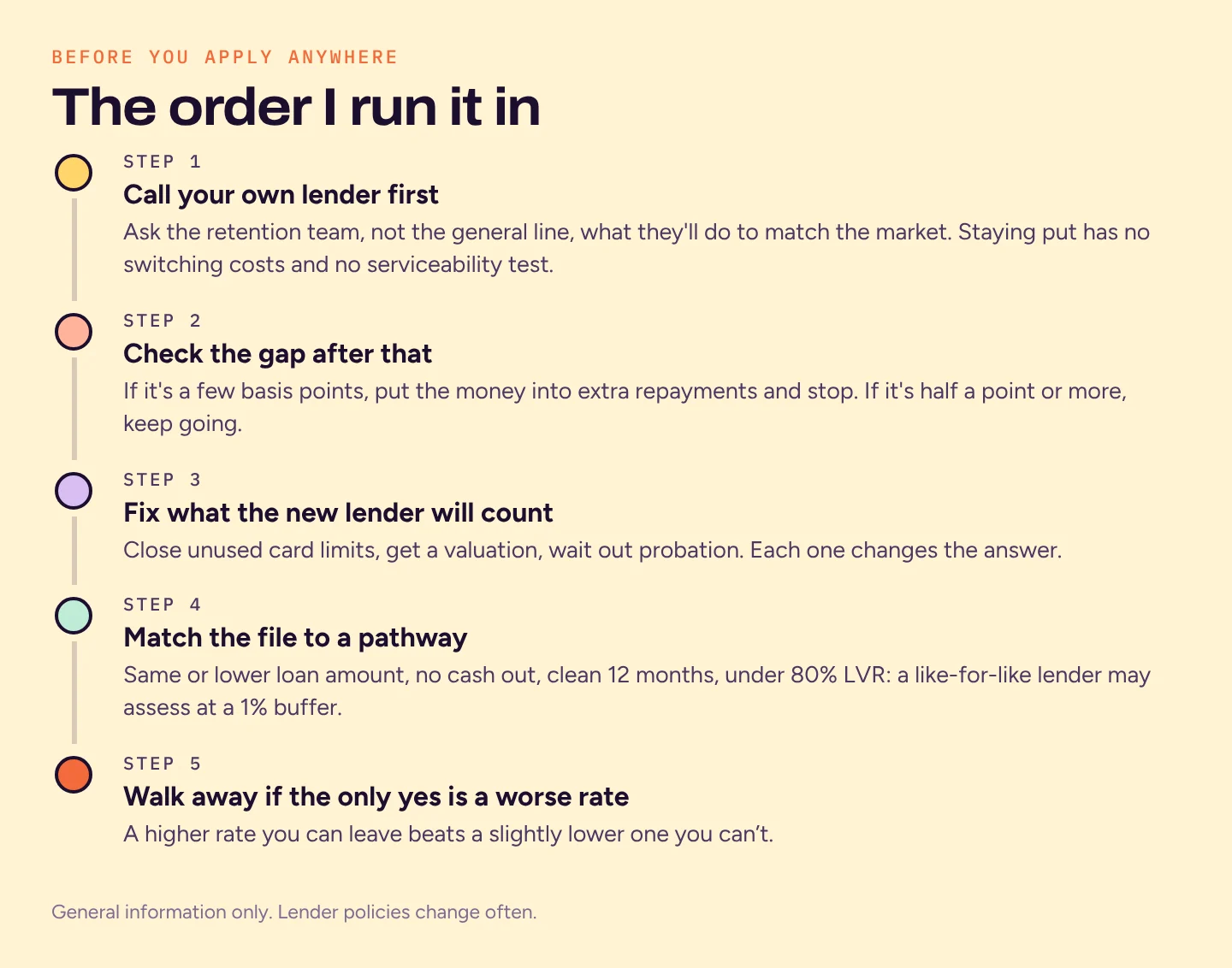
So before you apply anywhere, make the call. Ask your lender's retention team, not the general line, what they'll do to match the market. If the gap after that is only a few basis points, the switching costs and the serviceability risk probably aren't worth it. Put the money into extra repayments instead.
Three things that make a difference before you apply
- Close or cut unused credit limits. Lenders assess a $15,000 limit as about $450 a month of repayments, whether you use it or not.
- Get a valuation before you commit. If values in your suburb have fallen since you bought, your loan-to-value ratio has risen. Melbourne values are 6.2% lower than a year ago, which is enough to push a borrower from 78% to above 80% and out of the like-for-like pathway.
- Wait out any probation period. A new job at a higher salary is good news for a lender only once you're past probation, and some lenders want three months of payslips.
Investors coming off interest-only
The group I'm most concerned about heading into the 3 November Reserve Bank decision is investors whose interest-only period ends in the next year. Rolling to principal-and-interest on a $600,000 loan at 6.75% lifts the repayment from about $3,375 a month to about $3,892, before any further rate rise. Extending the interest-only period means a fresh assessment, and that's where the buffer bites again. If that's you, start the conversation six months before the term ends, not six weeks.
Where to start
The refinance calculator shows what a rate change saves after costs. Our refinancing page explains how a review works, including the retention call. If you've been told no already, book a free 30-minute chat. I'll check whether a like-for-like pathway fits your file, and I'll tell you if the honest answer is to stay where you are.
Sources
- Australian Broker: refinance trap, brokers say serviceability is locking borrowers in, 20 October 2026
- APRA: serviceability buffer held at 3 points, May 2026
- APRA: housing lending standards, guidance on exceptions
- MFAA: broker survey, August 2026
- Moneysmart: switching home loans
Last reviewed 24 October 2026. This is general information only. It doesn't take your objectives, financial situation or needs into account. Lender policies and the rates in the examples change.
Want this applied to your numbers?
Articles are general information. A 30-minute chat with Suvidh and the team turns it into a plan for your situation: borrowing power, structure and the lender that fits.
Book a free chatRun the calculatorsWritten by the Cinch Loans team · Reviewed by Suvidh Arora, Chief solutions officer · About us
Keep reading
More from Cinch Insights.
Plain-English articles on home loans, refinancing, rates and the property market, written for Australian borrowers rather than for lenders.
Refinancing
October 24, 2026
Mortgage prison 2026: the like-for-like refinance pathway explained | Cinch Loans
Half of all brokers now have clients who can't refinance on serviceability, up from a quarter in February. The 1% buffer pathway some lenders offer, who qualifies, and when staying put is the right call.