If your repayments have gone up four times this year, you're not imagining it.
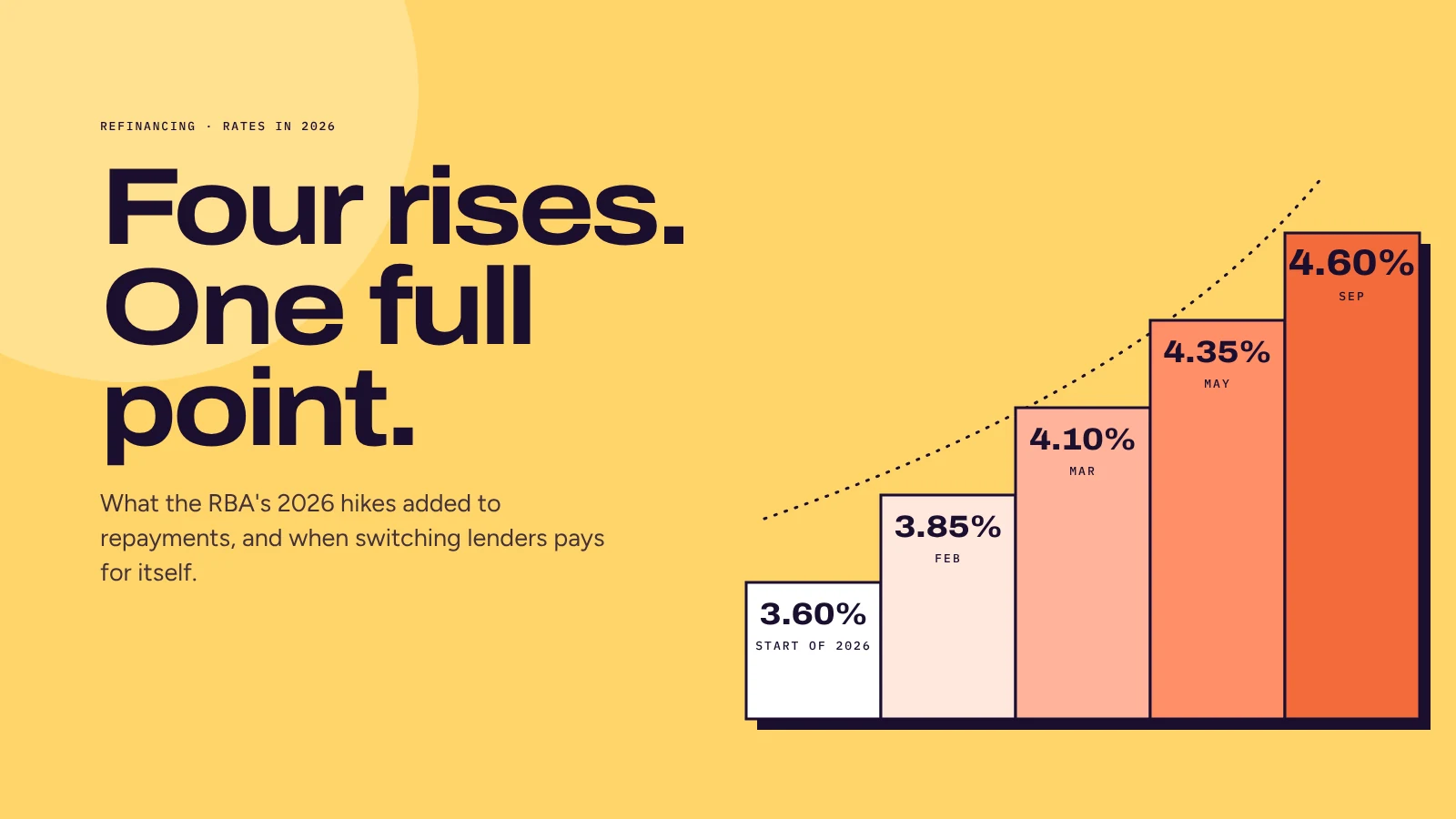
The Reserve Bank lifted the cash rate in February, March, May and September, taking it from 3.60% to 4.60%. That's the highest it's been in about 15 years. Here's what those rises have cost in dollars, and what switching lenders really costs if you're thinking about it.
How did we get here?
- 3 February: up 0.25 to 3.85%
- 17 March: up 0.25 to 4.10%, on a five-to-four vote
- 5 May: up 0.25 to 4.35%
- June and August: on hold
- 29 September: up 0.25 to 4.60%
The RBA pointed to fuel and energy prices, businesses passing on higher costs and an economy running close to capacity. Annual inflation was 4.0% in August, and the trimmed mean measure the RBA watches most closely was 3.6%.
CBA, Westpac, NAB and ANZ passed on every rise in full. The September increase reached their variable rates on 9 October.
The RBA's next decision is on 3 November, a week after the September quarter inflation figures land on 28 October. At its September meeting, the market was pricing in about another 0.15 of a point by the end of the year.
What has it done to repayments?
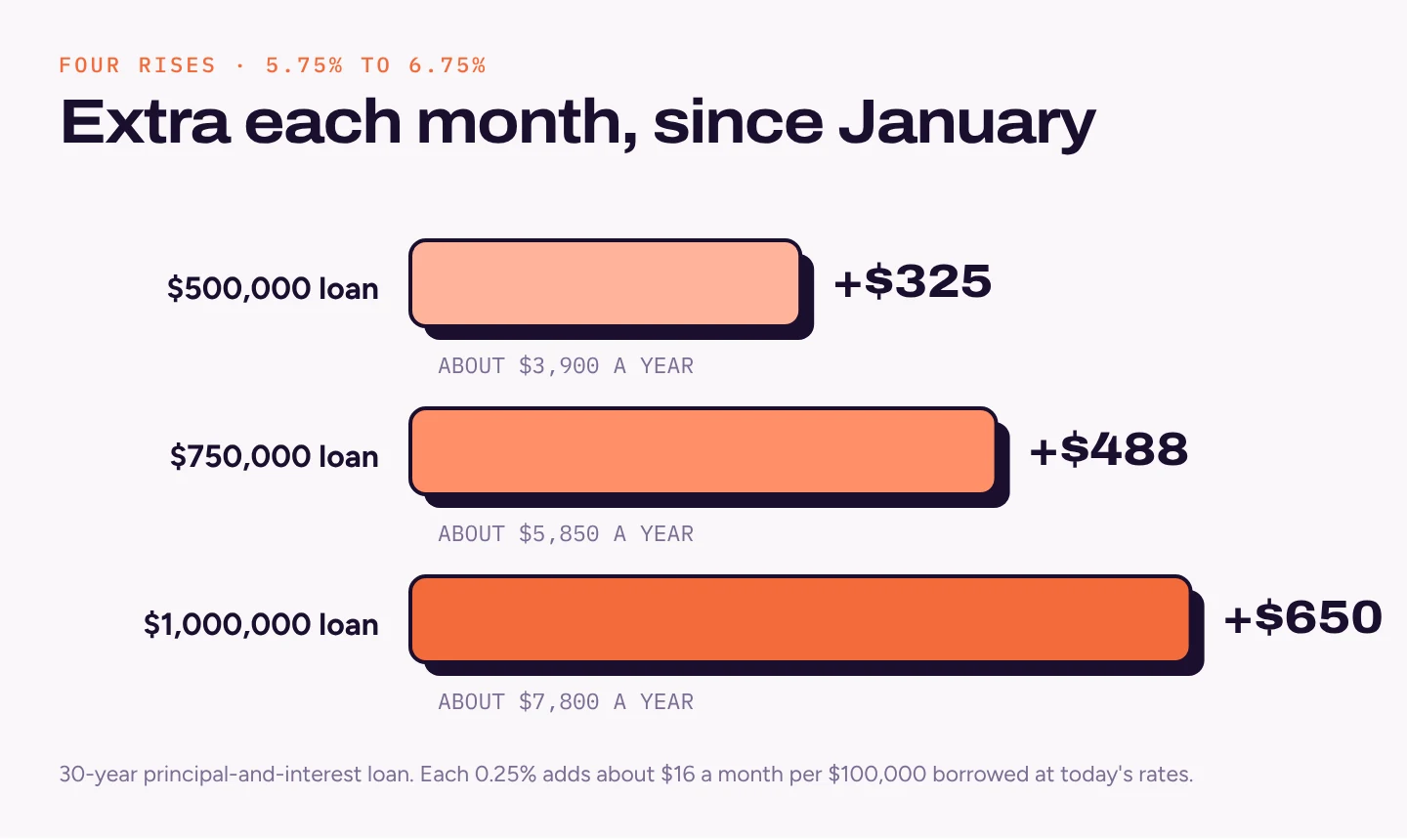
At today's rates, each 0.25% rise adds about $16 a month for every $100,000 you owe.
Across all four rises (going from 5.75% to 6.75% on a 30-year principal-and-interest loan), that adds up to:
- $500,000 loan: about $325 a month more, or $3,900 a year
- $750,000 loan: about $488 a month more, or $5,850 a year
- $1,000,000 loan: about $650 a month more, or $7,800 a year
Banks do give notice before your repayment changes. CBA gives at least 20 days, and Westpac, NAB and ANZ give at least 30.
What has it done to borrowing power?
Lenders don't test you at your actual rate. APRA requires them to add a 3 percentage point buffer, and it confirmed in May 2026 that the buffer is staying. A 6.75% loan gets assessed at 9.75%.
Say a lender works out you have $4,000 a month spare after living costs. At 5.75% that supported a loan of about $508,000. At 6.75% it supports about $466,000. That's around 8% less, from four quarter-point moves.
Canstar's modelling puts the drop at about $46,300 for a single person on an average wage.
This matters if you're refinancing too. A new lender tests you at its rate plus the buffer, so someone who passed easily in 2025 can find it tighter now. Some lenders have gentler rules for a straight like-for-like switch, and that list changes often.
What does switching actually cost?
Exit fees were banned on home loans taken out from July 2011, but switching still has costs:
- A discharge fee from your current lender, usually $150 to $400. The big four mostly charge about $350.
- Government fees to discharge the old mortgage and register the new one, usually $140 to $250 each.
- Break costs if you're on a fixed rate. They're worked out loan by loan and can run into the thousands.
- Any establishment or application fee on the new loan. Some lenders charge nothing, and others charge several hundred dollars.
- Lenders mortgage insurance, if you're borrowing more than 80% of the property's value. You may have to pay it again, so it's worth asking your current lender whether any of your original premium is refundable.
Cashbacks have mostly disappeared from the big banks. ANZ stopped its refinance offer in October 2025. A handful of smaller lenders still pay $2,000 to $4,000, usually only up to 80% of the property's value, and some take it back if you leave within two years.
A standard refinance takes about two to four weeks.
Is it worth it? A quick example
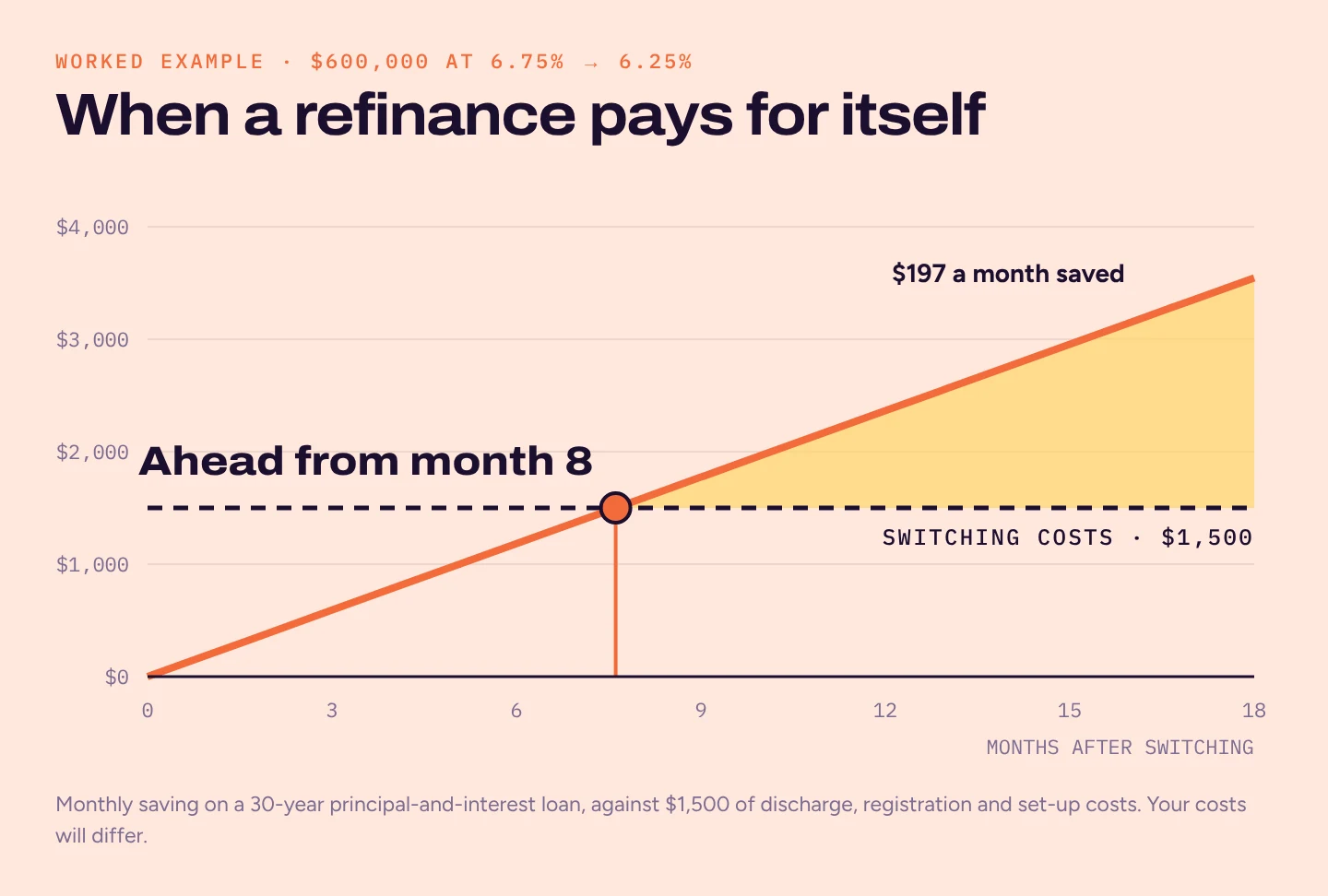
Let's say you owe $600,000 with 30 years to go at 6.75%, and another lender offers 6.25%.
- Your repayment drops from about $3,892 to about $3,694 a month, a saving of about $197.
- If switching costs you $1,500 all up, you're ahead after about eight months.
The catch is the loan term. Many people refinance onto a fresh 30-year loan, which lowers the repayment but stretches the debt out. If you keep paying the old $3,892 at the new rate, you'd clear the loan in about 26 years instead of 30.
Sometimes the better move is to ask your current lender for a sharper rate first. Some will move to keep you, and staying put has no switching costs.
Quick answers
Should I fix my rate now?
That depends on your plans and how much flexibility you need. Fixed rates rose quickly this year, and Canstar reported in October that none in its database still started with a 5. Fixing also limits extra repayments and can bring break costs if you sell or switch early. Some borrowers split the loan between fixed and variable to get a bit of both.
Will rates keep going up?
Nobody knows for sure. At its September meeting the market was pricing in a little more by the end of 2026, and the RBA's Governor said she wouldn't give forward guidance. The 3 November decision and the inflation figures the week before will say more.
Can I refinance if my property value has dropped?
Often, yes, but if the loan ends up above 80% of the new valuation you may pay lenders mortgage insurance, and some lenders won't take it at all. A valuation before you apply avoids surprises.
Where to start
The refinance calculator shows your monthly saving and break-even point once you add the costs. Our refinancing page covers how a review works, and the loan repayment calculator shows what extra repayments would do.
If you'd rather have someone run it for you, book a free 30-minute chat. I'll compare your loan with the market and tell you plainly if staying put is the better call.
Sources
- RBA: cash rate target history
- RBA: monetary policy decision, 29 September 2026
- ABS: monthly CPI, August 2026
- APRA: serviceability buffer held at 3 points, 28 May 2026
- Moneysmart: switching home loans
Last reviewed 22 October 2026, before the RBA's 3 November decision. This is general information only. It doesn't take your objectives, financial situation or needs into account.
Want this applied to your numbers?
Articles are general information. A 30-minute chat with Suvidh and the team turns it into a plan for your situation: borrowing power, structure and the lender that fits.
Book a free chatRun the calculatorsWritten by the Cinch Loans team · Reviewed by Suvidh Arora, Chief solutions officer · About us
Keep reading
More from Cinch Insights.
Plain-English articles on home loans, refinancing, rates and the property market, written for Australian borrowers rather than for lenders.
Refinancing
October 22, 2026
2026 rate rises and the real cost of refinancing | Cinch Loans
The cash rate is up a full point this year to 4.60%. What that adds to repayments, how it shrinks borrowing power, and the real costs to weigh before you switch lenders.