Rates & economy
28 October, then 3 November: what decides the RBA’s next move
The cash rate is 4.60% after four rises. The September quarter CPI lands on 28 October, the Board decides on 3 November, and the big four are split two-two. What each outcome adds to your repayment.
24 October 2026
5 min read
Two dates matter for every variable-rate borrower in the next fortnight. Wednesday 28 October, when the Bureau of Statistics publishes the September quarter inflation figures. And Tuesday 3 November at 2:30pm, when the Reserve Bank announces its decision.
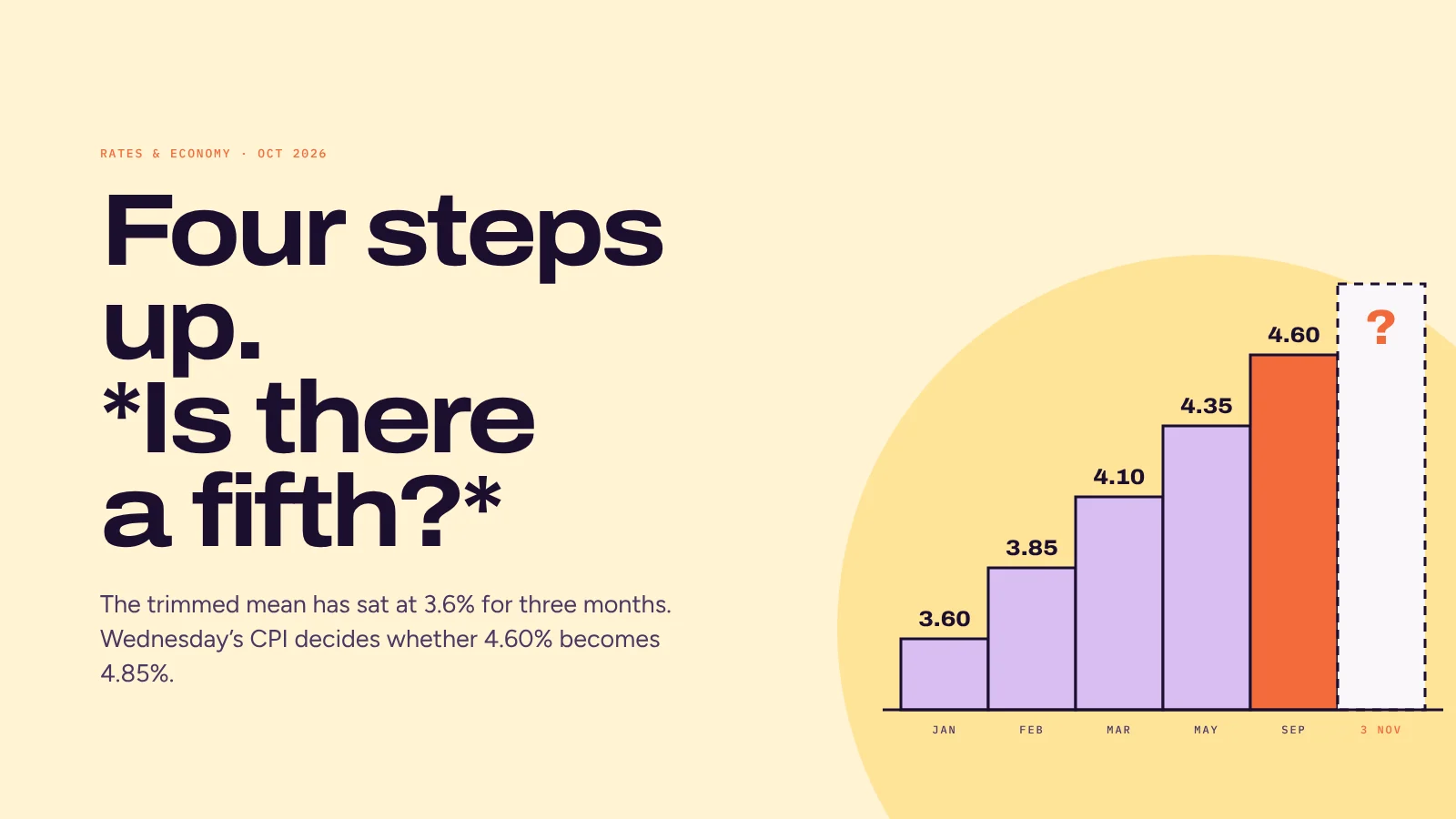
The cash rate is 4.60%. It has gone up four times this year. Whether it goes up a fifth time depends almost entirely on what the 28 October number says.
Here's what the Reserve Bank is looking at, what the big four banks think it will do, and what each outcome means for your repayments.
How we got to 4.60%
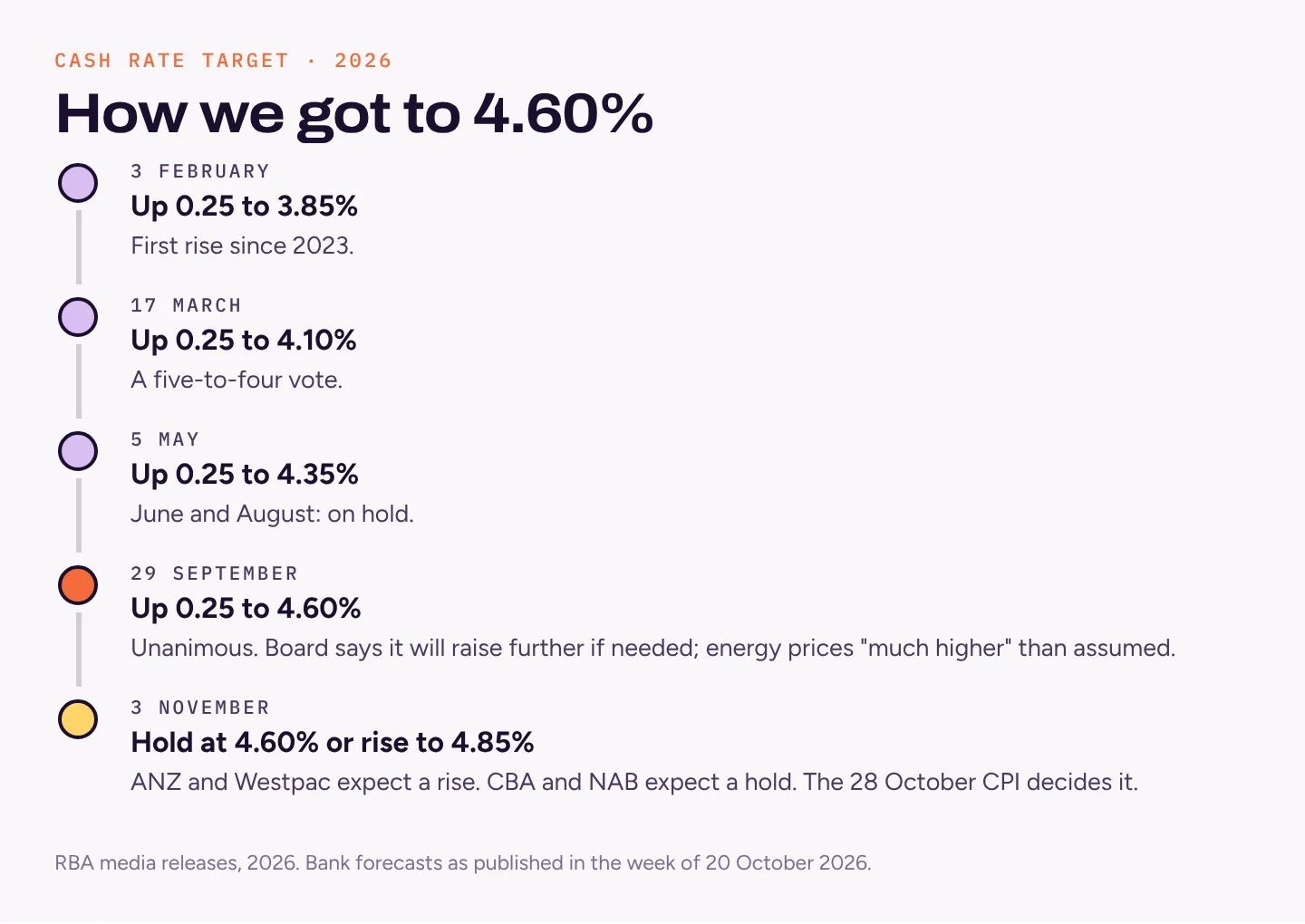
- 3 February: up 0.25 to 3.85%
- 17 March: up 0.25 to 4.10%
- 5 May: up 0.25 to 4.35%
- June and August: on hold
- 29 September: up 0.25 to 4.60%, a unanimous vote
The September decision came with a change in tone. The Board dropped its softer wording and said plainly it would raise the cash rate further if needed. Its reason was energy. Global energy prices, pushed up by the conflict in the Middle East, were "much higher than had been assumed" in the Bank's August forecasts, and businesses were passing those costs on.
The number that decides it
The Reserve Bank targets inflation of 2% to 3%. The measure it watches most closely is the trimmed mean, which strips out the most volatile price moves. On the monthly figures, the trimmed mean has been stuck at 3.6% for three months in a row. Headline inflation was 4.0% in August.
The quarterly figure on 28 October is the one that counts. Commonwealth Bank's economists expect the September quarter trimmed mean to come in at 1.0% for the quarter. Anything above that and the case for a November rise gets a lot stronger.
Deputy Governor Andrew Hauser gave the clearest steer yet on 21 October. The inflation outlook was "running a little above expectations", he said, and the Bank couldn't let inflation expectations drift away from target. He also said staff were still finalising the forecasts and he didn't know what the Board would decide. That's an unusually open way of saying the 28 October print will settle it.
What the big four expect
They're split down the middle.
- ANZ expects a 0.25 rise to 4.85%, and sees it as more likely than not.
- Westpac also expects a rise to 4.85%, unless energy prices fall sharply first. It thinks any rise beyond November would face a much higher bar.
- Commonwealth Bank expects a hold at 4.60%, but calls it finely balanced. Its view is that four rises are already slowing the economy enough.
- NAB expects a hold, with further tightening a risk rather than the base case.
Fixed rates give you another clue. Lenders lifted them after the September rise, which they usually only do when they expect more.
What each outcome means for you
A 0.25 percentage point rise adds about $16 to $17 a month for every $100,000 you owe, on a 30-year principal-and-interest loan. If your lender passes it on in full, which all of the big lenders did in September:
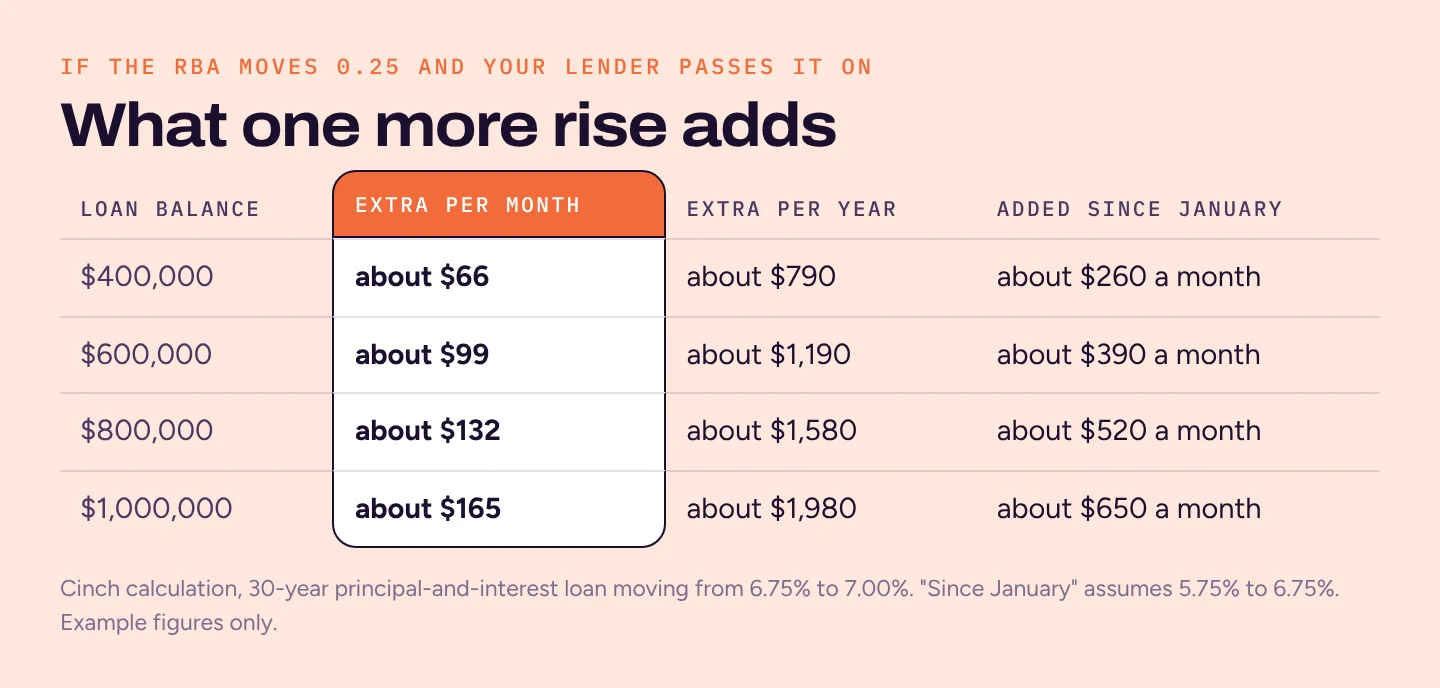
Those are the increments. Across all of 2026 so far, the four rises have added roughly $325 a month on a $500,000 loan and $650 a month on $1,000,000.
A hold is not a cut. Your repayments stay where they are. The relief, if it comes, is in 2027, and every bank economist I read has pushed their first-cut forecast later at least once this year.
Why the labour market and housing matter too
The Reserve Bank isn't only watching prices. Unemployment is already above its August forecast of 4.5% for the end of the year, and national house values have fallen for six months straight. Both are signs the rises are working. Hauser acknowledged as much on 21 October.
The Bank's problem is that inflation has been above 3% for long enough that people are starting to expect it. Once that happens, wages and prices chase each other and the job gets harder. That's why a weaker jobs market hasn't stopped the Board from talking tough.
What I'm telling clients this fortnight
Don't make a permanent decision on a two-week forecast. If your budget can't take another $100 a month, that's a reason to look at fixing part of your loan regardless of what happens on 3 November. If it can, a quarter point either way shouldn't change your plan.
Do know your number. The loan repayment calculator shows what 4.85% would mean for your loan, and the refinance calculator shows whether a sharper rate elsewhere would cover a rise. If you'd like someone to look at it with you, book a free 30-minute chat. I'll update this article on the afternoon of 3 November either way.
Sources
- RBA: monetary policy decision, 29 September 2026
- ABS: Consumer Price Index
- Commonwealth Bank: economists stick with November hold call
- Westpac: RBA hikes, retains hawkish language
- Aussie: what experts predict for the November decision
- Hauser remarks at the Citi conference, 21 October 2026
Last reviewed 24 October 2026, before the 28 October CPI release and the RBA's 3 November decision. This is general information only. It doesn't take your objectives, financial situation or needs into account. Repayment figures are examples.
Want this applied to your numbers?
Articles are general information. A 30-minute chat with Suvidh and the team turns it into a plan for your situation: borrowing power, structure and the lender that fits.
Book a free chatRun the calculatorsWritten by the Cinch Loans team · Reviewed by Suvidh Arora, Chief solutions officer · About us
Keep reading
More from Cinch Insights.
Plain-English articles on home loans, refinancing, rates and the property market, written for Australian borrowers rather than for lenders.
Rates & economy
October 24, 2026
RBA November 2026 decision: what to watch and what a rise costs | Cinch Loans
The cash rate is 4.60% after four rises. The September quarter CPI lands on 28 October, the Board decides on 3 November, and the big four are split two-two. What each outcome adds to your repayment.