Home loans
Should you fix your home loan before 3 November? The numbers both ways
Every fixed rate now starts with a 6, and banks lifted them after the September rise rather than before. What fixing costs, what it protects, and why most people who fix don't fix all of it.
24 October 2026
6 min read
"Should I fix?" has overtaken "what's your best rate?" as the first question I get asked. Four rate rises in a year will do that.
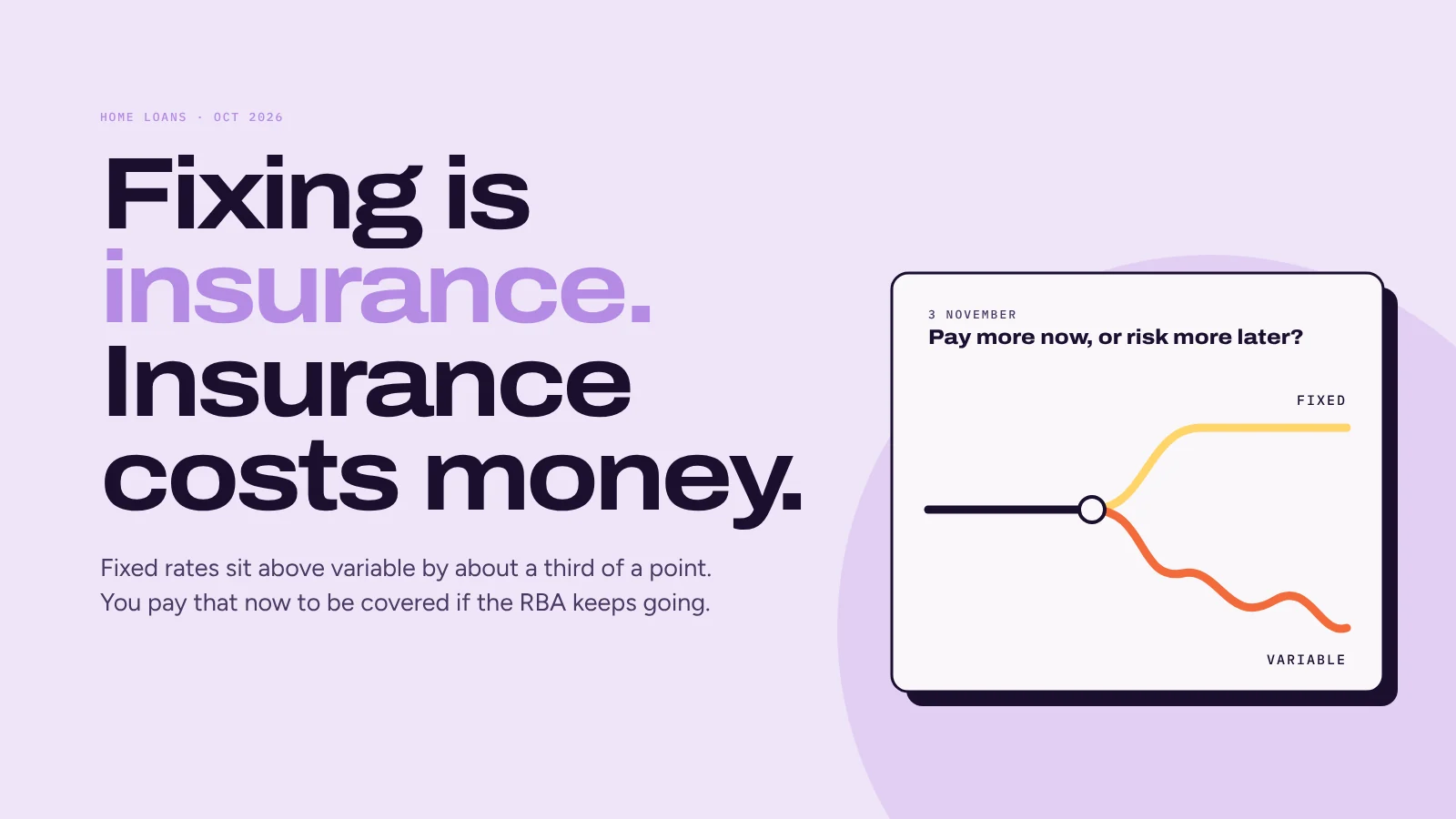
The short answer is that fixing is insurance, and insurance costs money. Whether it's worth paying depends on what you're insuring against, and on things no economist can tell you, like whether you'll sell in 18 months.
Here's how the decision looks in October 2026, with the numbers laid out so you can see both sides.
Where fixed rates sit right now
Every fixed rate in Canstar's database now starts with a 6 or higher. In the week after the Reserve Bank's September rise, 21 lenders lifted 510 fixed rates by an average of 0.21 percentage points.
Two things about that are unusual. Banks normally move fixed rates before a cash rate rise, not after it, because fixed pricing follows what markets expect. Lifting them afterwards says the banks think there's more to come. And more than 90% of lenders now offer their cheapest rate on a variable product, with the gap between a lender's lowest fixed and lowest variable averaging 0.34 points.
In plain terms: you pay more from day one to fix, and you're betting that variable rates rise by more than that gap over your fixed term.
A worked example
Let's say you owe $600,000 with 30 years to go. Your variable rate is 6.75%. Your lender offers a two-year fixed rate of 7.00%. These are example rates, not quotes.
- Variable at 6.75%: about $3,892 a month.
- Fixed at 7.00%: about $3,992 a month, so $100 more from the start.
Now play out what the Reserve Bank might do over those two years.
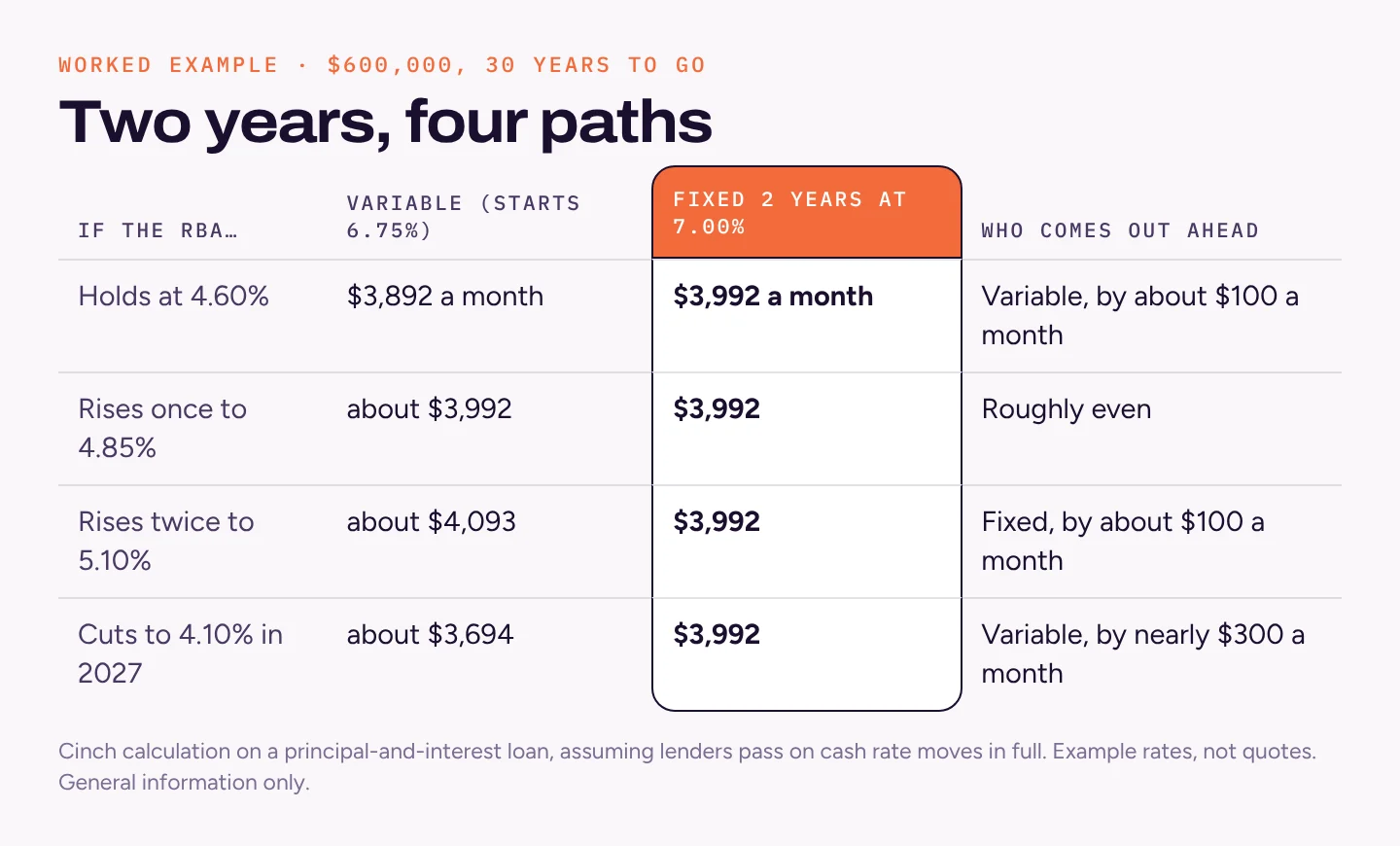
If the cash rate goes up once more and stays there, you're roughly square. Twice, and fixing saved you about $100 a month. If rates start coming down in 2027, which is what most bank economists still expect eventually, the variable borrower pulls ahead by nearly $300 a month in the later part of the term.
So the question isn't "will rates go up?" It's "will they go up by more than a quarter of a point, on average, across the whole two years?" That's a much closer call than the headlines suggest.
What you give up when you fix
The rate is only half of it. Fixed loans come with conditions, and these are the ones that catch people out:
- Extra repayments are capped, usually at $10,000 to $20,000 a year above the minimum. Put a bonus or an inheritance in beyond that and you'll pay a fee.
- Offset accounts mostly don't work on fixed loans. A handful of lenders offer a partial offset. Most don't offer one at all, so your savings stop reducing your interest.
- Break costs apply if you leave early. Sell the house, refinance, or pay the loan out, and the lender charges you for the interest it expected to earn. If you fix at 7.00% for three years and rates fall to 6.00% a year later, a rough guide on $600,000 is 1% of the balance for each remaining year, so around $12,000. Lenders use wholesale rates in the real calculation, and it can be more.
- When the fixed term ends you roll onto the lender's revert rate, which is often higher than what new customers get. Put a diary note in for two months before expiry.
- The rate you're quoted today isn't the rate you get at settlement unless you pay a rate lock fee, usually a few hundred dollars or a small percentage of the loan. In a rising market that fee has been worth it. In a falling one it isn't.
The middle path: splitting
Most of the people who fix with me don't fix the whole loan. They split it.
Say you fix $300,000 of the $600,000 for two years and leave $300,000 variable. Your repayments on the fixed half are locked. The variable half keeps the offset account, takes unlimited extra repayments, and can be refinanced without break costs. If rates rise, half your loan is protected. If they fall, half your loan benefits.
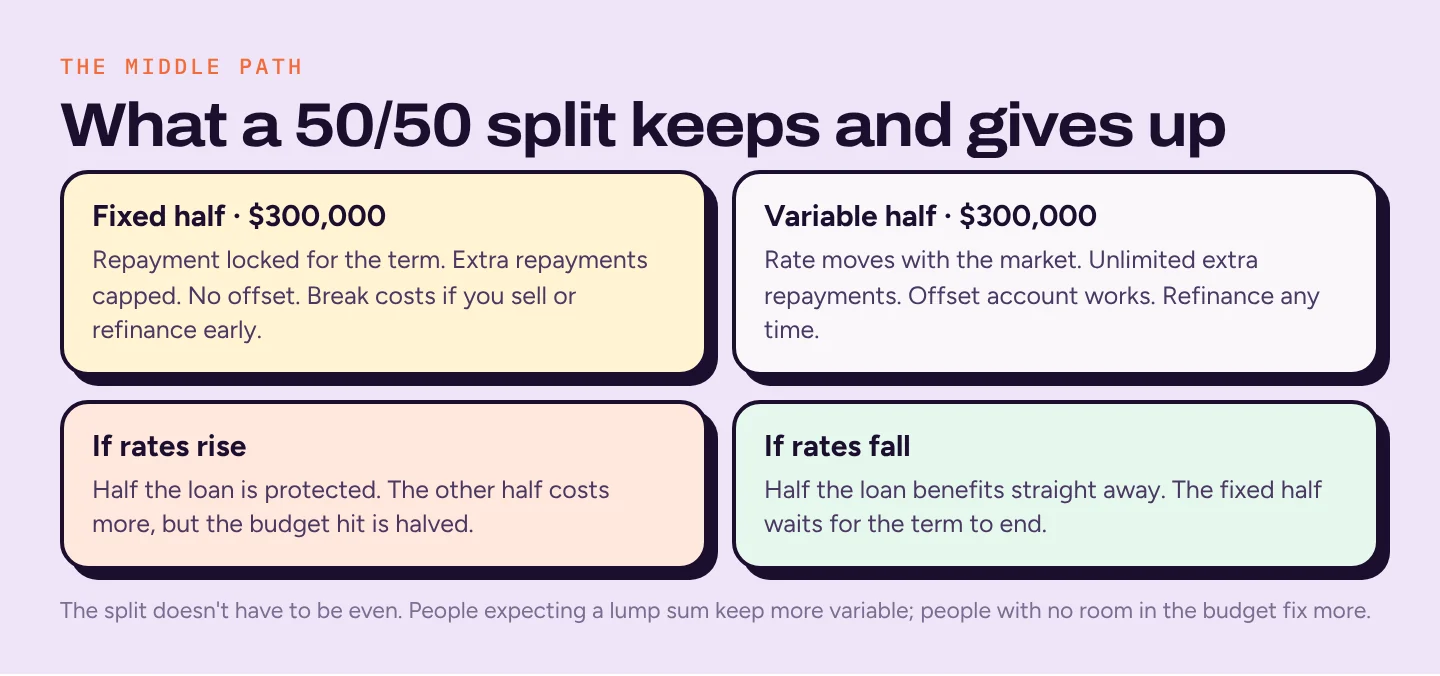
You don't have to split 50/50. People who expect a lump sum next year keep more variable. People whose budget has no room for another $200 a month fix more. The split should match your cash flow, not a forecast.
Who tends to fix, and who doesn't
Fixing suits borrowers whose budget can't absorb another two rises, who have no plans to sell or refinance during the term, and who'd rather know the number than chase the lowest one. The people who regret it are the ones who sold within the term, or who had a windfall they couldn't use.
Staying variable suits borrowers with a buffer, an offset balance that's doing real work, or a likely move. The people who regret it are the ones who had no buffer and got the fifth rise.
Neither group is wrong. They're insuring different things.
Before 3 November
The Reserve Bank meets again on 3 November, a week after the September quarter inflation figures land. Two of the big four banks expect a rise, two expect a hold. Fixed rates have already priced in a fair amount of that uncertainty, which is why they're above variable now.
If you want to see your own numbers, the loan repayment calculator will show what a quarter-point move does to your repayment, and our home loans page explains how a review works. Or book a free 30-minute chat and I'll run fixed, variable and a split side by side on your actual loan. I'll also tell you if the right answer is to do nothing, which it sometimes is.
Sources
- Canstar: weekly home loan rate wrap, 13 October 2026
- RBA: monetary policy decision, 29 September 2026
- Moneysmart: choosing a home loan (fixed, variable and split)
- Aussie: what the big four expect on 3 November
Last reviewed 24 October 2026, before the RBA's 3 November decision. This is general information only. It doesn't take your objectives, financial situation or needs into account, and the rates used are examples.
Want this applied to your numbers?
Articles are general information. A 30-minute chat with Suvidh and the team turns it into a plan for your situation: borrowing power, structure and the lender that fits.
Book a free chatRun the calculatorsWritten by the Cinch Loans team · Reviewed by Suvidh Arora, Chief solutions officer · About us
Keep reading
More from Cinch Insights.
Plain-English articles on home loans, refinancing, rates and the property market, written for Australian borrowers rather than for lenders.
Home loans
October 24, 2026
Should you fix your home loan now? Fixed vs variable, October 2026 | Cinch Loans
Every fixed rate now starts with a 6, and banks lifted them after the September rise rather than before. What fixing costs, what it protects, and why most people who fix don't fix all of it.