Most first home buyers I talk to still think the 5% Deposit Scheme is a lottery. Places run out, there's an income limit, and you'd better be quick.
That was true once. It hasn't been true since 1 October 2025.
Here's how the scheme works now, and what buying with 5% down really costs compared with saving 20%.
What changed in October 2025?
The old Home Guarantee Scheme is now called the Australian Government 5% Deposit Scheme. Housing Australia runs it, and from 1 October 2025 the government opened it right up:
- There are no income caps. A couple on $400,000 can use it the same way as a single teacher on $85,000.
- There's no limit on places, so there's no waiting list and no end-of-year scramble.
- The property price caps went up in every state.
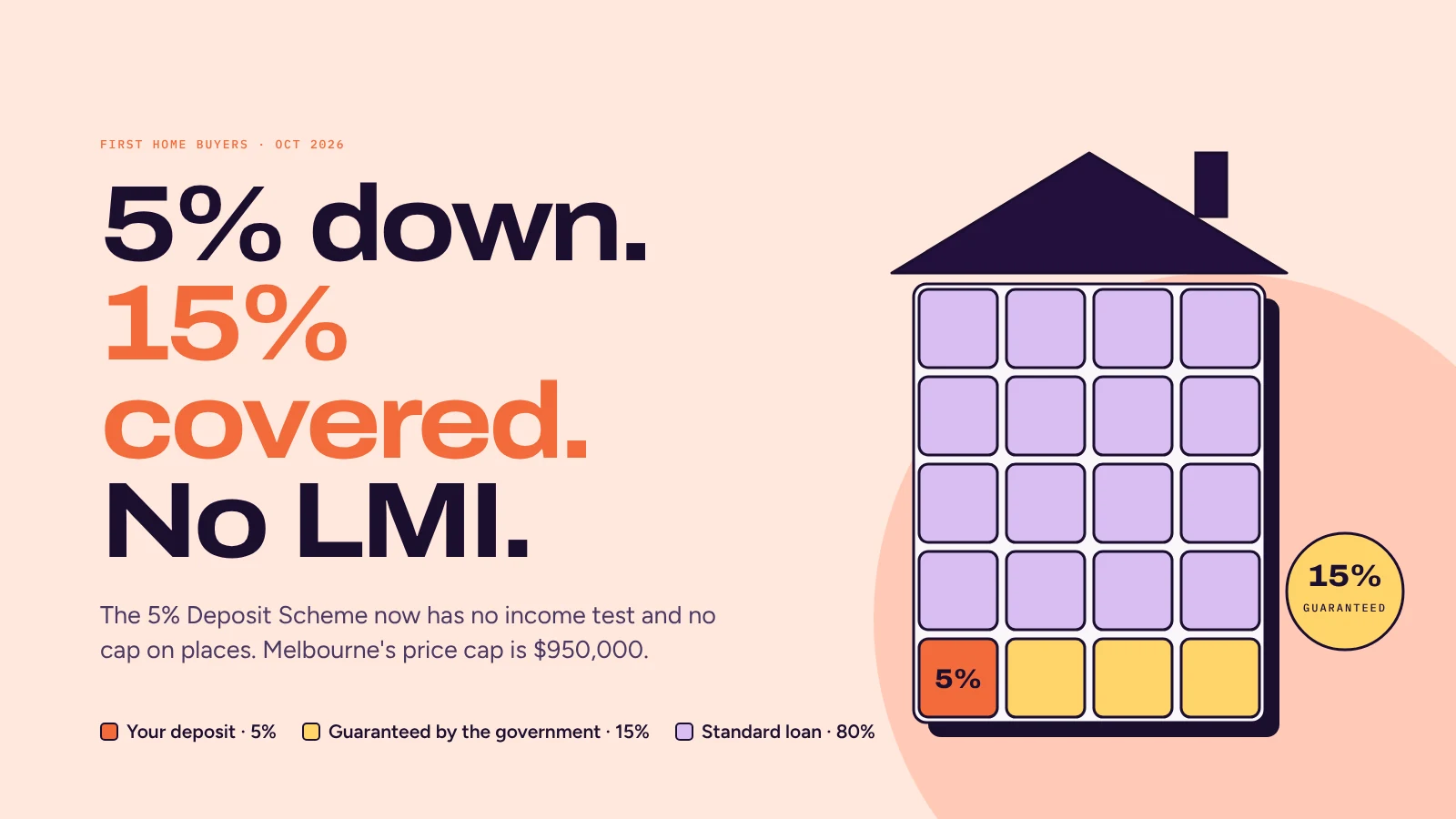
The guarantee covers up to 15% of the property's value. That lets a participating lender lend you up to 95% without charging lenders mortgage insurance (LMI).
About 102,000 first home buyers used the expanded scheme in its first year, and Victoria had the most of any state at 33,413. Roughly one in two first home buyers now uses a government scheme.
Who can use it?
You need to tick all of these:
- You're an Australian citizen or permanent resident, aged 18 or over.
- You're a first home buyer, or you haven't owned property in Australia in the past 10 years.
- You're buying on your own or with one other person.
- You'll live in the home.
- You have at least a 5% deposit and take a principal-and-interest loan of up to 30 years.
Houses, townhouses, apartments, house-and-land packages, off-the-plan purchases and land-plus-build all qualify, as long as the price fits under the cap.
Single parents and legal guardians can buy with a 2% deposit. They don't have to be first home buyers, but they must apply alone and can't own another property once the new home settles.
The separate regional guarantee is closed to new applications. Regional buyers now use the main scheme.
What are the price caps?
These are the caps as at October 2026. The cap applies to both the purchase price and the lender's valuation. For land plus a build, the two together must fit under it.
- NSW: $1,500,000 in Sydney, Newcastle–Lake Macquarie, the Illawarra and (since 1 July 2026) the Central Coast, Coffs Harbour–Grafton, the Mid North Coast and Richmond–Tweed. $800,000 elsewhere.
- Victoria: $950,000 in Melbourne and Geelong. $650,000 elsewhere.
- Queensland: $1,000,000 in Brisbane, the Gold Coast and the Sunshine Coast. $700,000 elsewhere.
- WA: $850,000 in Perth. $600,000 elsewhere.
- SA: $900,000 in Adelaide. $500,000 elsewhere.
- Tasmania: $700,000 in Hobart. $550,000 elsewhere.
- ACT: $1,000,000.
- NT: $750,000 in Darwin (up from $600,000 on 1 July 2026). $600,000 elsewhere.
Where Victorian buyers get caught
Melbourne's scheme cap is $950,000. Victoria's first home buyer stamp duty exemption stops at $600,000, and the concession runs out at $750,000.
So between $750,000 and $950,000 you can get the guarantee and still pay full stamp duty. Roughly how first home buyer duty works out at different prices:
- $600,000: nil (full duty would be $31,070)
- $700,000: about $24,700 (full duty would be $37,070)
- $750,000: $40,070, with no concession left
- $800,000: $43,070
- $950,000: $52,070
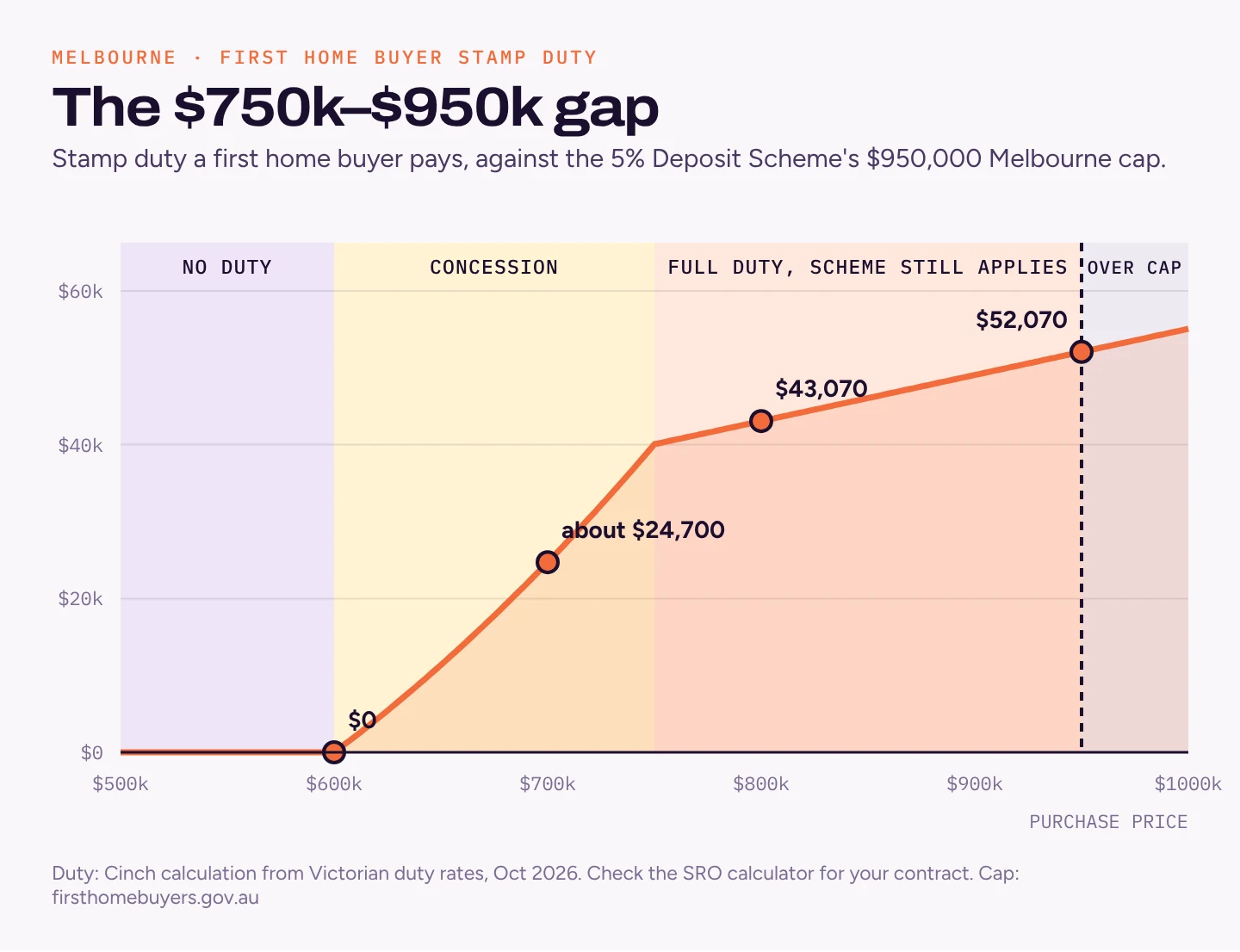
That duty comes out of your savings on top of the deposit. On an $800,000 apartment, 5% is $40,000 and the duty is another $43,070, before conveyancing and inspections.
The $10,000 First Home Owner Grant helps only if the home is new and valued at $750,000 or less. Our stamp duty calculator runs the Victorian numbers for any price, and the State Revenue Office's own calculator is the final word.
What does 5% down cost compared with 20%?
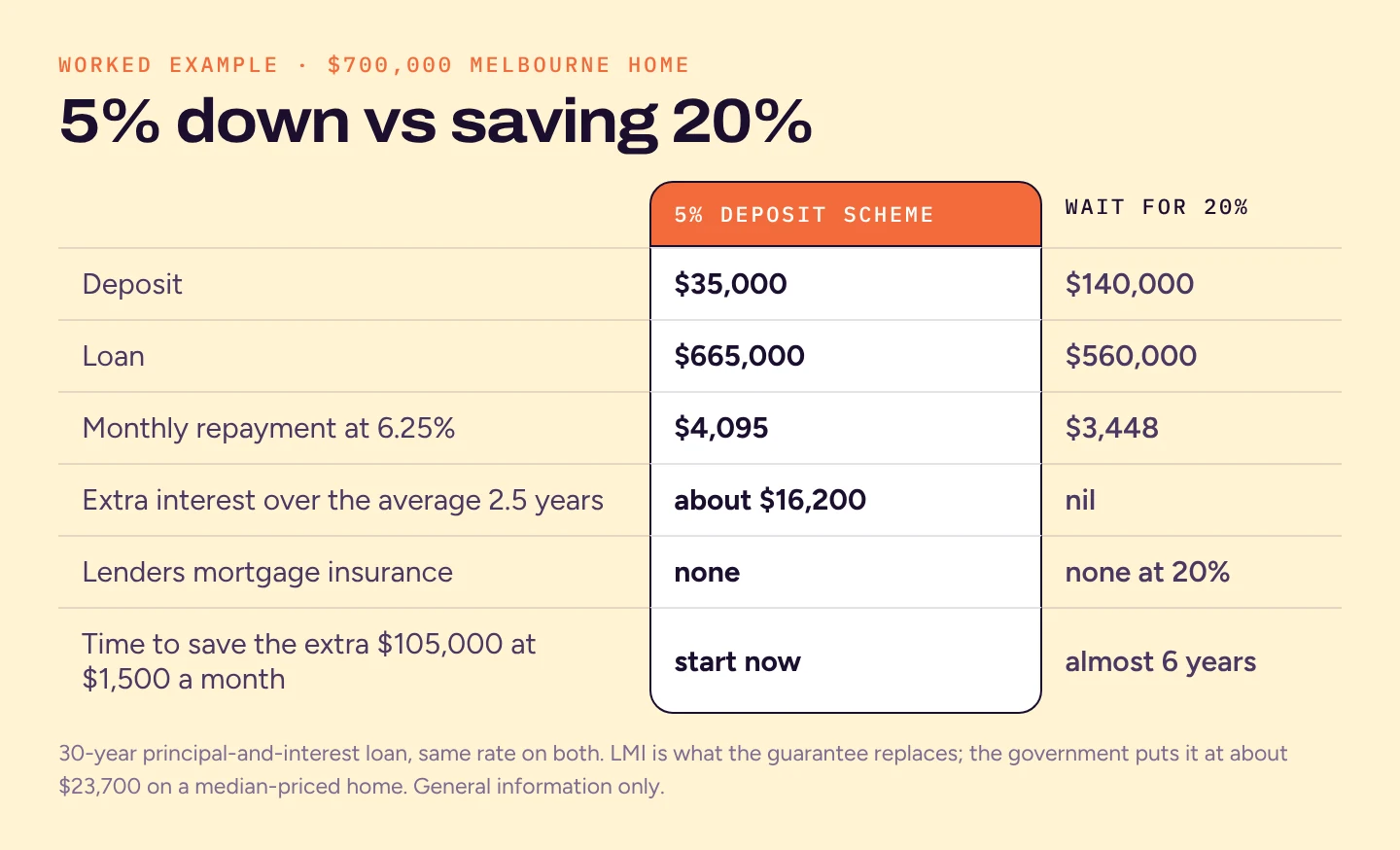
Let's say you're buying a $700,000 place in Melbourne, at a 6.25% variable rate over 30 years:
- With 5% down, you put in $35,000, borrow $665,000 and repay about $4,095 a month.
- With 20% down, you put in $140,000, borrow $560,000 and repay about $3,448 a month.
The scheme route costs about $647 a month more. Run both loans the full 30 years with no extra repayments and the 5% loan pays about $128,000 more interest. That assumes the same rate on both, and some lenders price a 95% loan higher.
The catch with that $128,000 figure is that hardly anyone keeps a loan for 30 years. On average, people leave the scheme after about two and a half years. Over that time the extra interest is about $16,200. The government puts the LMI you'd otherwise pay on a median-priced home with 5% down at about $23,700.
Then there's the waiting. Saving the extra $105,000 at $1,500 a month takes almost six years, and rent and prices don't stand still while you do it.
Neither route is free. The scheme swaps a bigger loan for an earlier start.
What changed in 2026?
- ANZ joined in March, so all four major banks now take part. Liberty became the first non-bank lender in August. More than 50 lenders and brands are on the panel.
- Since 1 July 2026 there's a limit on the savings you can keep after settlement: six months of living expenses plus six months of repayments. If you've saved well beyond your deposit, check how this applies before you sign a contract.
- Also since 1 July, switching between participating lenders is simpler, because eligible refinancing costs can be added to the loan.
Is it a good fit?
The scheme works best when your income can carry the repayments but your savings haven't kept pace with prices. It's a harder call if you're buying between $750,000 and $950,000 in Victoria and the stamp duty wipes out your buffer, or if the bigger repayment leaves nothing spare each month.
It also doesn't lower the bar for the loan itself. Lenders still test you at your rate plus a 3-point buffer, and APRA's debt-to-income limit still applies.
If you'd like your own numbers, the borrowing power calculator is a quick start, and our first home buyer page covers how we work. When you're ready, book a free 30-minute chat and I'll run the scheme against a standard loan for the exact place you're looking at.
Sources
- firsthomebuyers.gov.au: Australian Government 5% Deposit Scheme
- firsthomebuyers.gov.au: property price caps
- Treasury ministers: first-year uptake, 1 October 2026
- Broker Daily: caps and rules updated from 1 July 2026
- State Revenue Office Victoria: First Home Owner Grant
Last reviewed 22 October 2026. This is general information only. It doesn't take your objectives, financial situation or needs into account, and scheme rules, price caps and duty thresholds change.
Want this applied to your numbers?
Articles are general information. A 30-minute chat with Suvidh and the team turns it into a plan for your situation: borrowing power, structure and the lender that fits.
Book a free chatRun the calculatorsWritten by the Cinch Loans team · Reviewed by Suvidh Arora, Chief solutions officer · About us
Keep reading
More from Cinch Insights.
Plain-English articles on home loans, refinancing, rates and the property market, written for Australian borrowers rather than for lenders.
First home buyers
October 22, 2026
5% Deposit Scheme 2026: who qualifies and what it costs | Cinch Loans
No income test, no cap on places and a $950,000 limit in Melbourne. Who can use the 5% Deposit Scheme now, and what buying with 5% down costs compared with saving 20%.