Cars & vehicles
A $19,990 EV and the balloon-payment trap
New EVs now start under $20,000, which pulls down what every used EV is worth. If your loan has a balloon, that's your problem. How balloons work, what EV depreciation looks like, and four ways to structure around it.
25 October 2026
6 min read
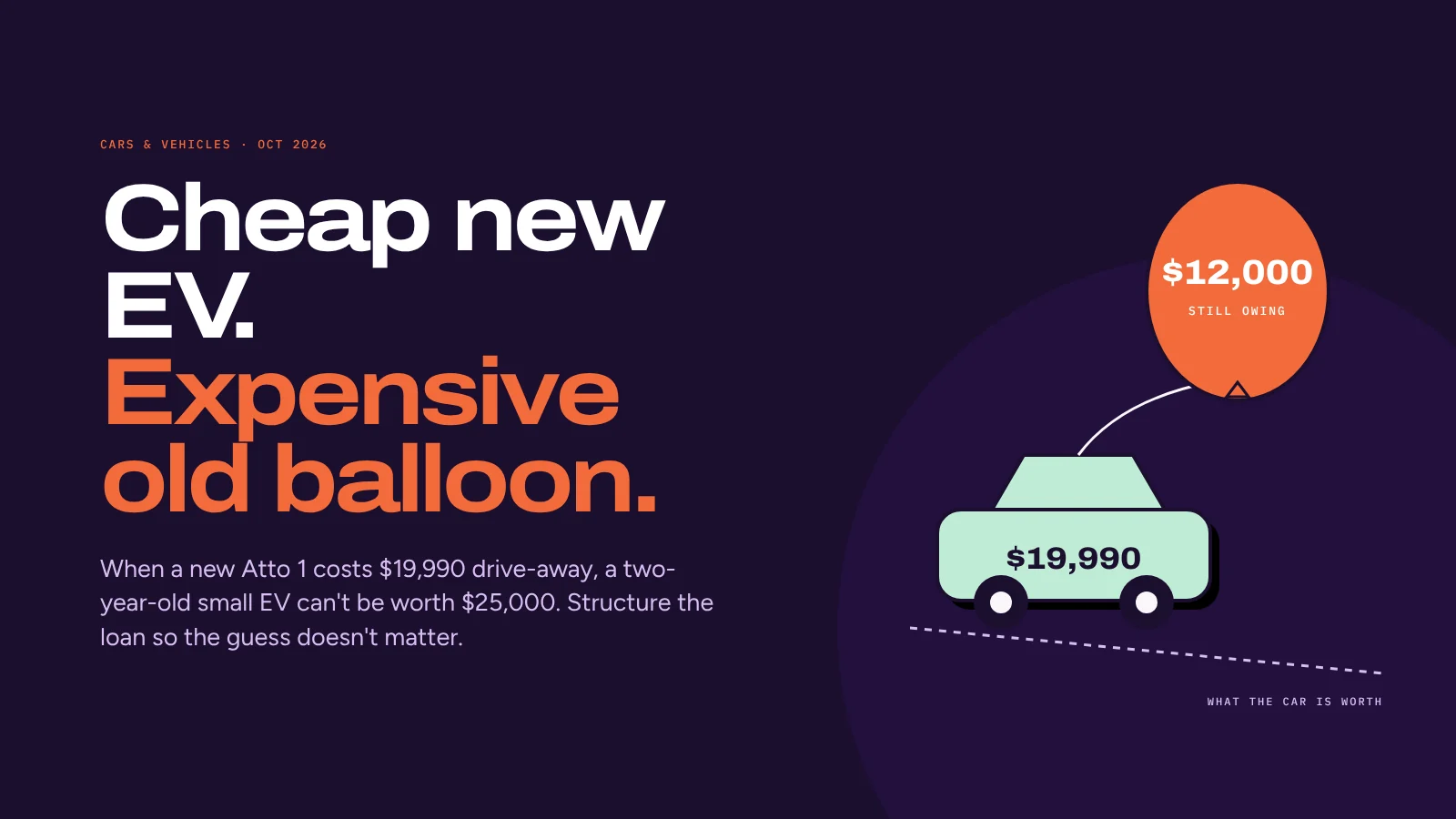
A new electric car for $19,990 drive-away. That's BYD's Atto 1 deal until mid-December, and it undercuts the Geely EX2, which itself launched in July from $26,490 before on-road costs. Two years ago the cheapest new EV in Australia cost nearly twice that.
Cheap new EVs are good news for buyers. They're bad news for one group: anyone who financed an EV with a balloon payment and now needs the car to be worth what the loan assumed.
Here's how the balloon works, why EVs make it riskier than it used to be, and how to structure a loan on a cheap car so it doesn't bite.
What a balloon is
A balloon, or residual, is a lump sum left owing at the end of a car loan. The lender spreads only part of the price across the monthly repayments and leaves the rest for the last day. It lowers the monthly figure, which is why dealers lead with it, and it raises the total interest, because you're borrowing more for longer.
At the end of the term you have three choices: pay the balloon out, refinance it, or sell the car and use the proceeds. That third option is the one most people plan on, and it only works if the car is worth at least the balloon.
Why EVs make it riskier
Used EV values have fallen faster than any other category. On Pickles and Datium data from last year, two-year-old EVs retained between 50% and 78% of their price, against 85% to 88% for the Toyotas they were compared with. One industry report put the first-year loss on an EV at about 25%, against 11.5% for a petrol car.
Some of that is technology moving on: a 2024 car with 350 km of range looks tired next to a 2026 car with 450. Most of it is the thing this article started with. When a new Atto 1 costs $19,990, a two-year-old small EV that cost $35,000 can't be worth $25,000. The cheap new car sets the ceiling for the used one.
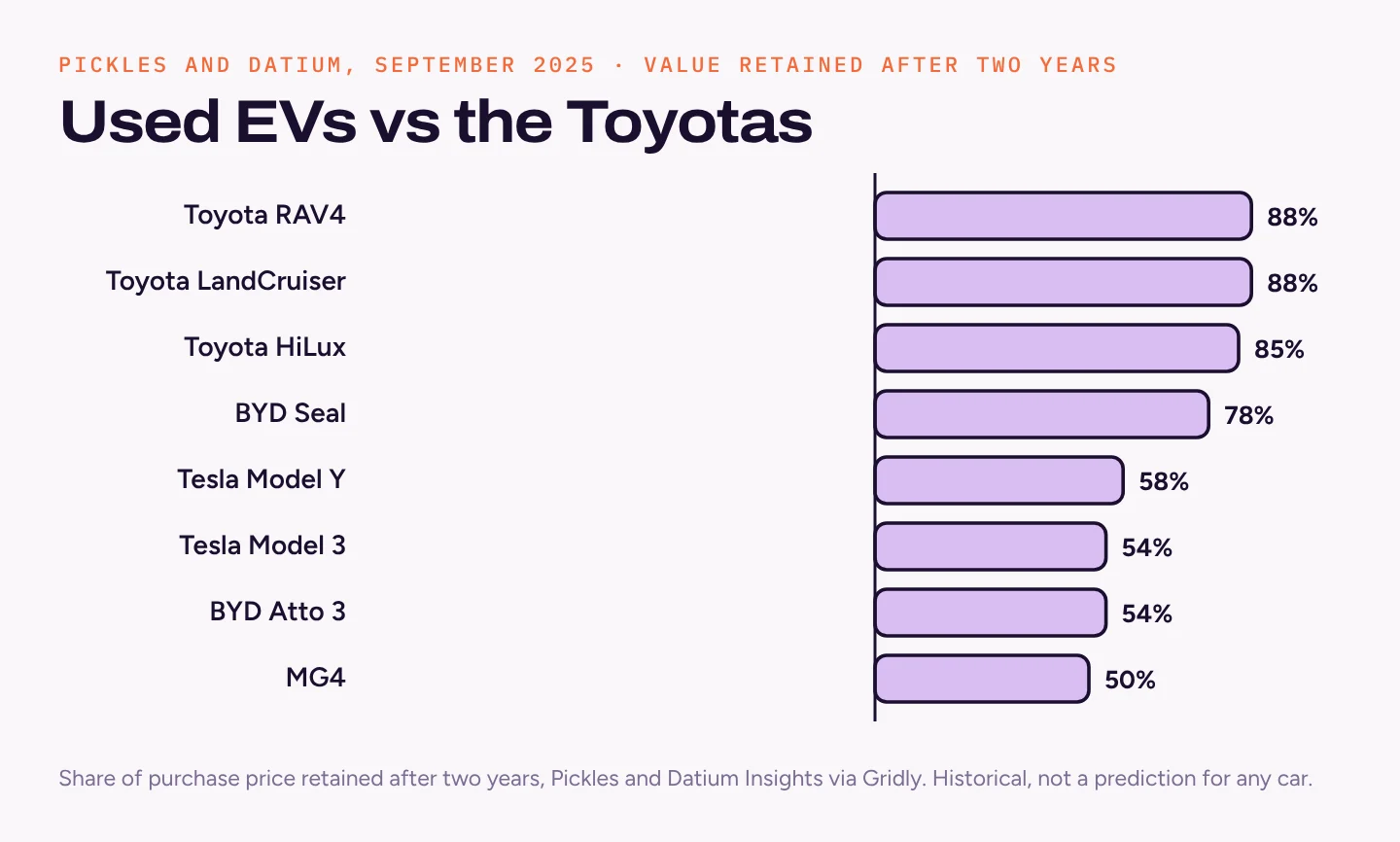
That isn't a reason not to buy an EV. It's a reason not to let a lender set your balloon at a number that assumes 2023 resale values.
A worked example
Let's say you finance $30,000 for a small EV over five years at 9%. These are example figures, not a quote.
- No balloon: about $623 a month, about $7,400 in interest, and the car is yours at the end.
- 30% balloon ($9,000): about $504 a month, about $9,200 in interest, and $9,000 owing in year five.
- 40% balloon ($12,000): about $464 a month, about $9,800 in interest, and $12,000 owing.
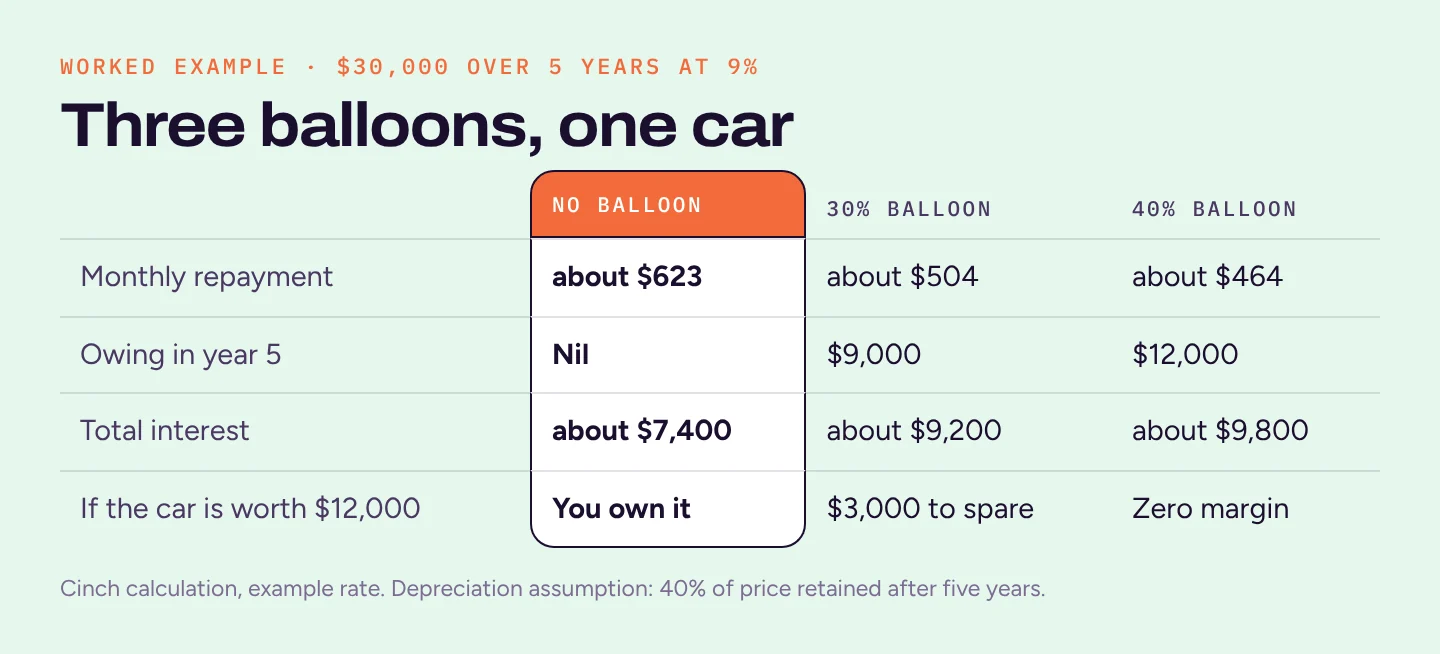
Now apply a realistic EV depreciation curve. If the car holds 60% of its value after two years and 40% after five, a $30,000 car is worth about $12,000 at the end of the term. The 40% balloon is a coin flip: the car might cover it, or you might be $2,000 to $3,000 short. Price the car at $19,990 instead and the balloon, by percentage, shrinks with it, but so does the gap between what you owe and what it's worth in a market where next year's model is cheaper again.
Four ways to take the risk out
- Smaller balloon, or none. On a car under $25,000 the repayment difference between a 30% balloon and no balloon is around $100 a month. Owning the car outright at the end is worth more than that.
- Shorter term. A three-year loan on a cheap car finishes before the steepest part of the depreciation curve does its damage, and the interest bill is smaller.
- Borrow less than the drive-away price. Putting the on-road costs and a few thousand dollars in from savings means the loan starts below the car's value instead of above it.
- Choose a model with a resale record, or accept that you won't have one. Four of the five best-selling EVs in September were from brands that didn't sell here three years ago. Their used values are a guess. If you're buying one, structure the loan so the guess doesn't matter.
What about a novated lease?
The residual on a novated lease is set by ATO guidelines, not by you, and the FBT exemption that makes leases attractive is winding back from April 2027. The same resale problem applies: if the car is worth less than the residual at the end, the gap is yours. The protection is the same too, a shorter term and a model with a track record. There's a fuller comparison of lease versus loan in the article from last week.
Where to start
Our asset and vehicle finance page covers car loans for individuals and businesses, with and without balloons. The loan repayment calculator will give you a monthly figure for any amount and term. If a dealer has handed you a quote with a residual on it, book a free 30-minute chat and I'll show you what it assumes the car will be worth.
Sources
- CarsGuide: the $19,990 BYD Atto 1 deal, 3 October 2026
- Drive: Geely EX2 vs BYD Atto 1, July 2026
- Gridly: EV depreciation in Australia (Pickles, Datium and AutoGrab data)
- The Driven: the coming reset in car values, 19 October 2026
- Moneysmart: car loans
Last reviewed 25 October 2026. This is general information only. It doesn't take your objectives, financial situation or needs into account. Repayment figures are examples; depreciation figures are historical and no guide to any particular car.
Want this applied to your numbers?
Articles are general information. A 30-minute chat with Suvidh and the team turns it into a plan for your situation: borrowing power, structure and the lender that fits.
Book a free chatRun the calculatorsWritten by the Cinch Loans team · Reviewed by Suvidh Arora, Chief solutions officer · About us
Keep reading
More from Cinch Insights.
Plain-English articles on home loans, refinancing, rates and the property market, written for Australian borrowers rather than for lenders.
Cars & vehicles
October 25, 2026
Cheap EVs and balloon payments: how to structure a car loan when resale values are falling | Cinch Loans
New EVs now start under $20,000, which pulls down what every used EV is worth. If your loan has a balloon, that's your problem. How balloons work, what EV depreciation looks like, and four ways to structure around it.