Rates & economy
Why a tanker in the Strait of Hormuz is setting your mortgage rate
The RBA named energy as the reason for the September rise. From a blockaded strait to the bowser to the trimmed mean, here is the chain between oil and your repayment, and what would break it.
25 October 2026
5 min read
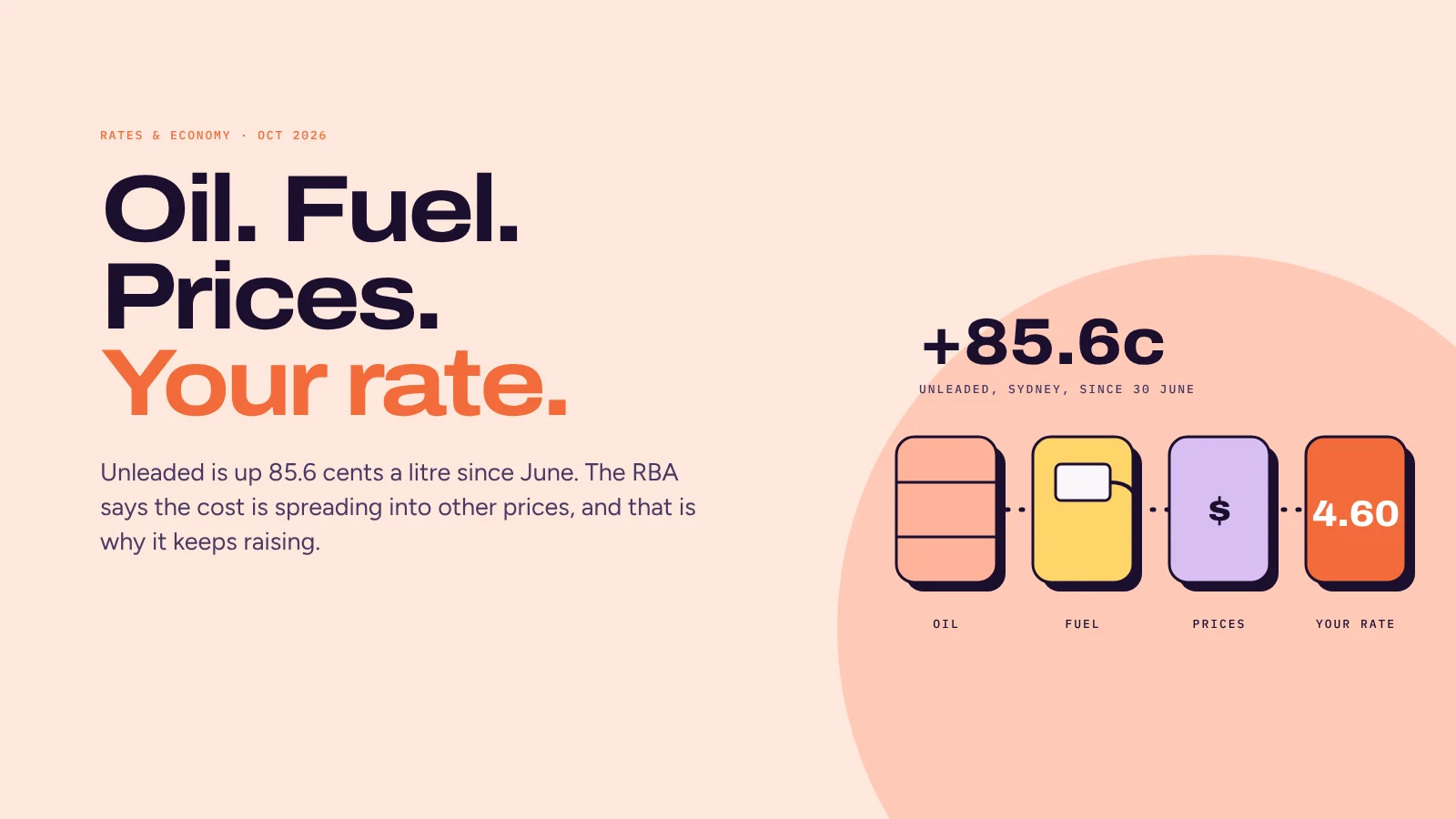
When the Reserve Bank raised the cash rate on 29 September, the word that did the work in its statement wasn't "housing" or "wages". It was "energy". Global energy prices were "much higher than had been assumed" in the Bank's August forecasts, and "higher fuel prices have partially been passed through to prices of other goods and services".
So the thing setting your mortgage rate this year is, to a large degree, the price of oil, which is being set by a conflict on the other side of the world. Here's the chain from a tanker in the Strait of Hormuz to your repayment, link by link.
Link one: the Strait
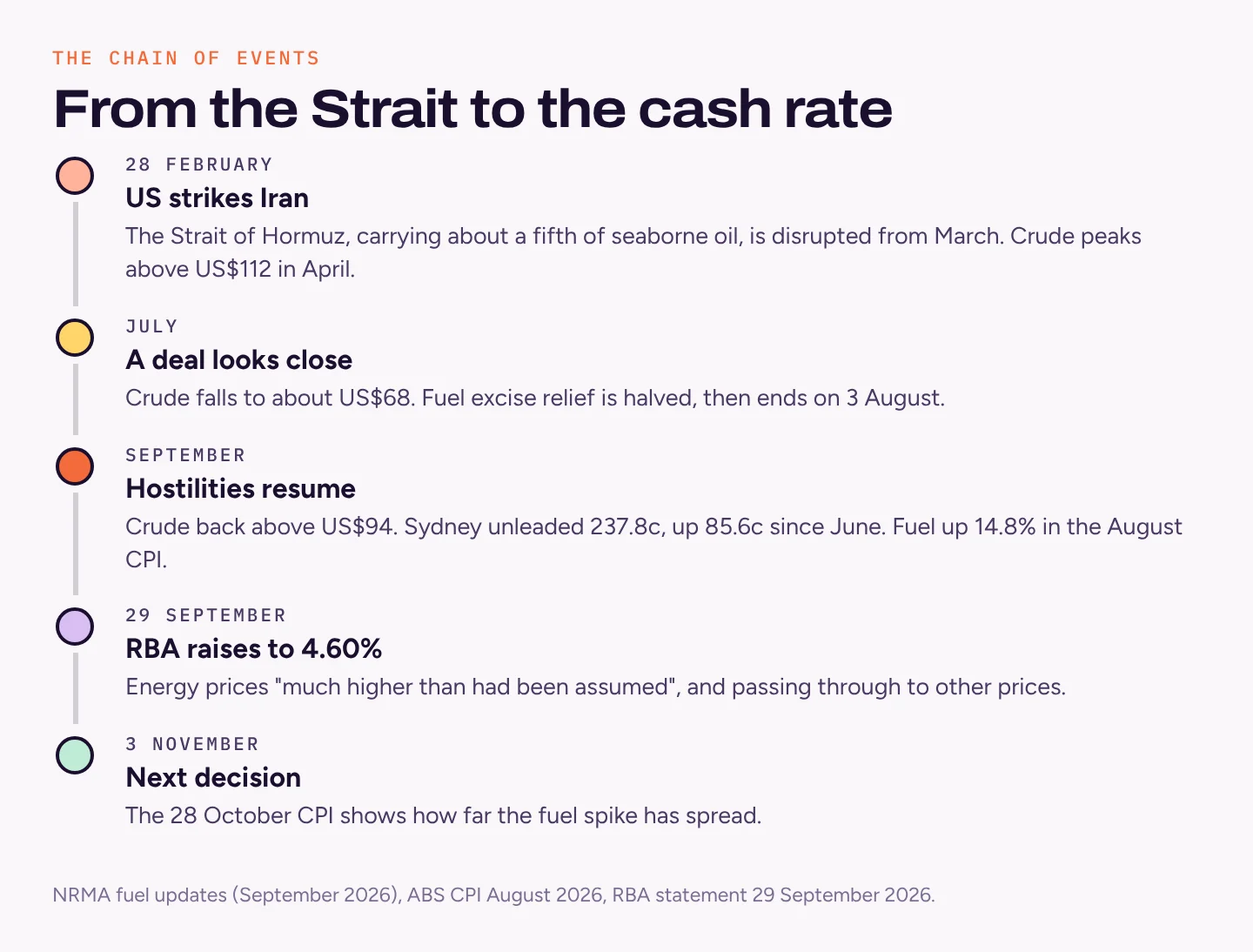
The United States struck Iran on 28 February. From March, shipping through the Strait of Hormuz, the channel that carries about a fifth of the world's seaborne oil, was disrupted. Crude peaked above US$112 a barrel in April, fell to about US$68 in July when a peace deal looked close, and was back above US$94 in September after hostilities resumed. The RBA's September statement noted the conflict "has broadened" and "remains unresolved".
Link two: the bowser
Australia imports most of its refined fuel, so the oil price lands at the pump within weeks. Sydney regular unleaded was 237.8 cents a litre on 22 September, up 85.6 cents since 30 June. Diesel was 286.1 cents, up 109.8. The federal excise relief that softened the blow from April was halved in July and ended on 3 August, and the government ruled out another cut in September.
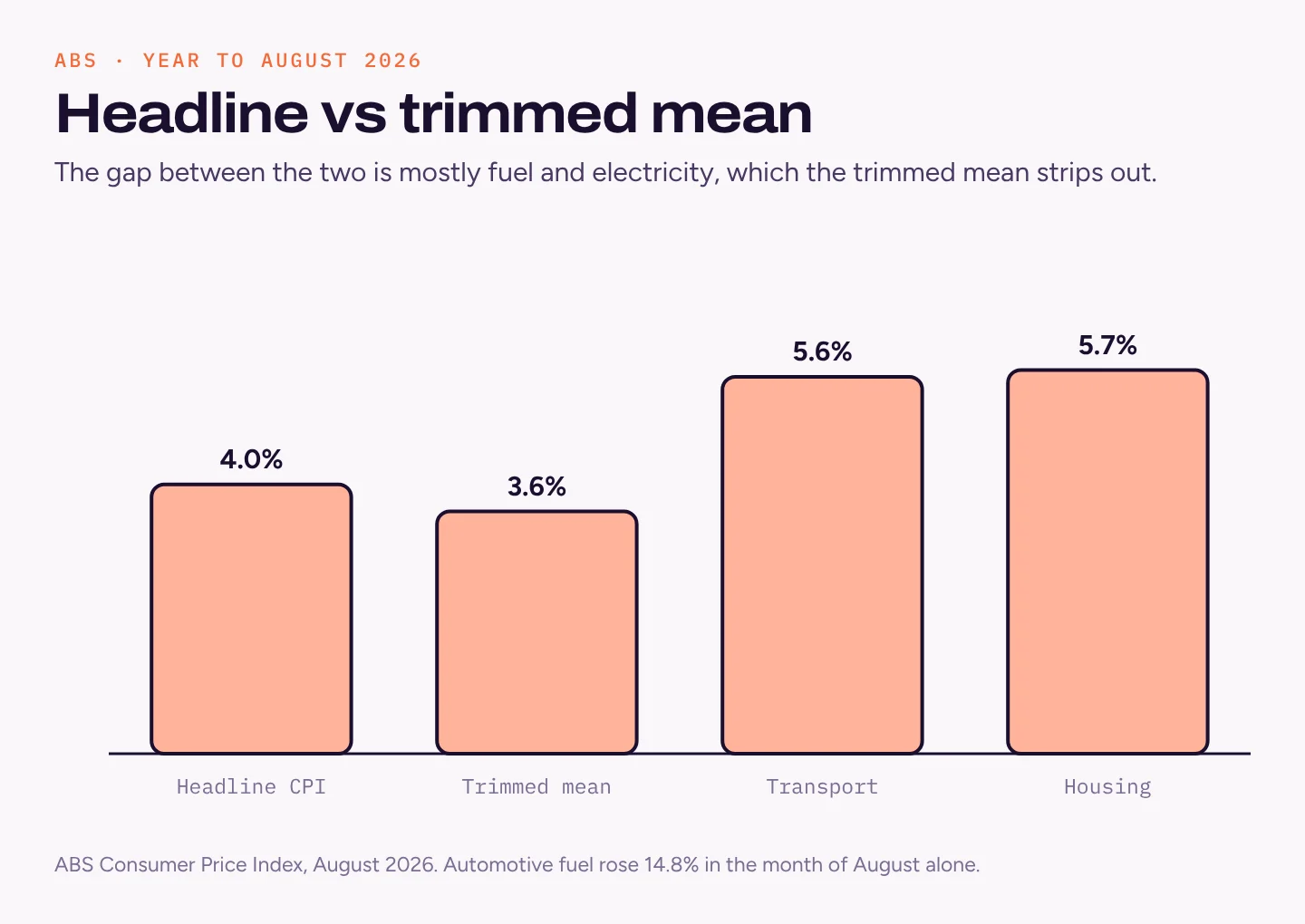
In the Bureau of Statistics' August numbers, automotive fuel rose 14.8% in a single month, after 7.5% in July. Transport costs were up 5.6% over the year, the second-largest contributor to inflation after housing.
Link three: everything that moves
Fuel is only about 3% of the CPI basket on its own. The reason it matters more than that is what it touches. Freight, farming, construction, airfares, food distribution: businesses pay the diesel bill and pass some of it on, which is the "partially passed through" line in the RBA's statement. Electricity has risen alongside it.
The Reserve Bank's preferred measure, the trimmed mean, strips out the most volatile items each month, which is why fuel and electricity have been excluded from it lately. Headline inflation was 4.0% in the year to August while the trimmed mean was 3.6%. The gap between those two numbers is mostly energy.
Link four: why the RBA can't just look through it
Central banks usually ignore an oil shock. It's a one-off price level change, it reverses when supply recovers, and raising rates doesn't make tankers move faster. That's the textbook position.
This time it hasn't, for three reasons it has stated. The pass-through is showing up in other prices, so it's no longer one-off. The economy was already running close to capacity, with June quarter growth stronger than expected. And inflation has been above 3% for long enough that the Bank is worried people start expecting it, at which point wages and prices chase each other. Deputy Governor Hauser said on 21 October that the Bank couldn't let inflation expectations drift away from target.
So the Board's reasoning is: energy is the cause, but the risk is that it spreads, and the only tool it has to stop that spread is the cash rate. Four rises in 2026, the last one unanimous, with the statement that it will go further "if needed".
What this means for a borrower
Two things, and they point in different directions.
First, the cash rate is now more tied to a war than to anything happening in Australian housing. If the Strait reopens and crude falls back toward US$70, the case for further rises weakens quickly, and the first cut moves closer. Westpac has said as much: a November rise is its base case unless the conflict is lastingly resolved first. If the conflict drags on, so does the pressure.
Second, you can't plan a mortgage around a ceasefire. What you can do is work out what one more rise costs you (about $16 to $17 a month per $100,000 owed), decide whether your budget can wear it, and if it can't, look at fixing part of the loan rather than guessing the geopolitics. The 28 October inflation figures will show how much of the fuel spike spread into other prices, and that's the number the Board will read on 3 November.
Where to start
The loan repayment calculator shows what a quarter-point move does to your repayment. The fixed-or-variable article runs the numbers on a split. If you'd like to talk it through, book a free 30-minute chat.
Sources
- RBA: monetary policy decision, 29 September 2026
- ABS: CPI rose 4.0% in the year to August 2026
- NRMA: fuel price updates and the Middle East conflict, September 2026
- Westpac: RBA hikes, retains hawkish language
- Hauser remarks, 21 October 2026
Last reviewed 25 October 2026, before the 28 October CPI release and the RBA's 3 November decision. This is general information only. It doesn't take your objectives, financial situation or needs into account.
Want this applied to your numbers?
Articles are general information. A 30-minute chat with Suvidh and the team turns it into a plan for your situation: borrowing power, structure and the lender that fits.
Book a free chatRun the calculatorsWritten by the Cinch Loans team · Reviewed by Suvidh Arora, Chief solutions officer · About us
Keep reading
More from Cinch Insights.
Plain-English articles on home loans, refinancing, rates and the property market, written for Australian borrowers rather than for lenders.
Rates & economy
October 25, 2026
Energy prices and the RBA: how oil reached your home loan rate in 2026 | Cinch Loans
The RBA named energy as the reason for the September rise. From a blockaded strait to the bowser to the trimmed mean, here is the chain between oil and your repayment, and what would break it.