Business & asset finance
Financing equipment when rates are rising: the three dials that matter more than the rate
A chattel mortgage is fixed the day you sign, so four cash rate rises change the price of the next deal, not the last one. How the term, the balloon and the deposit move the total cost, with a $60,000 example.
25 October 2026
5 min read
Four cash rate rises in a year have done something odd to equipment finance: they've made the structure of the deal matter more than the rate on it.
The Reserve Bank's average for new fixed-rate small business loans was 8.09% in August, before the September rise. The home loan on your house has moved four times since January. The chattel mortgage on your excavator hasn't moved at all, because it was fixed the day you signed. That difference is the whole point of this article.
Why equipment finance behaves differently
Almost all equipment finance in Australia is written at a fixed rate for a fixed term, usually three to seven years. Once you've signed, the cash rate can do what it likes. In a falling cycle that's a cost; in a rising one it's protection.
What rate rises do change is the price of the next deal. Lenders reprice new business as funding costs move, which is why a quote from March and a quote from October for the same machine can differ by a point or more. They also price on risk tiers: how long you've traded, your financials, the asset's age at the end of the term, and the owners' credit files. There's no comparison rate requirement on business lending, so two quotes with the same headline can cost very different amounts once fees and balloons are in.
The three dials on every quote
Let's say you're financing a $60,000 machine. These are example figures at 8.5%, not a quote, and the point is the shape rather than the number.
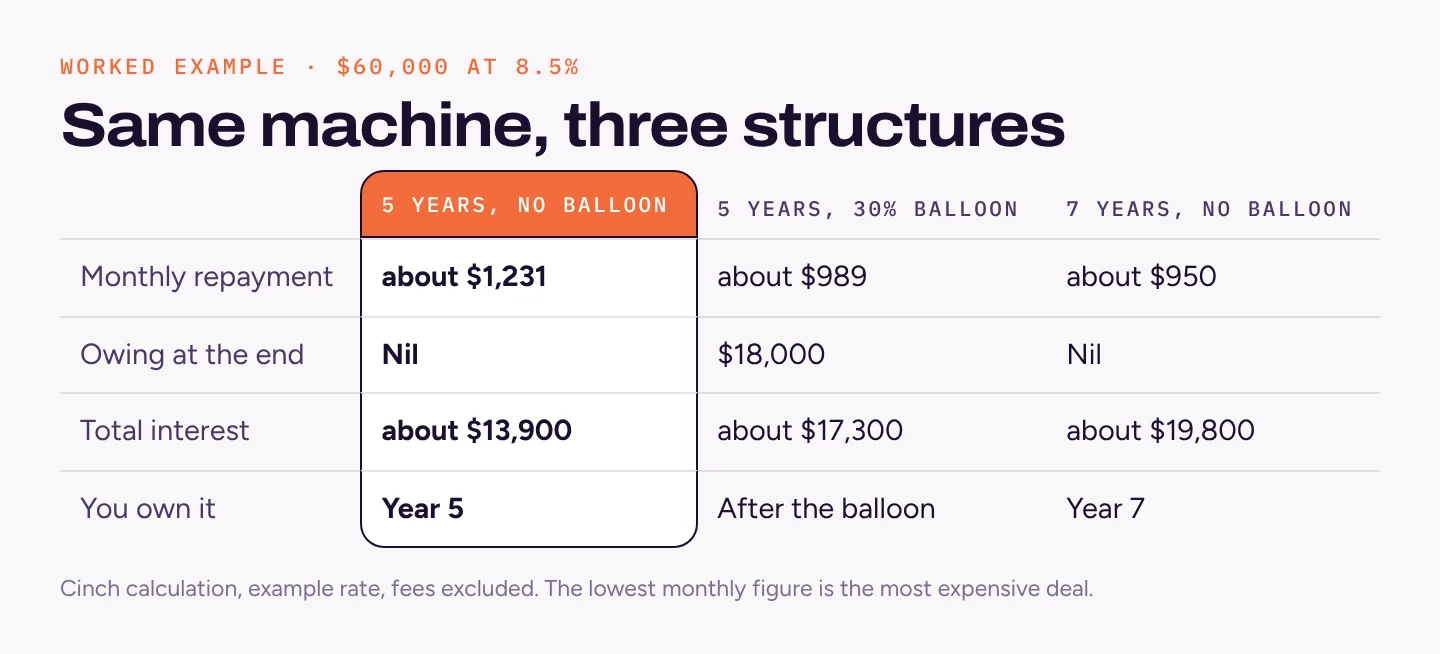
Over five years with no balloon, the repayment is about $1,231 a month and you own the machine outright at the end, having paid about $13,900 in interest. Add a 30% balloon and the monthly figure drops to around $989, but you owe $18,000 at the end and you've paid about $17,300 in interest. Stretch the same amount to seven years with no balloon and it's about $950 a month, with about $19,800 of interest.
The dealer's quote will show you the $950 or the $989. It won't show you the $3,500 to $6,000 of extra interest, or the $18,000 you'll need to find, refinance or trade out of in year five. Those are the numbers I'd ask for first.
Dial one: the term
Match it to how long the asset earns. A ute that's replaced every four years on a seven-year loan is underwater for most of its life. A CNC machine you'll run for fifteen years can carry a longer term without harm.
Dial two: the balloon
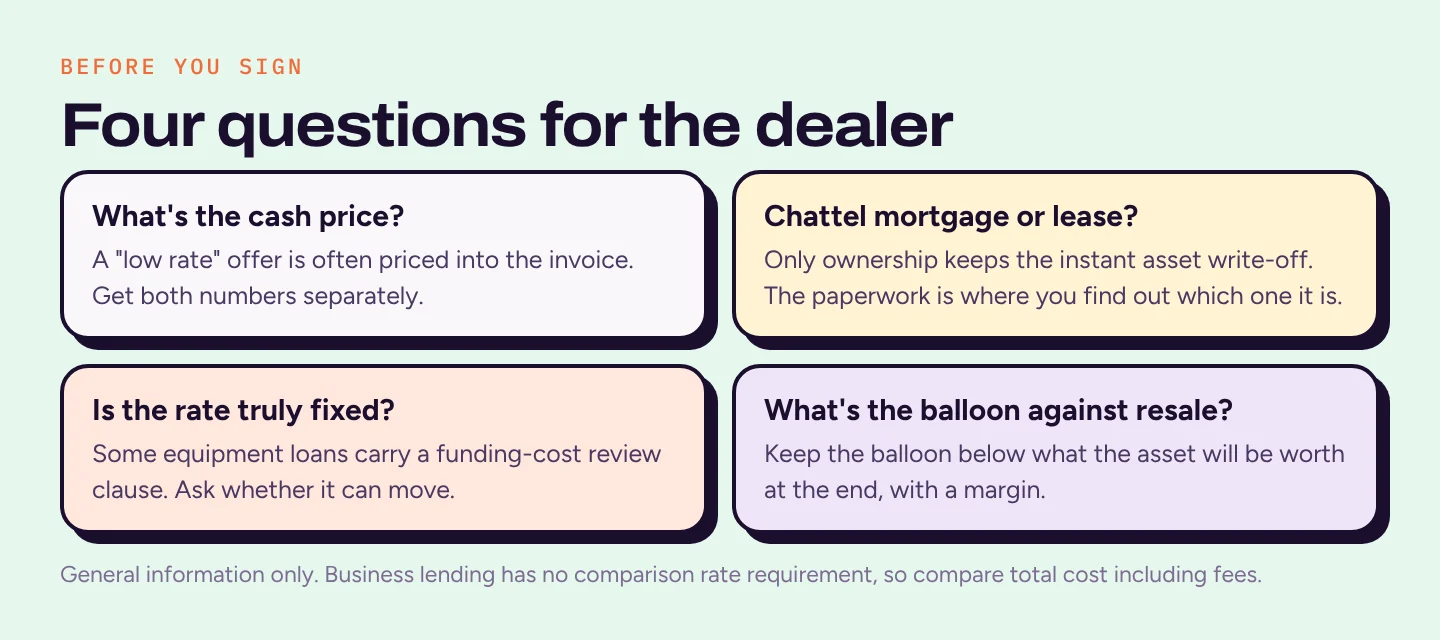
A balloon lowers the repayment and raises the total cost. It's useful when you'll sell or trade the asset at the end and its resale value will cover it. It's dangerous when the asset depreciates faster than the balloon, which is where some vehicle finance has ended up in 2026. Keep the balloon below the asset's likely value at the end of the term, with a margin.
Dial three: the deposit
Most lenders will finance 100% of the invoice for an established business. Putting cash in lowers the repayment and the lender's risk tier, which can lower the rate. Whether that beats keeping the cash as working capital in a year when overdraft rates have also risen is a question for your cash flow forecast, not for the lender.
What rising rates change in practice
- Lock the quote. Most lenders hold an approved rate for 30 to 60 days. If a rate decision is due inside that window, sign before it, not after.
- Don't refinance equipment to "free up cash" without pricing it. Refinancing a 2024 chattel mortgage at today's rates to lower the monthly payment is usually a longer term at a higher rate, which costs more in total.
- Watch the small print on "rate reviews". Some equipment loans aren't truly fixed; they carry a review clause tied to the lender's funding costs. Ask.
- Separate the finance from the purchase. A manufacturer's low-rate offer is often worth having, but check what the cash price would be, because the discount can be priced into the invoice.
And the write-off
With the $20,000 instant asset write-off now permanent, there's no deadline to rush for. That helps here too: a purchase made because the machine died, financed with a locked rate and a balloon that fits the asset's resale value, is a better deal than one made because 30 June was coming.
Where to start
Our asset and machinery finance page covers the lenders and structures we work with. The loan repayment calculator will show a monthly figure for any amount and term. If you've got a dealer quote in hand, book a free 30-minute chat and I'll pull it apart into term, balloon and total cost before you sign.
Sources
- RBA: lenders' interest rates, business lending (Table F7), August 2026
- RBA: monetary policy decision, 29 September 2026
- business.gov.au: types of business finance
- Cinch: the $20,000 write-off is permanent
Last reviewed 25 October 2026. This is general information only and isn't tax advice. It doesn't take your objectives, financial situation or needs into account. All repayment figures are examples.
Want this applied to your numbers?
Articles are general information. A 30-minute chat with Suvidh and the team turns it into a plan for your situation: borrowing power, structure and the lender that fits.
Book a free chatRun the calculatorsWritten by the Cinch Loans team · Reviewed by Suvidh Arora, Chief solutions officer · About us
Keep reading
More from Cinch Insights.
Plain-English articles on home loans, refinancing, rates and the property market, written for Australian borrowers rather than for lenders.
Business & asset finance
October 25, 2026
Equipment finance in a rising rate cycle: term, balloon and deposit explained | Cinch Loans
A chattel mortgage is fixed the day you sign, so four cash rate rises change the price of the next deal, not the last one. How the term, the balloon and the deposit move the total cost, with a $60,000 example.