Refinancing
Stay and negotiate, or switch? The fifteen-minute call that decides it
Switching is down 8.8% and same-lender refinancing down 28%, so retention teams are paying to keep you. How to make the call, what they'll offer, and the gap at which switching still wins.
25 October 2026
5 min read
The most profitable phone call most borrowers never make takes about fifteen minutes. You ring your own lender, ask for the retention team, and tell them you're reviewing your loan.
In 2026 that call has become more valuable, not less. Refinancing to a new lender is down 8.8% in a year and refinancing with your existing lender is down 28%, on Equifax's September numbers. Lenders know the switching pool has shrunk, and the ones who want to keep their book are paying to do it.
Here's how I'd decide between staying and switching, with the numbers that tip it either way.
What the "loyalty gap" looks like
Lenders price new customers sharper than existing ones. Industry analysis this year put the typical gap at 0.30 to 0.50 percentage points for the same product at the same bank. On a $600,000 loan, 0.40 points is about $160 a month, or close to $2,400 a year, for doing nothing except being loyal.
That gap is what both the retention team and a competing lender are competing over. The question is who closes it cheapest.
The retention call
Three things make it work.
- Ask for the retention or "customer solutions" team, not the general line. The front desk can't reprice; the retention team can.
- Have a real alternative in hand: a specific product and rate from another lender that you'd qualify for. "I'm thinking of leaving" gets you a standard discount. "I've been offered this" gets you the one that matters.
- Ask for the discount in writing, and ask whether it's for the life of the loan or an introductory period. Some retention offers quietly expire in two years.
What retention teams have been doing this year, by brokers' accounts in the trade press: bigger discounts than they offered in 2025, waived annual package fees, and in some cases matching a competitor outright. None of that costs you a discharge fee, a valuation, or a fresh serviceability assessment. In a year when half of brokers have clients who can't pass that assessment, the last point is bigger than it sounds.
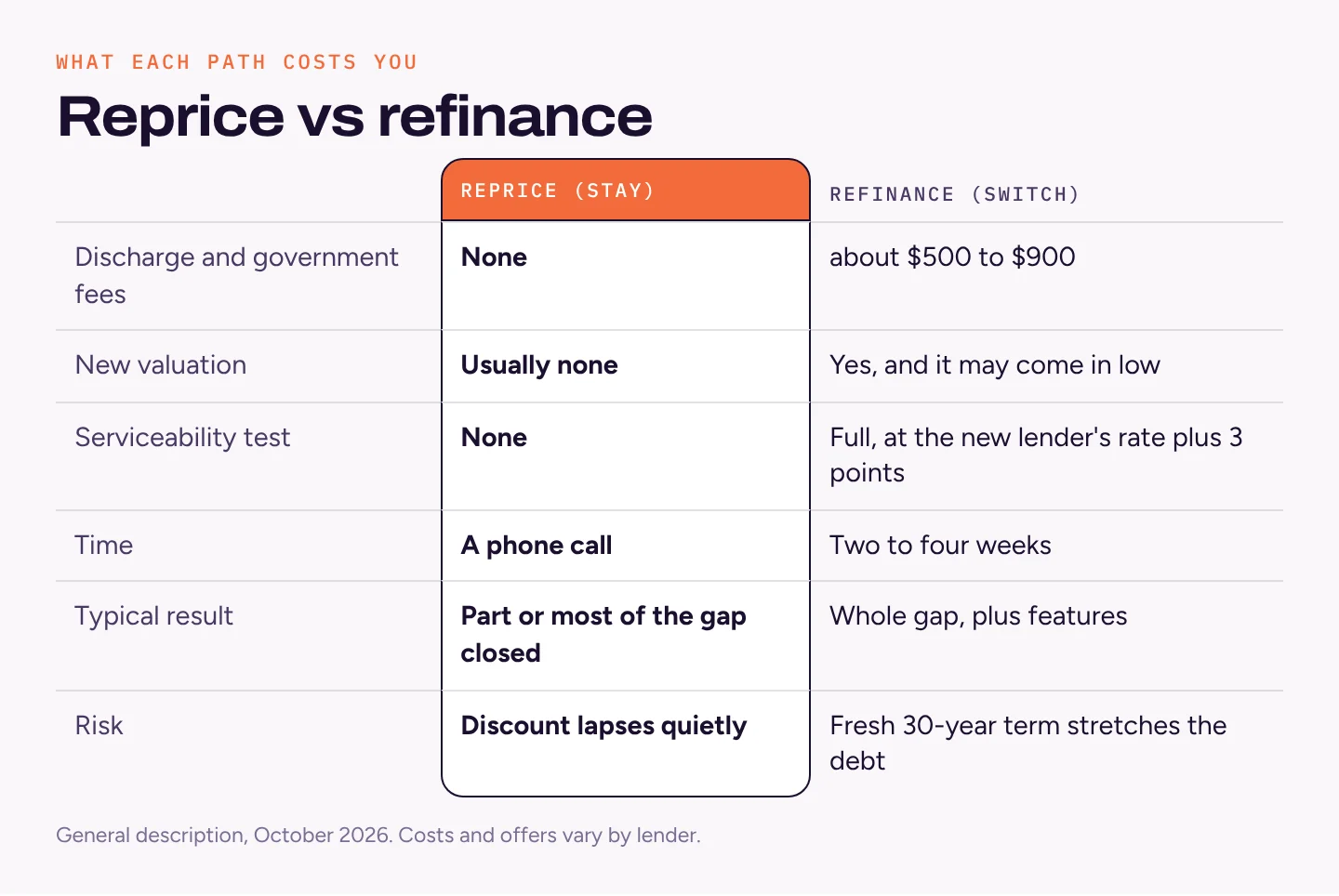
When switching wins anyway
The retention offer closes most of the gap most of the time. It doesn't close it when:
- Your lender's best new-customer rate is still well above the market. Some lenders simply aren't competitive any more and no retention discount fixes that.
- You want a feature your loan doesn't have: a proper offset, a split, the ability to make unlimited extra repayments, or a lender that treats your income type better.
- You're consolidating a car loan or a card into the home loan, which a reprice can't do.
- Your lender has quietly moved you to a legacy product it no longer sells, where the "discount" is off a rate nobody else pays.
In those cases the switching maths from last week's article applies: around $1,500 of costs, a saving of $197 a month on $600,000 for a half-point improvement, and break-even in about eight months. Cashbacks are mostly gone from the big lenders, with a handful of smaller ones still paying $2,000 to $4,000, usually only up to 80% of the property's value and clawed back if you leave within two years.
A decision guide
These are the rules of thumb I use, with example figures on a $600,000 loan.
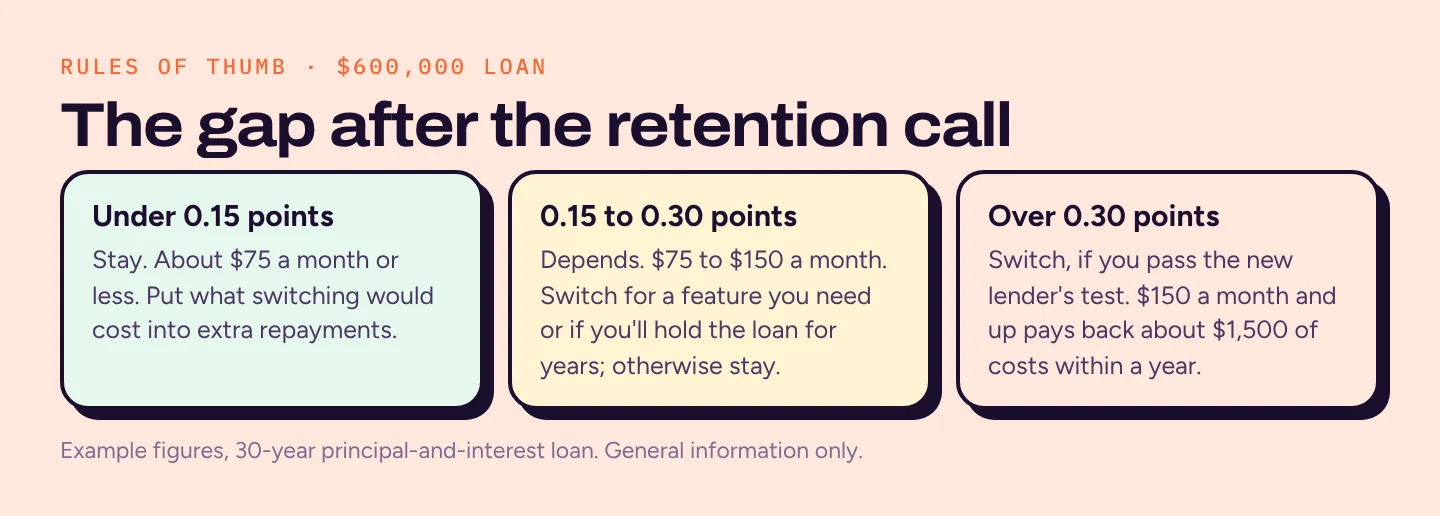
Under 0.15 points after the retention call, stay, and put what you were going to spend on switching into extra repayments. Between 0.15 and 0.30, it comes down to features and how long you'll keep the loan: switching costs take longer to earn back on a smaller gap. Above 0.30 points, switch, if you can pass the new lender's assessment and the product does what you need.
The trap on both sides
Staying has one: a retention discount that lapses. Diarise the date and ring again before it does.
Switching has one too: refinancing onto a fresh 30-year term. The repayment falls, the debt stretches, and the interest bill over the life of the loan goes up unless you keep paying the old amount. Ask the new lender for a term that matches what you had left.
Where to start
The refinance calculator shows what a given rate change saves after costs, which is the number to take into the retention call. Our refinancing page explains how we run a review, retention call included. If you'd like me to make the call with you, or to price the switch properly, book a free 30-minute chat.
Sources
- Australian Broker: refinance trap, 20 October 2026 (Equifax switching figures)
- Mozo: refinancing and the gap between new and existing customer pricing
- Moneysmart: switching home loans
- Cinch: mortgage prison, 2026 edition
Last reviewed 25 October 2026. This is general information only. It doesn't take your objectives, financial situation or needs into account. Rate gaps and discounts are examples and vary by lender and over time.
Want this applied to your numbers?
Articles are general information. A 30-minute chat with Suvidh and the team turns it into a plan for your situation: borrowing power, structure and the lender that fits.
Book a free chatRun the calculatorsWritten by the Cinch Loans team · Reviewed by Suvidh Arora, Chief solutions officer · About us
Keep reading
More from Cinch Insights.
Plain-English articles on home loans, refinancing, rates and the property market, written for Australian borrowers rather than for lenders.
Refinancing
October 25, 2026
Refinance or reprice: how to use your lender's retention team in 2026 | Cinch Loans
Switching is down 8.8% and same-lender refinancing down 28%, so retention teams are paying to keep you. How to make the call, what they'll offer, and the gap at which switching still wins.