First home buyers
Buying your first home while prices fall: the valuation gap nobody warns you about
Falling prices put buyers in a strong position, with one catch. Lenders lend on the lower of the price and their valuation, and on a 5% deposit the gap comes out of your savings. The numbers, and how to protect yourself.
26 October 2026
6 min read
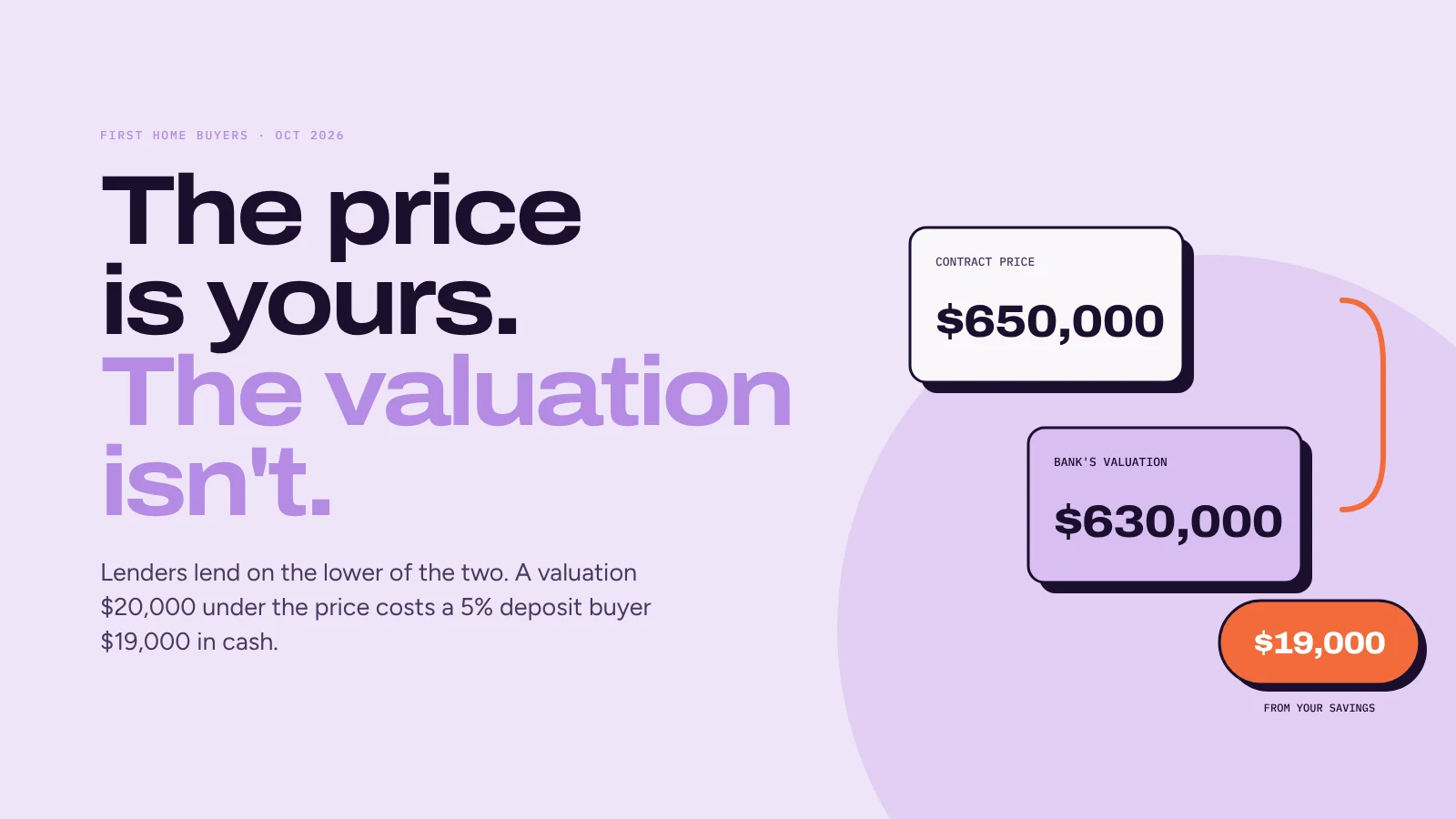
In a falling market the price is on your side and the valuation isn't. Lenders lend against the lower of the contract price and their own valuation, so if the valuer comes in under what you agreed to pay, the gap comes out of your savings, even under the 5% Deposit Scheme. Get the valuation before you're locked in, not after.
Melbourne values fell 6.2% in the year to September. Nationally they're down 5.2% from the March peak, after six monthly falls in a row. For a first home buyer with a deposit and a pre-approval, that's the best negotiating position in years.
It also brings a risk that a rising market hides: the bank's valuer may not agree with the price you've agreed. In a falling market, valuers look backwards at recent sales, and recent sales were higher than today's prices on some streets and lower on others. Here's how that plays out, with the numbers, and how to protect yourself.
How a valuation shortfall happens
Every lender works out your loan-to-value ratio on the lower of two numbers: the price on the contract, or what its own valuer says the property is worth. The 5% Deposit Scheme doesn't change that. The government guarantee lets you borrow up to 95%, but 95% of the lender's number, not yours.
Let's say you sign a contract at $650,000 with a $32,500 deposit and a pre-approval for $617,500. These are example figures.
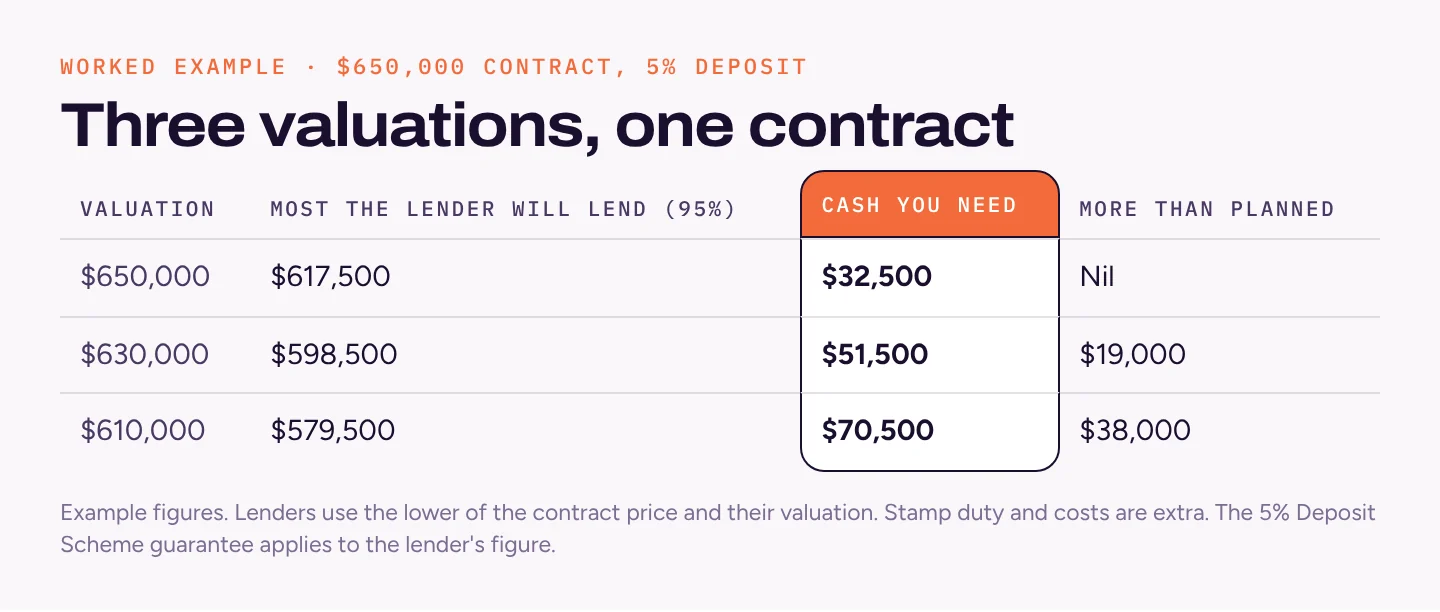
If the valuation comes in at $650,000, nothing changes. At $630,000, the most the lender will lend at 95% is $598,500, so you need $19,000 more in cash than you planned. At $610,000, it's $38,000 more. Stamp duty and conveyancing sit on top of that, and none of it is covered by the guarantee.
That's why a valuation shortfall hurts first home buyers most. Someone buying with 20% down can absorb a lower valuation by borrowing a little more. Someone at 95% has nowhere to go but their savings.
Why it's more likely right now
Valuers base their figure on comparable sales, usually from the last three to six months. When prices are falling, two things happen at once. Comparable sales from the peak can make a property look cheap, which helps you. But if a street or a building has seen weaker recent sales, or there are few sales at all, the valuer will be conservative, and conservative in a falling market means lower.
Units and townhouses in larger developments are the most exposed, because a single forced sale in the building becomes the comparable for everyone. So are properties at the top of a suburb's range, where there are fewer sales to compare against.
The difference between private sale and auction
This is where Victorian rules matter.
- Private sale. You can make the contract subject to finance, which normally includes the lender's valuation. If the valuation comes in short and you can't cover the gap, the clause lets you end the contract within the agreed period. You also get three clear business days of cooling off on most residential private sales, and using it costs the greater of $100 or 0.2% of the price, about $1,300 on a $650,000 home.
- Auction. There's no cooling off and no finance clause. If you're the winning bidder, you're committed, whatever the valuer says the following week.
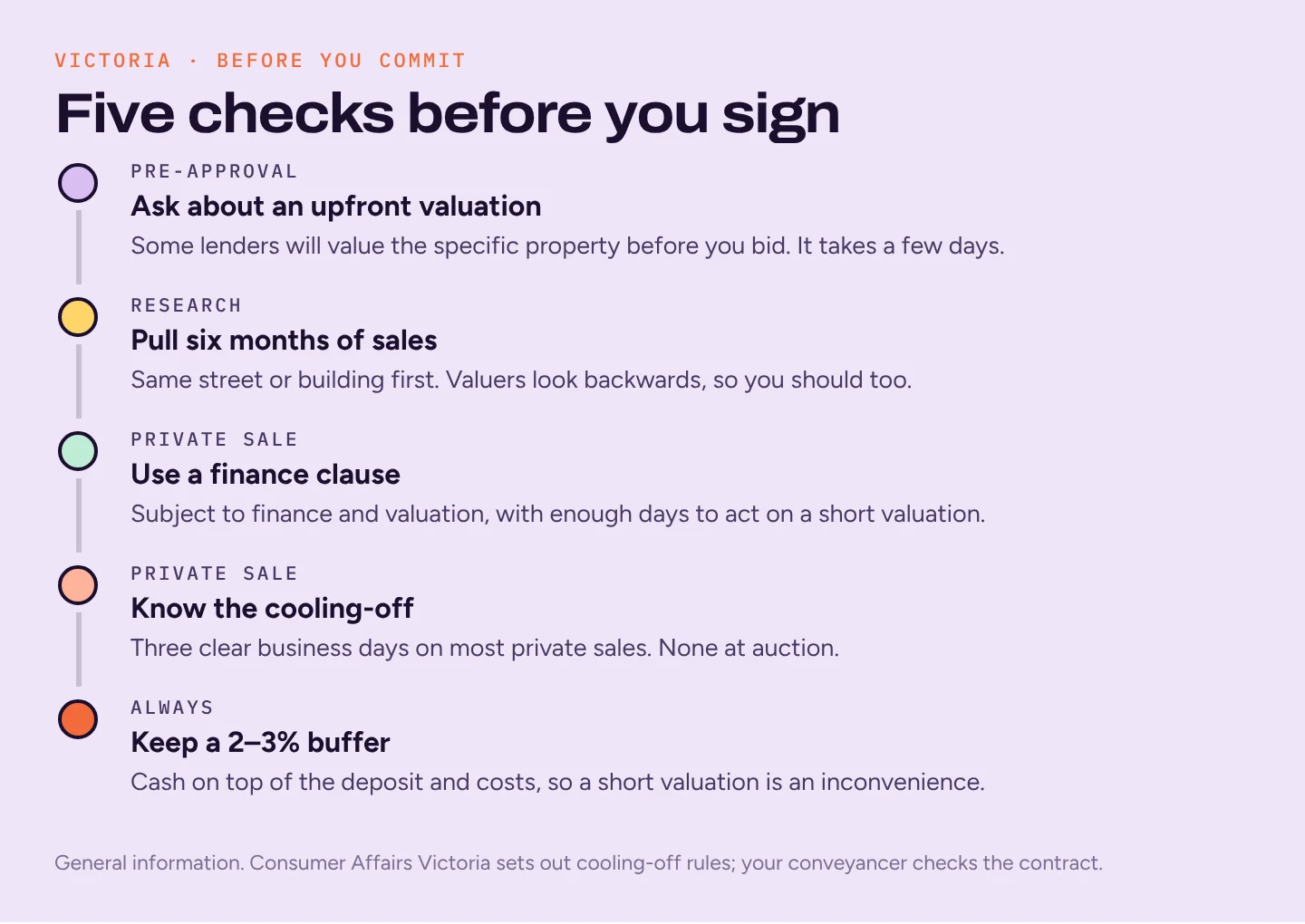
For an auction, the valuation has to happen before the hammer falls. Some lenders will do an upfront valuation on a specific property as part of pre-approval if you ask. If yours won't, the next best thing is a desktop estimate from your broker and a realistic look at the last six months of sales in the street.
If the valuation comes in short
You have more options than people think, and they're worth going through in order.
- Ask what the valuer relied on. A valuation can be challenged with better comparable sales. It doesn't always move, but sometimes it does.
- Try a second lender. Each lender uses its own valuation panel. A different valuer can come back with a different number, and switching lenders before settlement is possible if there's time.
- Renegotiate the price. On a private sale with a finance clause, a short valuation is a reason to go back to the vendor. In a falling market, many will take less rather than relist.
- Top up the deposit. Savings, a gift from family, or a guarantor can cover the gap. A guarantor removes the need for the cash but puts their home on the line.
- Walk away, if your contract allows it. That's what the finance clause is for.
The upside of buying now
None of this is a reason to stay out. Falling prices mean more stock, longer selling times and vendors willing to negotiate. Six straight months of falls also mean less competition at open inspections than a year ago. The borrowing figure is the hard part this year, as I wrote in the deposit is solved, borrowing power isn't. If your loan size is the problem rather than the deposit, Help to Buy is worth a look.
The buyers who do well in this market keep a buffer of 2% to 3% of the price in cash on top of the deposit and costs, so a short valuation is an inconvenience, not a crisis.
Questions people ask
Does the 5% Deposit Scheme cover a valuation shortfall?
No. The guarantee lets the lender go to 95% of its own valuation. If the valuation is below the price, the difference is yours to fund.
Can I get the property valued before I bid at auction?
Sometimes. Some lenders will value a specific property as part of pre-approval. Ask early, because it takes a few days.
Is a falling market a good time for a first home buyer?
It can be, if you buy with a buffer. Prices are lower and there's less competition. The risk is the valuation, and that's manageable if you plan for it.
Where to start
The borrowing power calculator gives you a starting figure, and the stamp duty calculator shows the costs on top. Our first home buyer page covers how we run the scheme. If you've found a place, or you're about to bid, book a free 30-minute chat and I'll pressure-test the price against recent sales before you commit.
Sources
- Cotality: Home Value Index, September 2026
- Housing Australia: Home Guarantee Scheme
- Consumer Affairs Victoria: buying property by private sale
- Moneysmart: buying a house
Last reviewed 26 October 2026. This is general information only. It doesn't take your objectives, financial situation or needs into account. All dollar figures are examples.
Want this applied to your numbers?
Articles are general information. A 30-minute chat with Suvidh and the team turns it into a plan for your situation: borrowing power, structure and the lender that fits.
Book a free chatRun the calculatorsWritten by the Cinch Loans team · Reviewed by Suvidh Arora, Chief solutions officer · About us
Keep reading
More from Cinch Insights.
Plain-English articles on home loans, refinancing, rates and the property market, written for Australian borrowers rather than for lenders.
First home buyers
October 26, 2026
First home buyers in a falling market: valuation shortfalls and the 5% deposit | Cinch Loans
Falling prices put buyers in a strong position, with one catch. Lenders lend on the lower of the price and their valuation, and on a 5% deposit the gap comes out of your savings. The numbers, and how to protect yourself.