Home loans
Offset, redraw or extra repayments? Where your spare cash should sit while rates rise
On a variable loan all three save exactly the same interest. The differences are control, fees, tax if the home becomes an investment, and fixed-rate limits. A worked example and a guide to which suits whom.
26 October 2026
6 min read
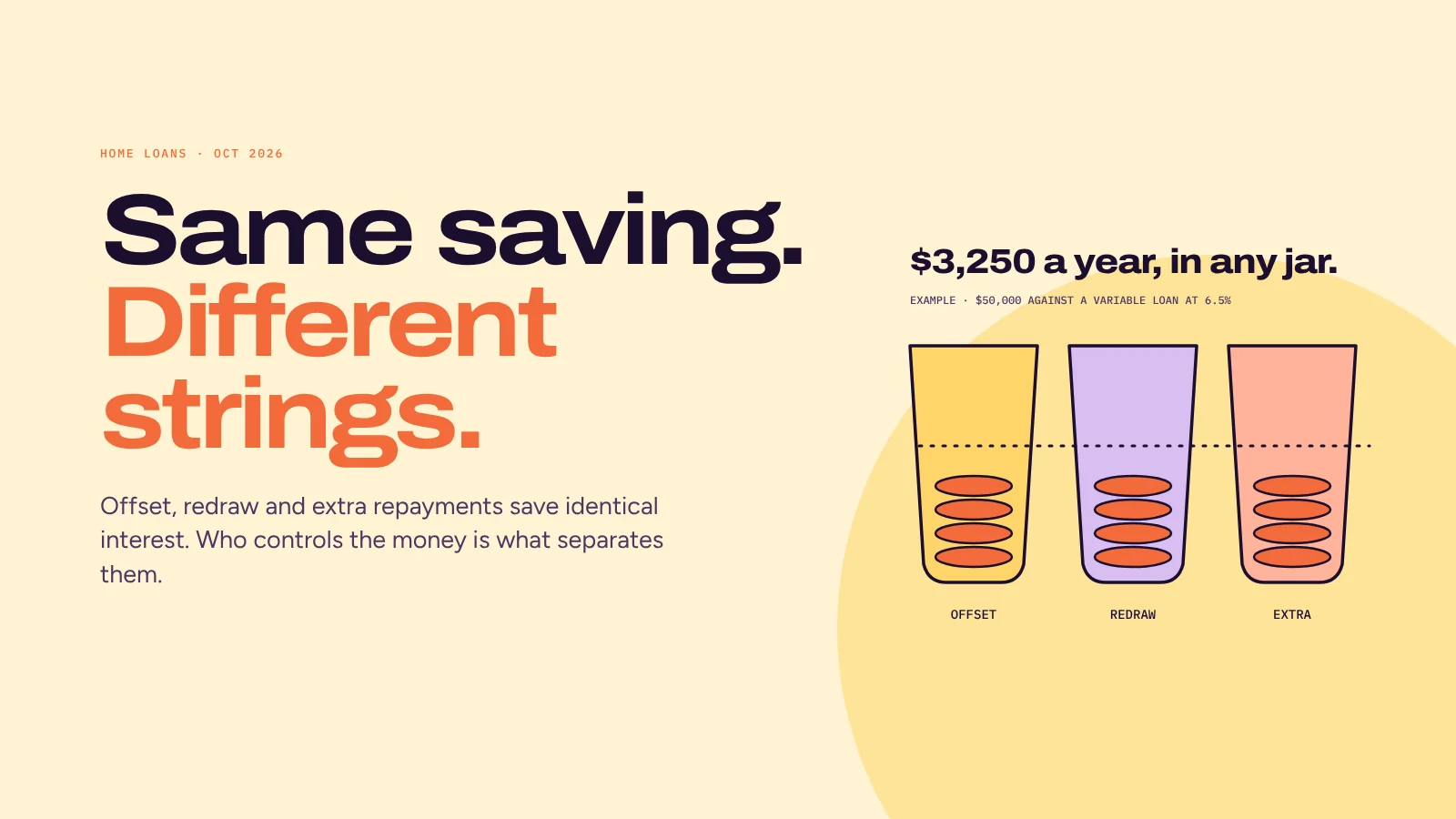
On a variable home loan, money in an offset account, money sitting in redraw and extra repayments all save the same interest. The differences are who controls the money, what it costs, how the tax works if the home later becomes an investment, and what happens on a fixed rate. For most people with savings they might need, an offset is the safer home for it.
Every rate rise this year has made spare cash against a home loan worth a little more. At 6.5%, $50,000 sitting against a $600,000 loan saves about $3,250 of interest a year. Each quarter-point rise adds another $125 to that.
The question I get asked is where that money should sit. There are three places, and on the interest maths alone they're almost identical. The differences are elsewhere.
The interest maths, first
Let's say you owe $600,000 at 6.5% over 30 years, so your repayment is about $3,792 a month. These are example figures.
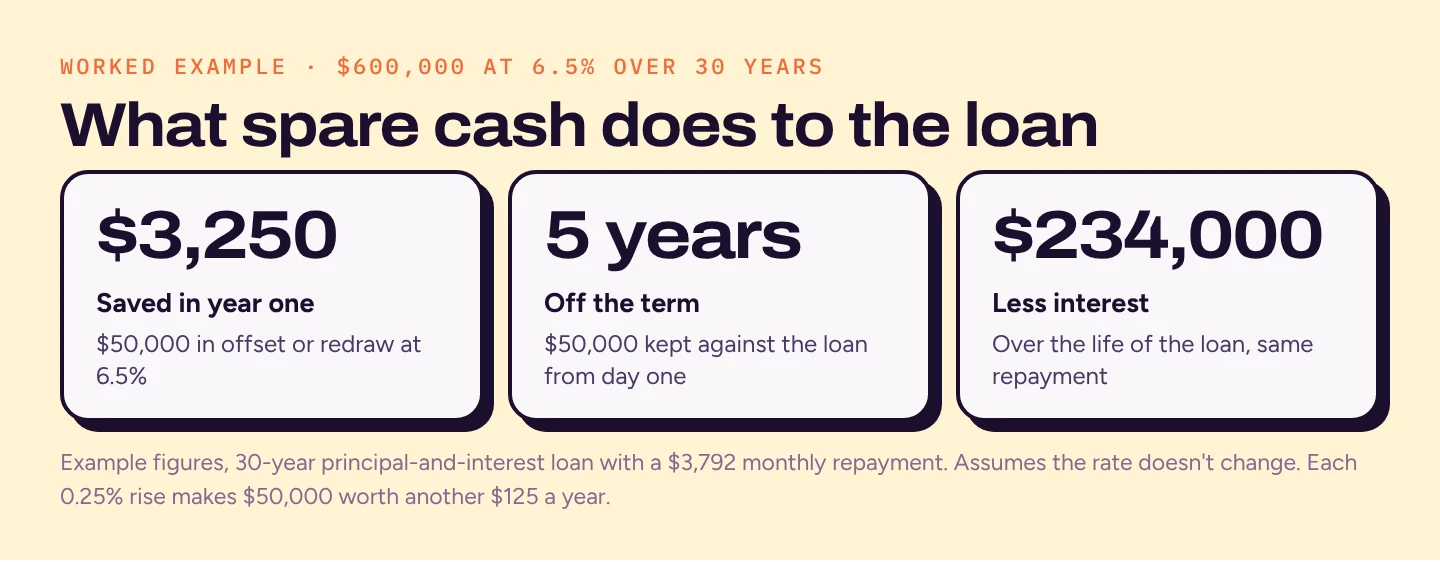
Put $50,000 in an offset from day one, keep the repayment the same, and the loan finishes about five years early, with roughly $234,000 less interest. Pay an extra $500 a month instead and it finishes about eight years early, with roughly $240,000 less interest. Same principle in both cases: every dollar against the loan saves interest at the loan rate, which after tax is a better return than most savings accounts can offer.
Whether that dollar sits in an offset, in redraw or as an extra repayment makes no difference to the interest on a variable loan. It makes a lot of difference to everything else.
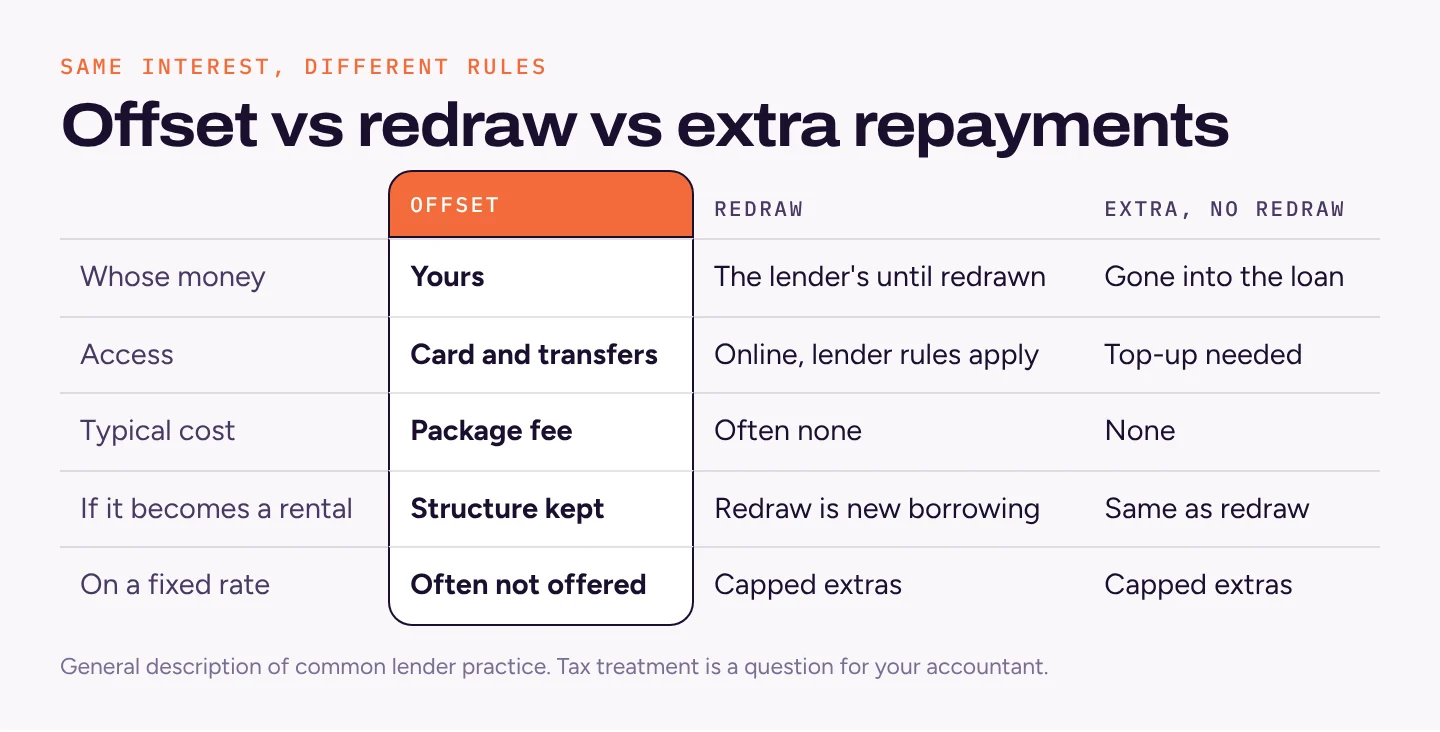
Offset: your money, still your money
An offset is a transaction account linked to the loan. The balance is subtracted from the loan before interest is calculated, but the money is still in your account. Your pay can go in, your card can come out of it, and nobody can stop you using it.
The costs: offsets usually come with a package loan and an annual fee of a few hundred dollars, and the rate on a package loan isn't always the sharpest. On a balance under about $10,000, the fee can cost more than the offset saves.
Redraw: the lender's money until you ask
Extra repayments go into the loan, and redraw lets you take back what you've paid ahead. It has no separate fee on most basic loans, which is why it's popular.
Three things to know. The money has been repaid, so it's the lender's until you redraw it, and lenders can set minimum amounts or limit redraw under the loan terms. Some loans only let you redraw online, or not at all on certain products. And for tax purposes, money you redraw is generally treated as new borrowing, with its deductibility depending on what you use it for. That matters if the home might become a rental later.
Extra repayments with no redraw
Some people want the money gone so they can't spend it. Paying extra into a loan without redraw, or asking the lender to lower the scheduled repayment after a lump sum, works if you're sure you won't need it. If you're not sure, use redraw or an offset instead, because getting money back out of a home loan otherwise means a top-up and a fresh assessment.
Where fixed rates change the answer
On a fixed rate, most lenders cap extra repayments, often around $10,000 a year, or $20,000 to $30,000 across the fixed term, and many don't offer a full offset at all. Paying in more than the cap can trigger break costs. That's one reason people who fix often split the loan: the variable part carries the offset and the extra repayments, and the fixed part carries the certainty. I went through the split in should you fix before 3 November.
Which one, for whom
- You might keep this home as an investment one day. Offset. Paying down the loan and redrawing later can turn deductible debt into non-deductible debt. The detail is a question for your accountant, but the structure is worth getting right now.
- You're holding an emergency fund or saving for something specific. Offset, so it stays accessible and separate from the loan.
- You want a simple loan with the lowest fees and you won't touch the money. Extra repayments with redraw as a backstop.
- You're on a fixed rate. Check the cap, then use a variable split or an offset on the split for anything above it.
One more lever: money against the loan also shows a lender spare capacity when you apply for your next loan, which is one of the borrowing power levers in six levers that move your borrowing power.
Questions people ask
Does an offset save more interest than redraw?
No. On the same variable loan at the same rate, a dollar in offset and a dollar in redraw save exactly the same interest.
Can my lender stop me using redraw?
Lenders can set conditions on redraw under the loan contract, including minimum amounts and, in some cases, limits. An offset balance is your deposit and works like any bank account.
Is an offset worth the package fee?
It depends on the balance. As a rough guide, at 6.5% you need about $6,100 sitting there all year to cover a $395 fee before you're ahead.
Where to start
The loan repayment calculator shows what an extra repayment does to your term. Our home loans page covers how we structure offsets and splits. If you're not sure your current loan has the right setup, book a free 30-minute chat and bring your last statement.
Sources
- Moneysmart: mortgage offset accounts
- ATO: residential rental properties
- Canstar: back to 2011, how to manage another hike, 28 September 2026
Last reviewed 26 October 2026. This is general information only and isn't tax advice. It doesn't take your objectives, financial situation or needs into account. All dollar figures are examples.
Want this applied to your numbers?
Articles are general information. A 30-minute chat with Suvidh and the team turns it into a plan for your situation: borrowing power, structure and the lender that fits.
Book a free chatRun the calculatorsWritten by the Cinch Loans team · Reviewed by Suvidh Arora, Chief solutions officer · About us
Keep reading
More from Cinch Insights.
Plain-English articles on home loans, refinancing, rates and the property market, written for Australian borrowers rather than for lenders.
Home loans
October 26, 2026
Offset vs redraw vs extra repayments in 2026: which is right for you | Cinch Loans
On a variable loan all three save exactly the same interest. The differences are control, fees, tax if the home becomes an investment, and fixed-rate limits. A worked example and a guide to which suits whom.