Property market
Victoria's off-the-plan stamp duty concession: what it saves, who can use it, and the April 2027 deadline
Sign for an off-the-plan apartment, unit or townhouse before 21 April 2027 and duty is worked out on the price minus construction still to come. Any buyer, no price cap. The saving, the rules and the lending risks.
26 October 2026
6 min read
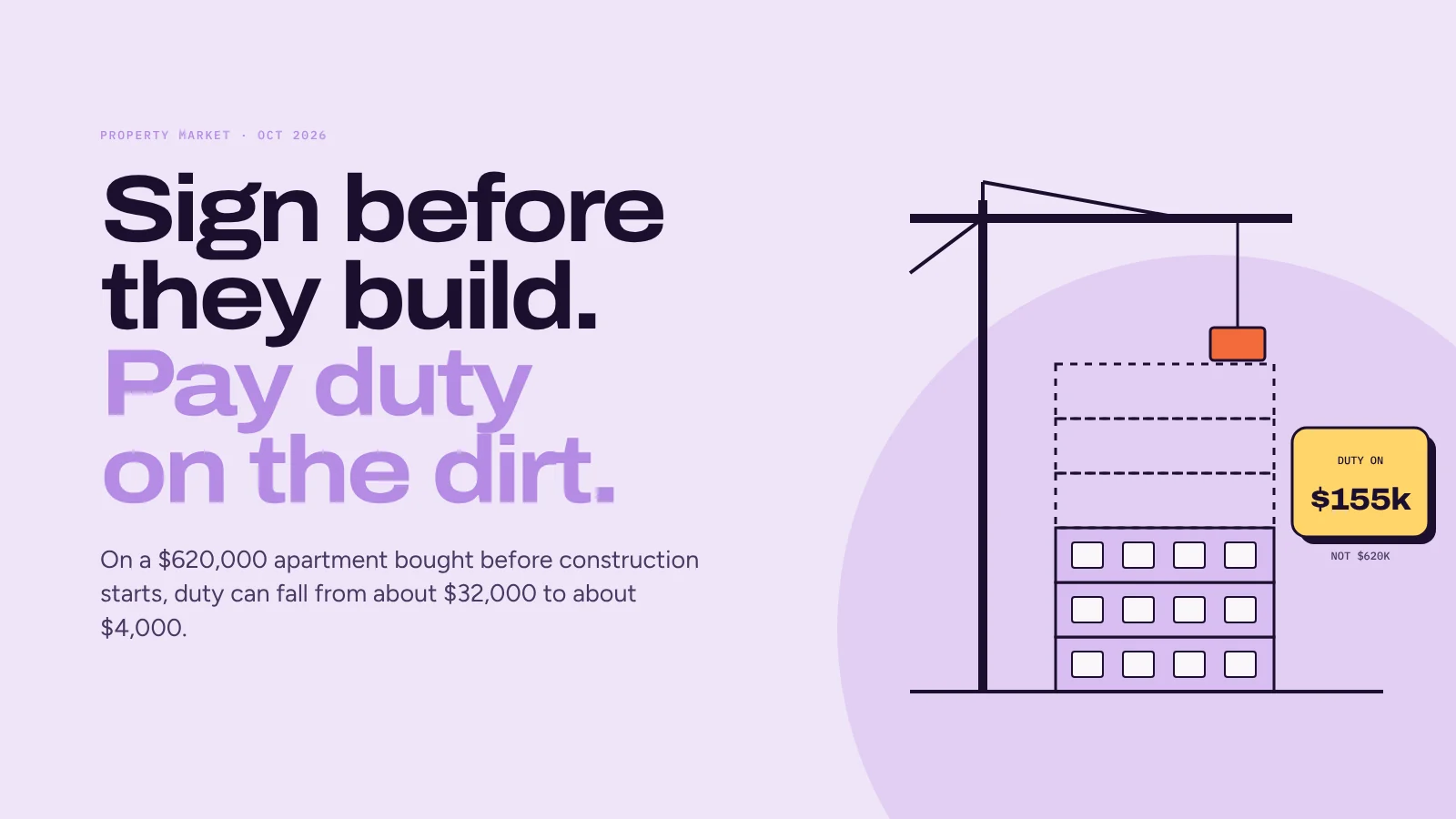
If you sign a contract for an off-the-plan apartment, unit or townhouse in Victoria before 21 April 2027, stamp duty is worked out on the price minus the construction costs still to come. Anyone can claim it, investors included, with no price cap. Buy before building starts and the duty on a $620,000 apartment can fall from about $32,000 to about $4,000. The lending side needs as much planning as the duty.
Victoria's temporary off-the-plan concession was due to end on 20 October this year. The 2026–27 State Budget extended it by six months, so it now covers contracts entered into from 21 October 2024 up to and including 20 April 2027.
It's the largest stamp duty saving available to most Victorian buyers right now, and the one I see misunderstood most. Here's how it works, what it's worth, and the lending risks that come with buying something that doesn't exist yet.
What qualifies
- An apartment, unit or townhouse bought off the plan, on a lot in a strata subdivision that creates common property, such as a shared driveway, foyer or hallway.
- A contract entered into on or after 21 October 2024 and before 21 April 2027.
- Any buyer: first home buyers, owner-occupiers and investors alike. There's no value cap on this extended version.
House and land packages and other homes outside that kind of subdivision don't qualify for the extended concession. First home buyers and owner-occupiers can still use the older off-the-plan concession on those, which has value caps of $750,000 and $550,000 respectively.
How the saving is worked out
Normally, duty is calculated on the full contract price. Under the concession, you deduct 100% of the construction and refurbishment costs still to be carried out after the contract date. What's left, broadly the land and any work already done, is the dutiable value.
So the earlier you sign, the bigger the saving. Here's an example on a $620,000 apartment where the land and common-property share is $155,000 and the building is $465,000. These are example figures; the developer's figures and the SRO's assessment decide the real numbers.
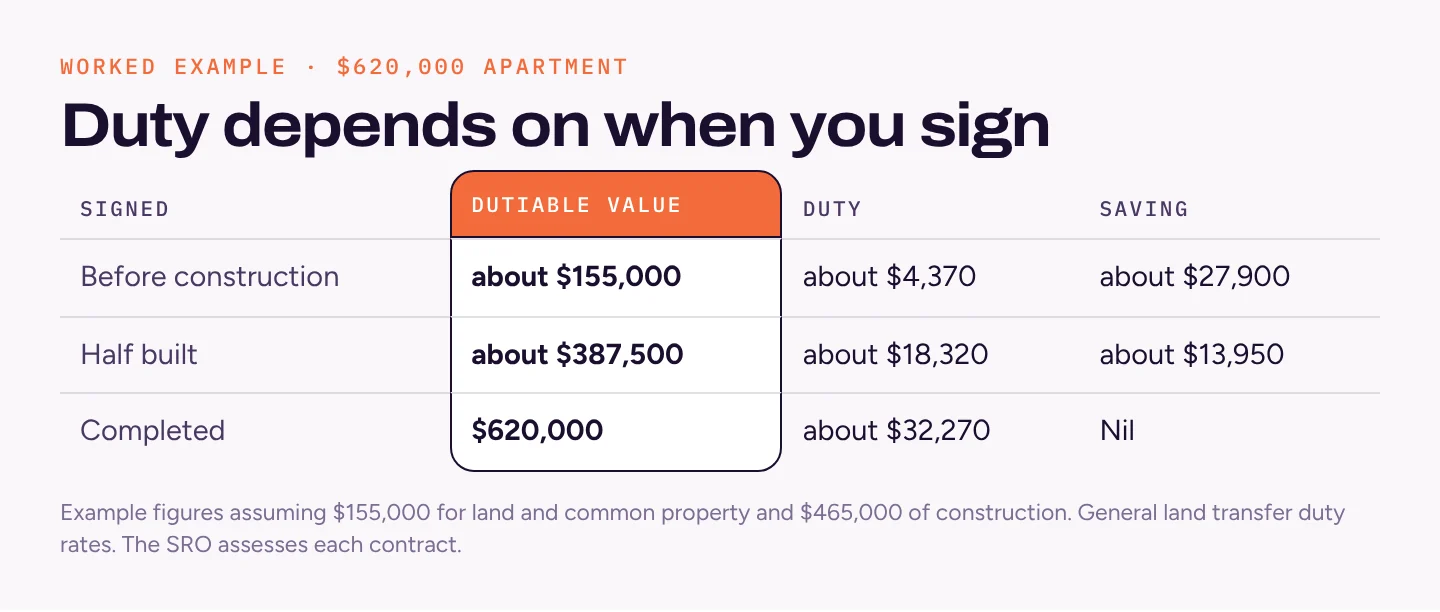
At general rates, as an investor would pay, and signed before construction starts, the dutiable value is about $155,000 and the duty about $4,370, a saving of roughly $27,900 against full duty of $32,270. Signed when the building is half done, the duty is about $18,320. Signed after completion, there's no concession at all.
For a first home buyer, there's a second benefit. Victoria's first home buyer exemption and concession thresholds are applied to the dutiable value after the deduction, so an apartment priced above $600,000 may still fall within the full exemption. Confirm how it applies to your contract with your conveyancer or the State Revenue Office before you rely on it.
The lending risks of buying off the plan
The duty saving is real. So are these, and they're where off-the-plan purchases go wrong.
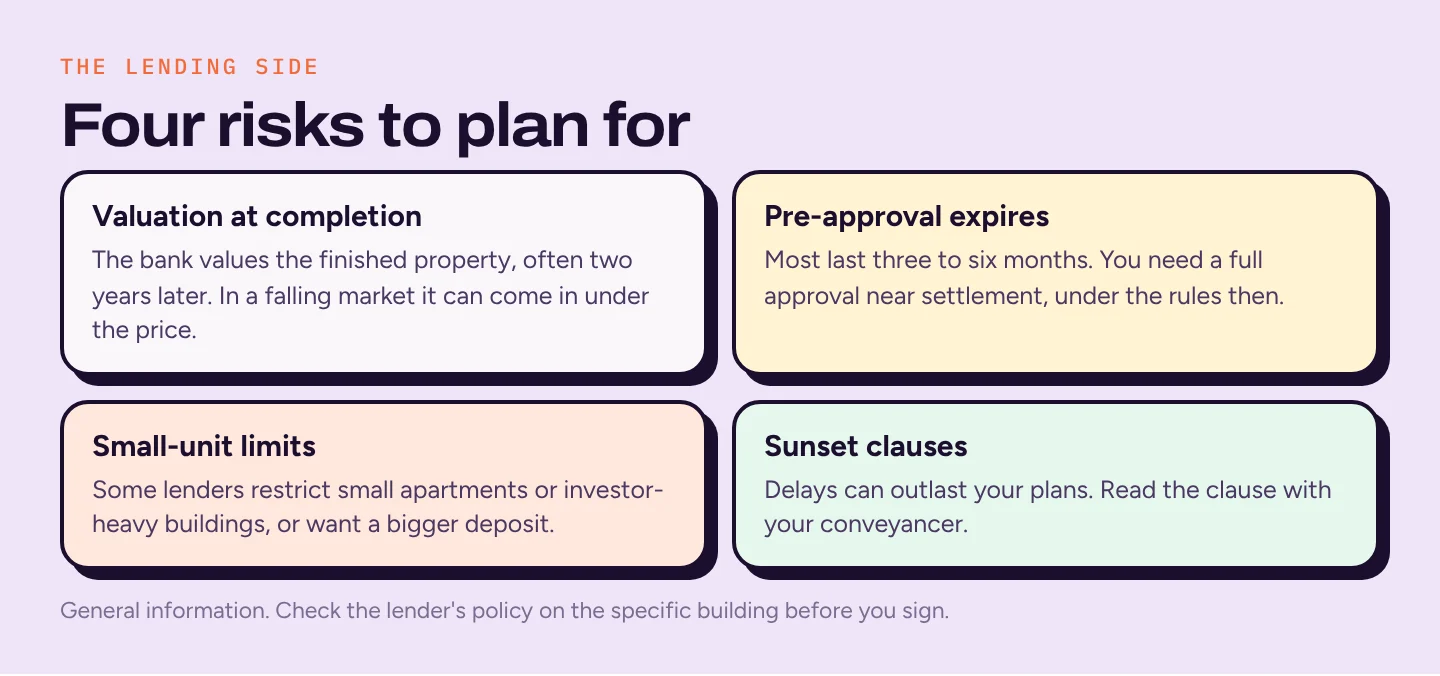
- The valuation at settlement. You sign today, but the lender values the property when it's finished, often 18 months to three years later. If prices have fallen, the valuation can come in below the contract price and you fund the gap. I covered how that works in buying your first home while prices fall.
- Pre-approval expires. Most pre-approvals last three to six months. You'll need a full, fresh approval near completion, under the rates and rules at that time.
- Lender limits on small apartments. Some lenders restrict lending on units under a certain size, or in buildings with a high concentration of investors, or require a bigger deposit.
- Sunset clauses and delays. If the project runs late, your circumstances can change before settlement. Read the sunset clause with your conveyancer.
None of these is a reason to avoid off the plan. They're reasons to buy with a buffer, check the lender's policy on the specific building before you sign, and keep your borrowing well inside your limit.
Who it suits
A first home buyer who wants a new apartment and can wait for it. An investor buying a new build, which also keeps negative gearing under the May Budget changes. A downsizer moving from a house into a townhouse. For each, the concession can save tens of thousands, and the deadline is fixed.
If you're weighing it up against an established home, the market context is in investors are leaving and Melbourne prices are falling.
Questions people ask
When does the Victorian off-the-plan concession end?
It covers contracts entered into before 21 April 2027. Contracts signed on or after that date don't qualify unless it's extended again.
Can investors use it?
Yes. The extended concession is available to any buyer of an eligible off-the-plan apartment, unit or townhouse, with no value cap.
Does it apply to house and land packages?
Not the extended version. First home buyers and owner-occupiers may still use the older concession on those, within its value caps.
Where to start
The stamp duty calculator shows full duty on any price. Our first home buyer page and investment loans page cover how lenders treat new apartments. If you're looking at a development, book a free 30-minute chat before you pay the deposit, and bring the contract.
Sources
- Building Legislation and Treasury Legislation (Tax Relief) Amendment Act 2026 (Vic), Royal Assent 23 June 2026
- Victorian Government: cutting costs of buying off the plan
- State Revenue Office: strata apartments and townhouses temporary concession
- King & Wood Mallesons: 2026–27 state budgets, stamp duty
- State Revenue Office: land transfer duty current rates
Last reviewed 26 October 2026. This is general information only and isn't legal or tax advice. It doesn't take your objectives, financial situation or needs into account. Duty figures are examples; the SRO assesses each contract.
Want this applied to your numbers?
Articles are general information. A 30-minute chat with Suvidh and the team turns it into a plan for your situation: borrowing power, structure and the lender that fits.
Book a free chatRun the calculatorsWritten by the Cinch Loans team · Reviewed by Suvidh Arora, Chief solutions officer · About us
Keep reading
More from Cinch Insights.
Plain-English articles on home loans, refinancing, rates and the property market, written for Australian borrowers rather than for lenders.
Property market
October 26, 2026
Victorian off-the-plan stamp duty concession 2026–27: savings, eligibility, deadline | Cinch Loans
Sign for an off-the-plan apartment, unit or townhouse before 21 April 2027 and duty is worked out on the price minus construction still to come. Any buyer, no price cap. The saving, the rules and the lending risks.