Rates & economy
The 2026 rate rises, added up: what they have cost so far, and what a full year looks like
On the average new Victorian loan, the four 2026 rises add about $432 a month: about $3,100 paid by December and $5,200 over the next twelve months. More than a 3.2% pay rise adds to a $150,000 household before tax.
26 October 2026
6 min read
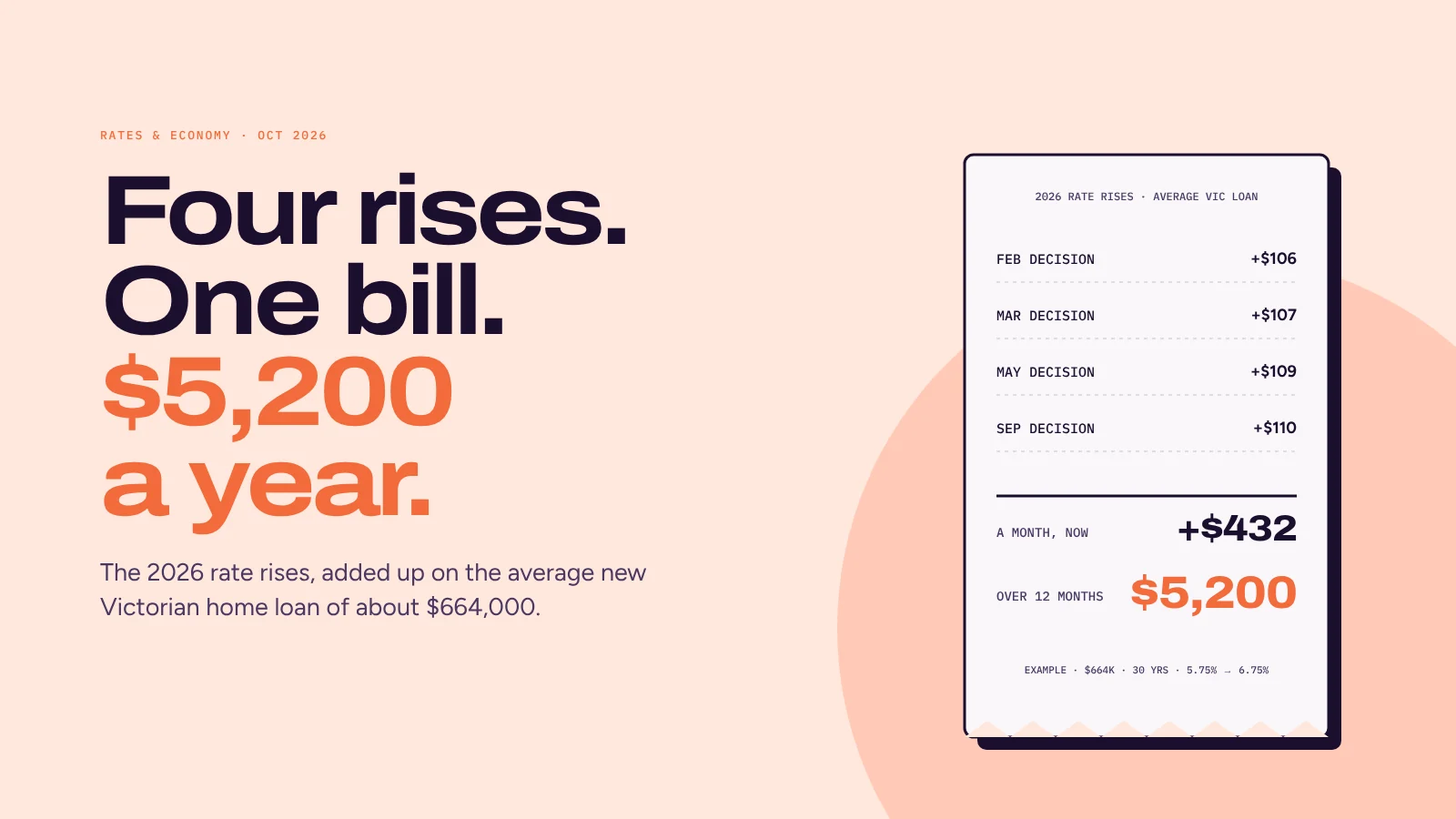
On the average new Victorian home loan of about $664,000, the four 2026 rate rises add about $432 a month, roughly $100 a week. By December that's about $3,100 paid this year that wouldn't have been, and about $5,200 over the next twelve months if rates stay put. That's more than a 3.2% pay rise adds to a $150,000 household income before tax.
Most coverage of rate rises gives you the monthly figure. The monthly figure is useful, and I've used it in the November preview. But nobody budgets one month at a time, and four rises in one year are easier to understand as dollars actually paid.
So here's the 2026 cycle added up: what it's cost so far, what a full year looks like, and what a fifth rise on 3 November would add.
How the year played out
The cash rate went from 3.60% to 4.60% in four steps: February, March, May and September. Lenders passed each one on in full, usually from the following month. So a borrower on a typical variable rate saw their repayment rise in March, April, June and October.
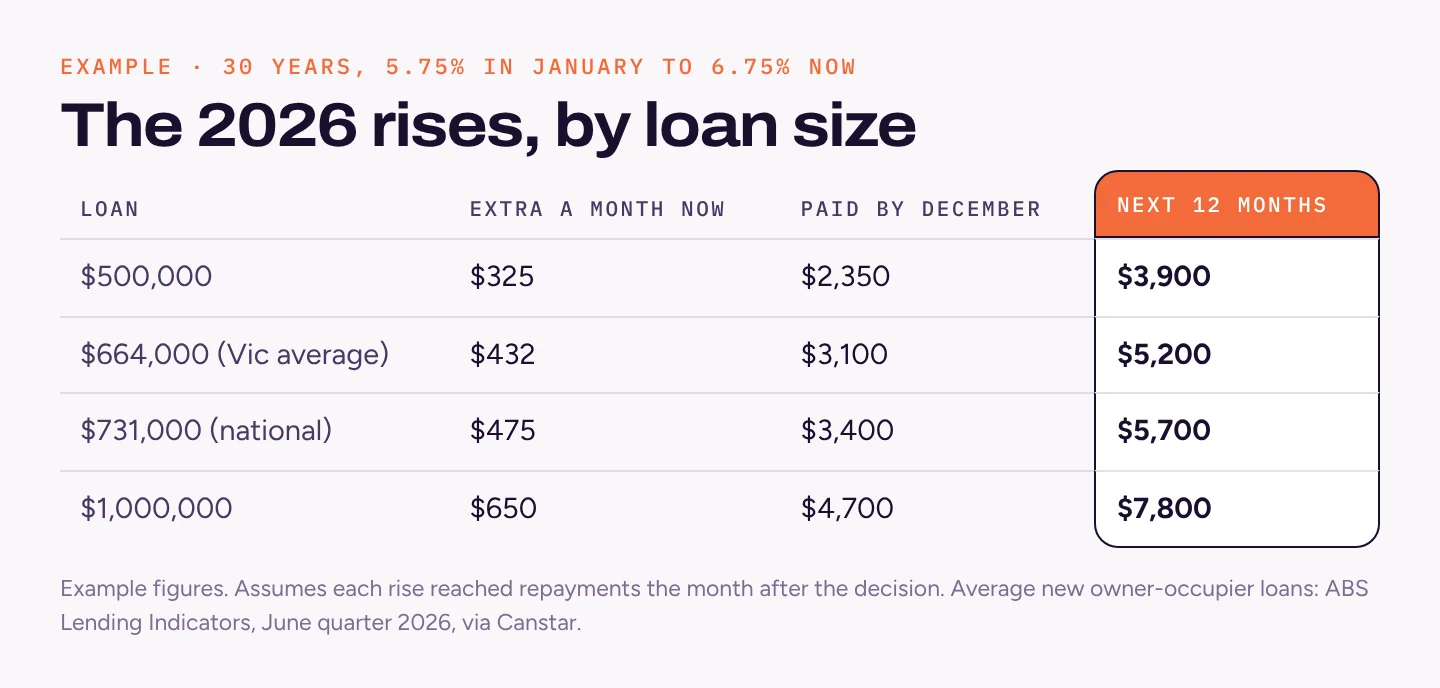
For the examples below, I've assumed a 30-year principal-and-interest loan that started the year at 5.75% and is now at 6.75%, with each rise hitting the repayment the month after the decision. Your own rate and timing will differ, but the shape won't.
The numbers, by loan size
- $500,000: about $325 a month more now, about $2,350 extra paid by December, about $3,900 over the next twelve months.
- $664,000, the average new Victorian owner-occupier loan in the June quarter: about $432 a month, $3,100 by December, $5,200 over a year.
- $731,000, the national average: about $475 a month, $3,400 by December, $5,700 over a year.
- $1,000,000: about $650 a month, $4,700 by December, $7,800 over a year.
The year-to-date figures look smaller than you'd expect because the rises arrived in stages. The September rise has only been in repayments since October. The twelve-month figure is the one to plan around.
Against what's come in
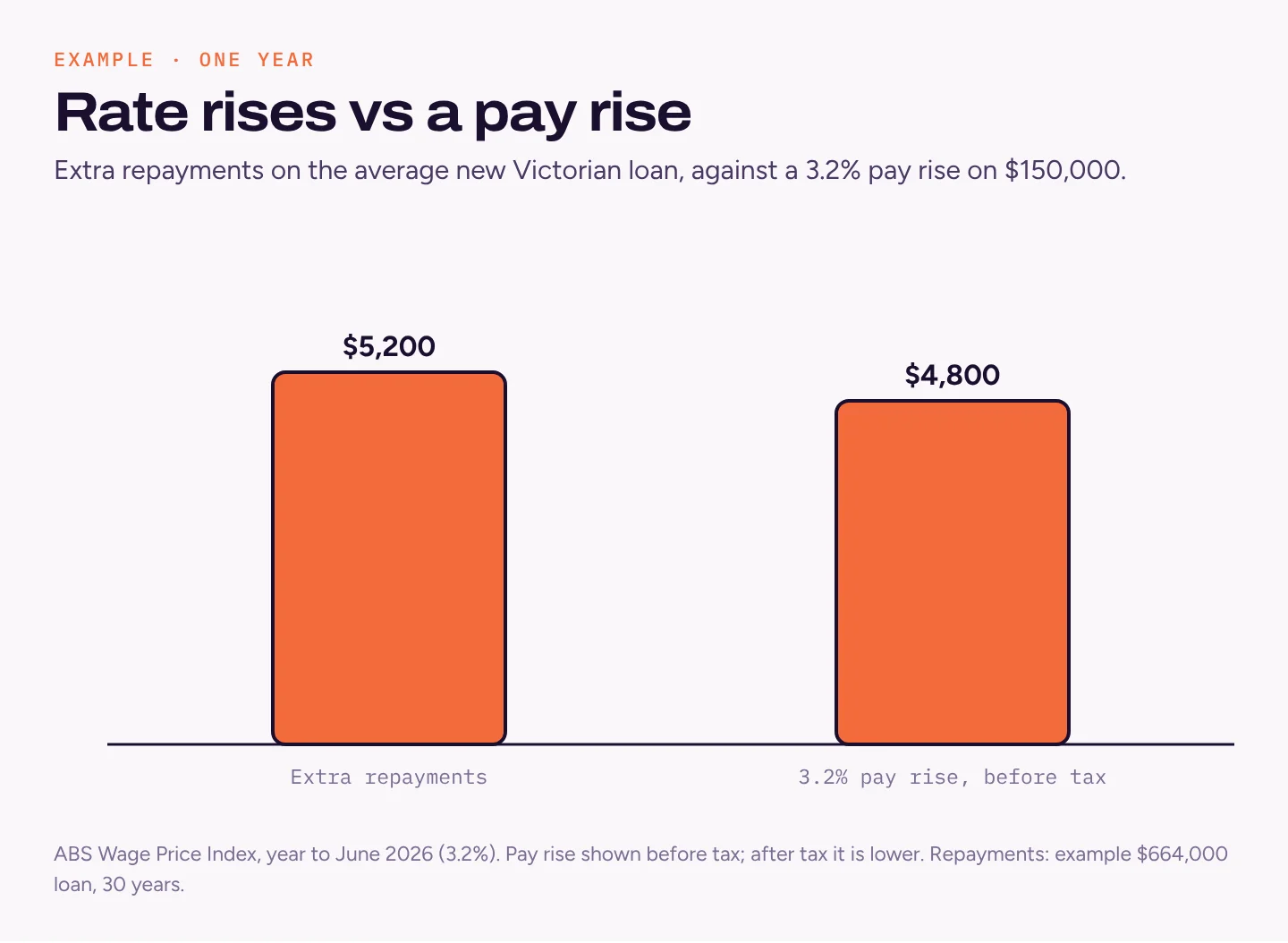
Wages grew 3.2% in the year to June, on the ABS Wage Price Index. On a household income of $150,000, that's about $4,800 a year before tax. After tax it's noticeably less.
Put that next to the $5,200 a year the rises add to the average Victorian loan, and the arithmetic is plain: for a typical new borrower, the 2026 rate rises have taken more than the year's pay rise, before groceries, power and fuel have had their go. That's the squeeze people describe, in one line.
Where the money goes
Early in a loan, most of each repayment is interest. On the average Victorian loan at 6.75%, about $3,735 of the first month's $4,307 repayment is interest, close to 87%. At 5.75% in January it was about 82%. So the rises have also slowed how fast the debt comes down, which is why an offset balance or a small extra repayment does more work in a high-rate year than a low one.
If there's a fifth rise
The September quarter inflation figures land on Wednesday. If the RBA lifts again on 3 November, a quarter point adds roughly $16 to $17 a month for every $100,000 owed: about $111 a month on the average Victorian loan, or $1,330 a year. I explained why energy prices are driving the decision in why a tanker in the Strait of Hormuz is setting your mortgage rate.
What actually reduces the bill
You can't change the cash rate. These are the things that move your number, roughly in order of effort:
- Ring your lender's retention team. Lenders often price new customers sharper than existing ones, and a call costs nothing. The method is in stay or switch.
- Move savings into an offset. Every dollar there saves interest at the loan rate. Offset, redraw or extra repayments covers where it should sit.
- Refinance, if the gap after the retention call is still big and you can pass a new lender's test.
- Fix part of the loan, if the budget can't take another rise and you'd rather pay for certainty.
If you're already finding repayments hard, talk to your lender early. Lenders have hardship processes, and asking early keeps the options open.
Questions people ask
How much have 2026 rate rises added to a $600,000 loan?
About $390 a month on a 30-year principal-and-interest loan, if all four rises were passed on in full.
Why does the yearly figure matter more than the monthly one?
Because it's what you plan a budget around. $432 a month sounds manageable. $5,200 a year is a number every household budget notices.
Will rates come down in 2027?
Nobody knows. Some of the major banks now forecast another rise rather than a cut. Plan for rates staying where they are, and test your budget against one more rise.
Where to start
The loan repayment calculator shows your own figure, and the refinance calculator shows what a lower rate would save after costs. If you'd like your loan checked against the market, book a free 30-minute chat.
Sources
- RBA: monetary policy decision, 29 September 2026
- Canstar: average new loan sizes, ABS Lending Indicators June quarter 2026
- ABS: annual wage growth of 3.2%, June quarter 2026
- Canstar: back to 2011, how to manage another hike
Last reviewed 26 October 2026, before the 28 October CPI release and the RBA's 3 November decision. This is general information only. It doesn't take your objectives, financial situation or needs into account. All repayment figures are examples.
Want this applied to your numbers?
Articles are general information. A 30-minute chat with Suvidh and the team turns it into a plan for your situation: borrowing power, structure and the lender that fits.
Book a free chatRun the calculatorsWritten by the Cinch Loans team · Reviewed by Suvidh Arora, Chief solutions officer · About us
Keep reading
More from Cinch Insights.
Plain-English articles on home loans, refinancing, rates and the property market, written for Australian borrowers rather than for lenders.
Rates & economy
October 26, 2026
What the 2026 RBA rate rises cost: dollars per year by loan size | Cinch Loans
On the average new Victorian loan, the four 2026 rises add about $432 a month: about $3,100 paid by December and $5,200 over the next twelve months. More than a 3.2% pay rise adds to a $150,000 household before tax.