
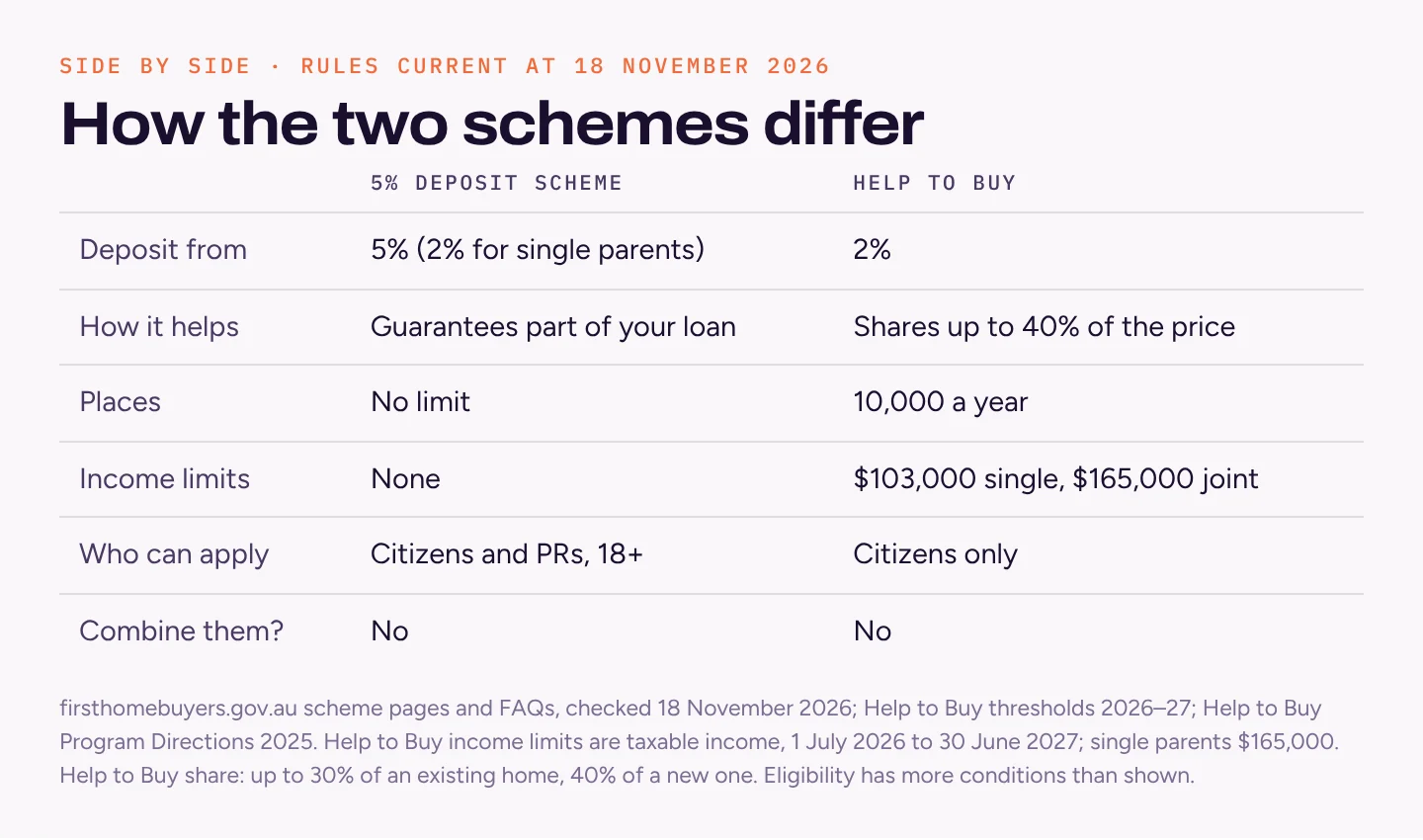
The 5% Deposit Scheme lets eligible first home buyers buy with a 5% deposit, with the government guaranteeing part of the loan. Since 1 October 2025 there's no limit on places. Single parents can use the Family Home Guarantee with a deposit from 2%. Help to Buy is a separate scheme with income limits and 10,000 places a year, and you can't use both on the same purchase. Check the price cap for where you're buying before you start looking.
If you're planning to buy your first home next year, two government schemes keep coming up: the 5% Deposit Scheme and Help to Buy. They sound alike, and the question we hear most is whether you can use both. You can't. Here's how each one works, what the price caps are where you're looking, and what to weigh up.
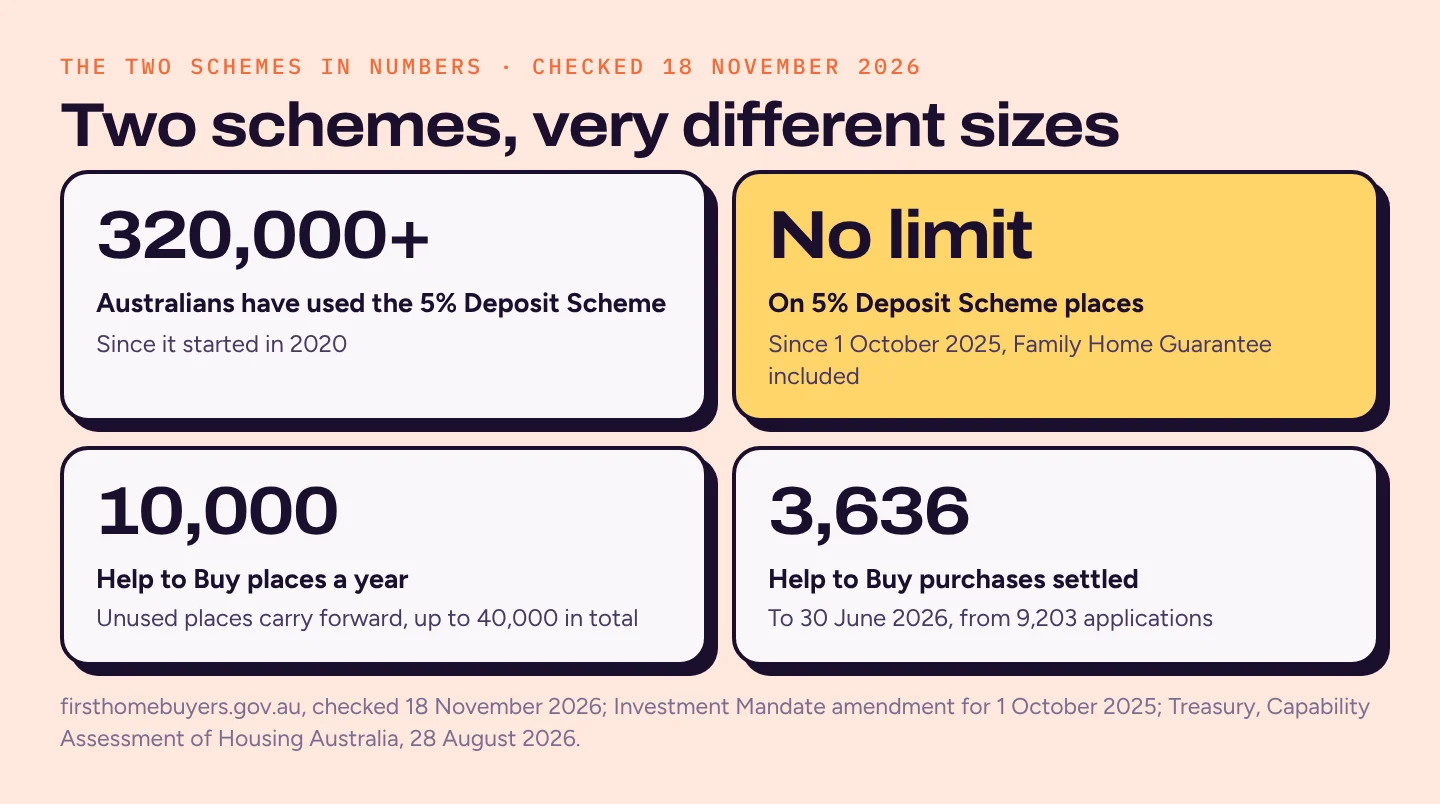
More than 320,000 Australians have used the 5% Deposit Scheme since it started in 2020 (firsthomebuyers.gov.au, checked 18 November 2026). It's no longer a niche option.
The 5% Deposit Scheme in one minute
Housing Australia issues the guarantees for the Australian Government. Under the scheme, the government guarantees part of your home loan, so an eligible first home buyer can buy with a deposit from 5%. Since 1 October 2025 there's no lenders mortgage insurance on a loan under the scheme. That holds while you keep meeting the scheme's conditions, including living in the home. If you don't, your lender may ask you to pay lenders mortgage insurance.
On 1 October 2025 the government removed the limit on the number of guarantees. There's no waiting for a place to open up. There are no income caps. You need to be an Australian citizen or permanent resident aged 18 or over, and a first home buyer or someone who hasn't owned property or land in Australia in the last 10 years. The home has to be one you'll live in: you must move in within six months of settlement and keep living there while the guarantee is in place. You can apply alone or with one other person, and the lender's own credit rules still apply.
For full eligibility, see the government's scheme pages on firsthomebuyers.gov.au.
Single parents: the Family Home Guarantee
The Family Home Guarantee is part of the same scheme, for single parents and single legal guardians of one or more dependent children. The deposit starts from 2%.
The limit on places was removed for the Family Home Guarantee from 1 October 2025 too. The official single parents page describes it as unlimited spots with no waiting list.
One detail catches people out. If you're separated but not divorced, you don't count as single for this guarantee.
Property price caps, state by state
The home you buy has to come in under the price cap for its area. Capital cities and some regional centres have a higher cap than the rest of the state.
Property price caps, current as at 1 July 2026 (checked 18 November 2026)
| State or territory | Capital city and regional centres | Rest of state |
|---|---|---|
| New South Wales | $1,500,000 | $800,000 |
| Victoria | $950,000 | $650,000 |
| Queensland | $1,000,000 | $700,000 |
| Western Australia | $850,000 | $600,000 |
| South Australia | $900,000 | $500,000 |
| Tasmania | $700,000 | $550,000 |
| Australian Capital Territory | $1,000,000 | n/a |
| Northern Territory | $750,000 (Darwin) | $600,000 |
| Jervis Bay Territory and Norfolk Island | $550,000 | n/a |
| Christmas Island and Cocos (Keeling) Islands | $400,000 | n/a |
Regional centres on the higher cap:
- New South Wales: Central Coast, Coffs Harbour–Grafton, Illawarra, Mid North Coast, Richmond–Tweed, and Newcastle and Lake Macquarie.
- Victoria: Geelong.
- Queensland: Gold Coast and Sunshine Coast.
What changed on 1 July 2026: the Northern Territory cap was split, with Darwin at $750,000 and the rest of the territory at $600,000, and four more New South Wales areas joined the regional centres. Caps have changed before and will again, so check the official price caps page before you make an offer.
Help to Buy: a different scheme
Help to Buy is a shared equity scheme, which works differently from a deposit guarantee. You need a deposit of at least 2%. The government contributes up to 30% of the price of an existing home, or up to 40% of a new one. You own the home, but the government shares in any rise or fall in its value. You can buy back its share over time, in part or in full, or repay it when you sell, always at the home's value at the time. Help to Buy is open to Australian citizens only.
What the official sources do confirm:
- Places: 10,000 a year. Unused places carry forward, up to 40,000 in total.
- Income limits (taxable income, 1 July 2026 to 30 June 2027): $103,000 for a single applicant, $165,000 for joint applicants, and $165,000 for a single parent. They're indexed each 1 July.
- Lenders: you apply through a participating lender. The government publishes the current list and says the panel will be reviewed and updated gradually.
Uptake so far: to 30 June 2026 there were 9,203 applications, 4,808 approved and 3,636 settled (Treasury, August 2026).
Can you use both? No
To be eligible for Help to Buy, you can't also be getting a home buyer guarantee from the Commonwealth, another shared equity scheme, or a state or territory loan or guarantee. The 5% Deposit Scheme guarantees are Commonwealth home buyer guarantees, so it's one or the other for the same purchase. This isn't only a test when you apply. It stays a condition while you're in Help to Buy.
First home owner grants aren't caught by this rule.
So the real question is which one suits you. That depends on your income, your deposit, where you're buying and how you feel about the government holding a share of your home.
What to have ready before you look
- Look up the price cap for every suburb you're considering, not just the city.
- If you're thinking about Help to Buy, check your taxable income against this year's limits.
- Have your savings history and the source of your deposit in order.
- Budget for stamp duty and buying costs. Your state or territory revenue office lists any first home buyer concessions.
- Get your finance lined up before you sign a contract.
Questions people ask
Is there still a waiting list for the 5% Deposit Scheme?
No. The limit on places was removed from 1 October 2025 for first home buyers and for the Family Home Guarantee.
Can I use the 5% Deposit Scheme and a first home owner grant?
The rule that stops you combining Help to Buy with a guarantee doesn't catch first home owner grants. Check your state or territory's own grant rules too.
Can a broker help with Help to Buy?
The government's FAQ says a broker can guide you through the process and liaise with a participating lender for you. Applications are made with a participating lender.
Where to start
Work out what you could borrow with our borrowing power calculator, then check it against the price cap where you want to buy. When you're ready, talk it through with a broker from our team. Bring your income details and a rough idea of your savings.
Sources
- Federal Register of Legislation: Investment Mandate Amendment (2026 Measures No. 2) Direction 2026, registered 12 May 2026, in force 1 July 2026 and its explanatory statement
- Federal Register of Legislation: Investment Mandate amendment for 1 October 2025, made 25 August 2025 and its explanatory statement
- Federal Register of Legislation: Help to Buy Program Directions 2025, registered 13 June 2025
- firsthomebuyers.gov.au: Property price caps, checked 18 November 2026
- firsthomebuyers.gov.au: Single parents, checked 18 November 2026
- firsthomebuyers.gov.au: Help to Buy thresholds 2026–27 and Customer Guide, 1 July 2026
- firsthomebuyers.gov.au: Help to Buy FAQs, checked 18 November 2026
- firsthomebuyers.gov.au: 5% Deposit Scheme, checked 18 November 2026
- firsthomebuyers.gov.au: First home buyers, checked 18 November 2026
- firsthomebuyers.gov.au: 5% Deposit Scheme FAQs, checked 18 November 2026
- firsthomebuyers.gov.au: Help to Buy, checked 18 November 2026
- Treasury: Homes for Australia, A National Plan, June 2026
- Treasury: Capability Assessment of Housing Australia, 28 August 2026
Last reviewed 18 November 2026. Price caps current as at 1 July 2026. General information only. It doesn't take into account your objectives, financial situation or needs. Cinch Loans is a trading name of Additude Financial Services Pty Ltd (ABN 87 629 633 423), a credit representative authorised under Australian Credit Licence 389087 held by Australian Finance Group Ltd.
Want this applied to your numbers?
Articles are general information. A 30-minute chat with Suvidh and the team turns it into a plan for your situation: borrowing power, structure and the lender that fits.
Talk to a brokerRun the calculatorsWritten by the Cinch Loans team · Reviewed by Suvidh Arora, Chief solutions officer · About us
Keep reading
More from Cinch Insights.
Plain-English articles on home loans, refinancing, rates and the property market, written for Australian borrowers rather than for lenders.
First home buyers
November 18, 2026
5% Deposit Scheme and Help to Buy: what first home buyers need to know | Cinch Loans
Price caps for every state, the Family Home Guarantee for single parents, Help to Buy income limits, and why you can't use both schemes on the same purchase.