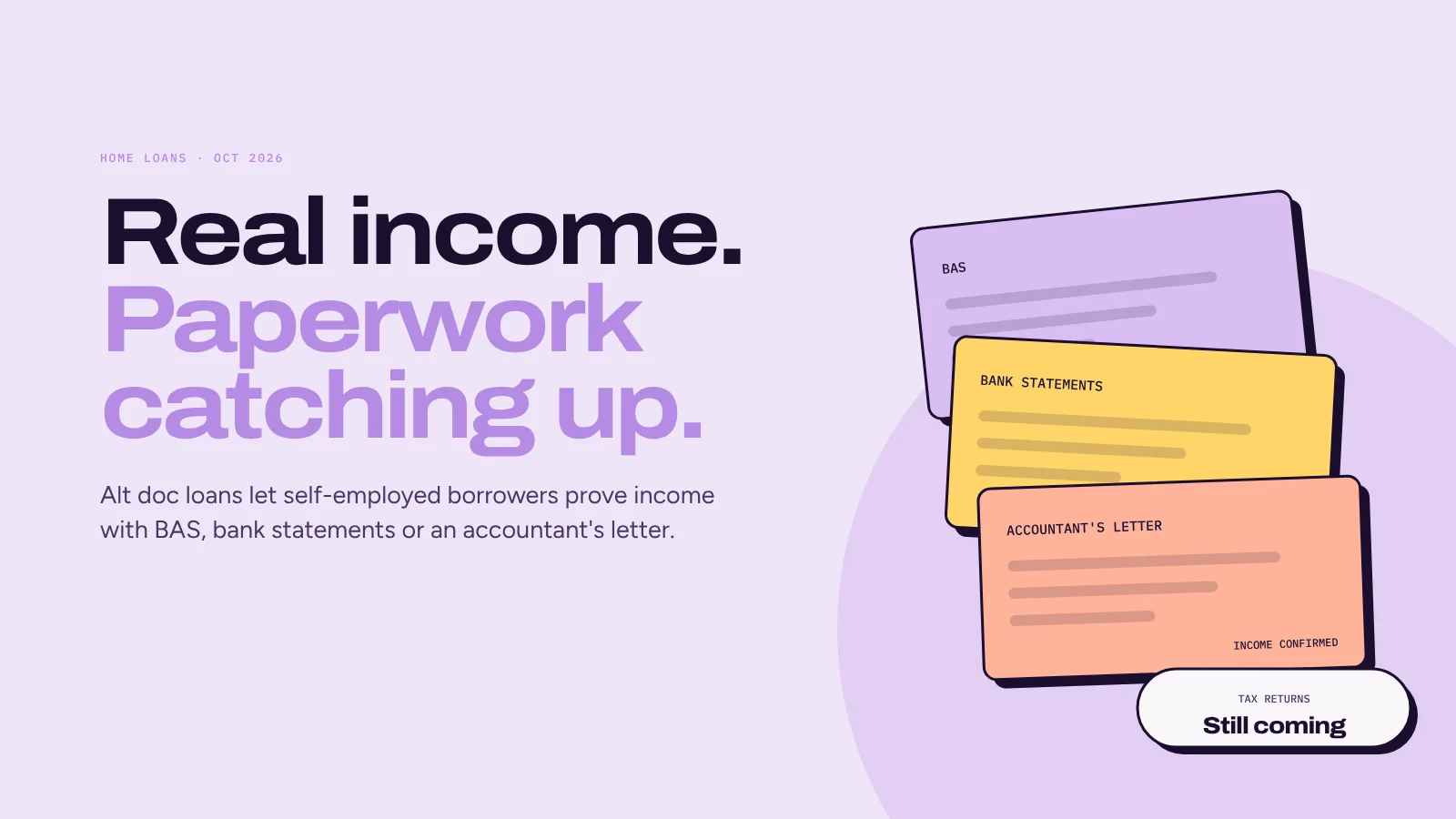
Alt doc (or low doc) home loans let self-employed borrowers prove income with a signed declaration backed by BAS, business bank statements or an accountant's letter, instead of two years of tax returns. Lenders often want an ABN held for 6 to 18 months, many cap the loan at 80% of the property's value, and pricing is usually higher. The responsible lending checks still apply.
Your business is 14 months old. Work is steady, the BAS goes in every quarter, and your first tax return is still sitting with your accountant.
Then a bank tells you to come back with two years of returns.
Alt doc loans are built for self-employed borrowers whose income is real but whose paperwork hasn't caught up yet. They also come with trade-offs, and they don't let anyone skip the income checks.
Low doc, alt doc: what's the difference?
Mostly the name. ASIC's Moneysmart describes a low doc loan as one that needs less financial documentation to prove income, assets and liabilities than a standard loan. It's typically used by self-employed people and small business owners.
Most lenders now call it alt doc, short for alternative documentation. The name fits better: you still prove your income, just with different documents.
In practice, you sign an income declaration and back it up with at least one document the lender accepts.
What counts as alt doc?
Across our lender panel, the common options look like this. Each lender sets its own mix.
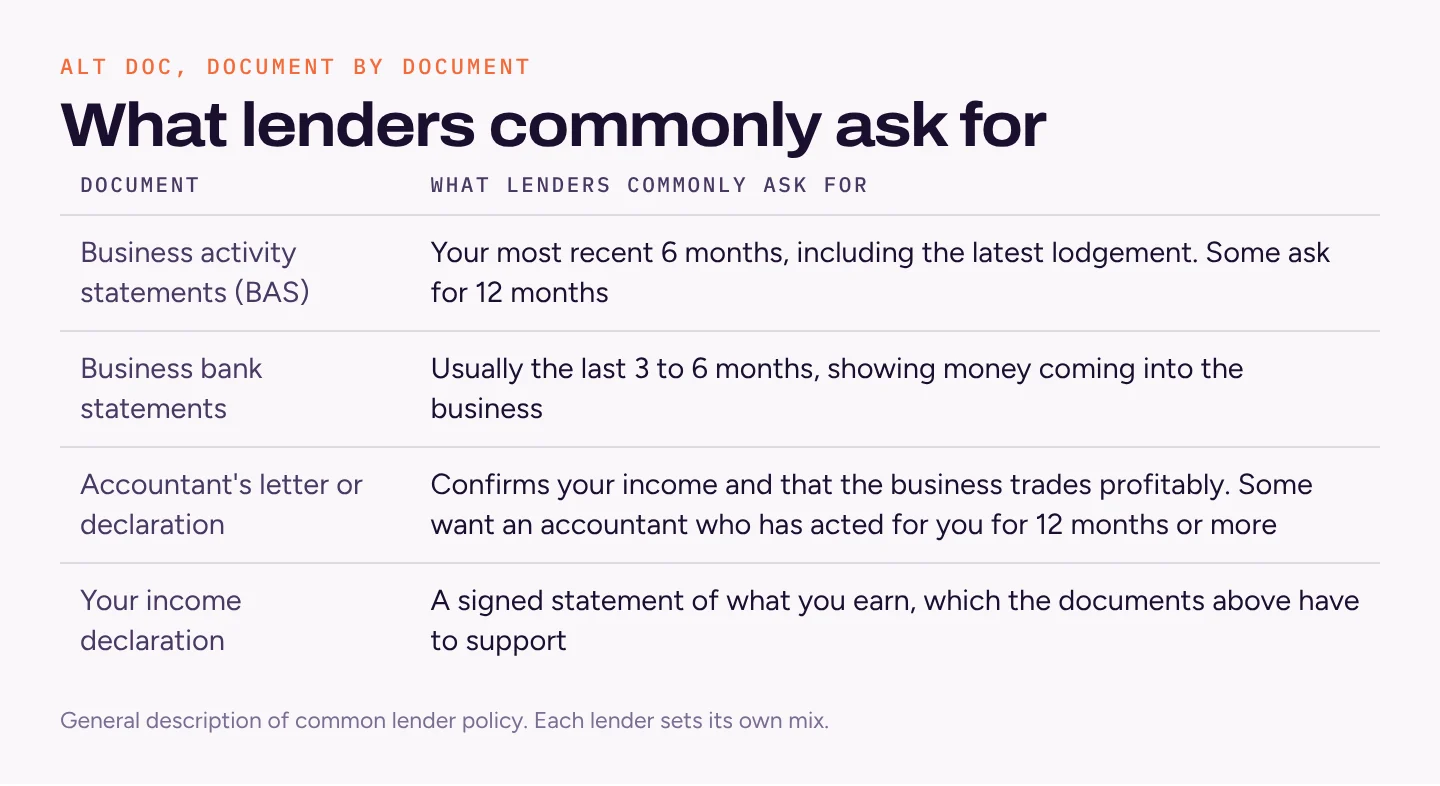
A BAS is the form GST-registered businesses use to report GST and PAYG to the ATO. If your GST turnover is under $20 million, you'll usually lodge quarterly.
How long do you need an ABN and GST registration?
This is where lenders differ the most. In the policies we work with, minimum ABN periods for alt doc run from about 6 months to 18 months. Twelve months is common.
GST registration matters too. The ATO requires you to register once your GST turnover reaches $75,000. Lenders often want GST registration in place for 6 to 12 months where your turnover is above that level.
Search your ABN on ABN Lookup before you apply. It shows the date your ABN became active and the date your GST registration started. Lenders check it, so know those dates first.
How much can you borrow on alt doc?
The loan-to-value ratio (LVR) is your loan as a percentage of the property's value. Many specialist lenders cap alt doc at 80%. Some go to 85% for a purchase, and a few go higher for strong applications, usually with a risk fee or lenders mortgage insurance (LMI) above 80%.
LMI is usually a one-off cost, and it protects the lender, not you.
Example: $750,000 purchase, alt doc, deposit needed before stamp duty and costs.
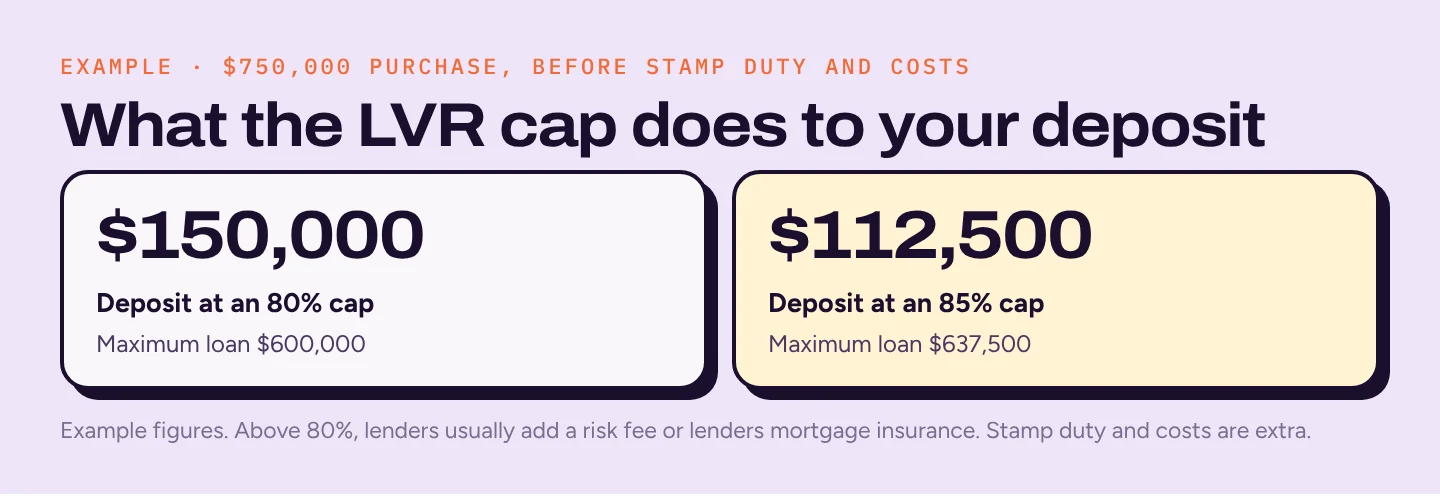
That $37,500 gap is often the deciding factor. Add stamp duty on top with our stamp duty calculator.
Moneysmart also notes that low doc loans usually come at higher interest rates and may include terms that restrict borrowers. That's the price of the flexibility.
Responsible lending still applies
Alt doc changes the documents. It doesn't change the law.
Under the National Credit Act, lenders and brokers must make reasonable inquiries about your requirements, objectives and financial situation. They must take reasonable steps to verify that information. Then they must assess whether the loan is unsuitable, which includes whether you'd only be able to repay it with substantial hardship.
ASIC's Regulatory Guide 209 is clear that it's not enough to simply rely on a borrower providing true information. It even gives an example of a small business owner seeking a home loan, where the lender looks at business bank account balances, written advice from the accountant and BAS to estimate likely income.
So your declared income has to make sense next to your other documents.
Example: you declare $160,000 a year. Your last two quarterly BAS show $70,000 of sales over six months. That's about $140,000 a year in sales, which is less than your declared income before a single business cost comes out. Expect questions, or a decline.
Brokers also have a best interests duty under the same Act (ASIC Regulatory Guide 273), so we have to show why a loan suits you.
How does full doc with one year of financials compare?
Full doc means tax returns and Notices of Assessment from the ATO. Many lenders want two years in business and two years of returns. If your two years are uneven, many will average them, or use the lower year if your latest one has dropped.
Some lenders will assess you on one year of returns plus the Notice of Assessment. That path is usually only open at or below 80% LVR.
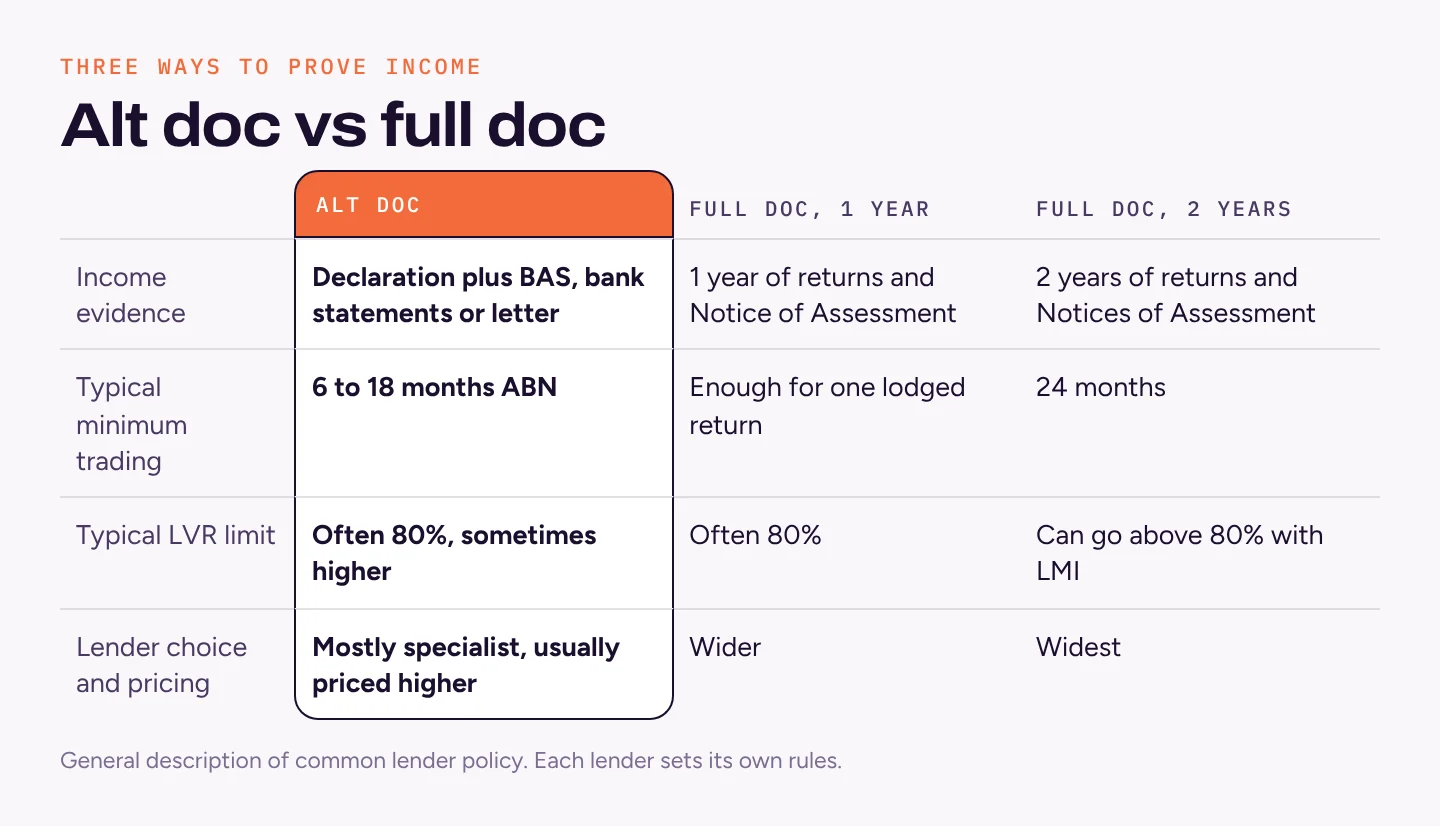
Timing decides it. If your first return is only a few months away, waiting for it may open up more lenders. If you need to buy now, alt doc can get you in, and refinancing to full doc later is an option once you have returns lodged, provided you pass a fresh credit assessment at that point.
When to lodge, and how your accountant presents your profit, are tax questions. Talk those through with your accountant or tax adviser. Our post on 4 tips for self-employed home loan applications explains why it pays to tell your accountant early that a loan is coming.
What to prepare before you apply
- Your ABN Lookup record, showing ABN and GST start dates
- Your last 6 to 12 months of lodged BAS
- 3 to 6 months of business bank statements, plus your personal accounts
- An accountant's letter confirming your income, if your lender takes that route
- Your latest tax return and Notice of Assessment, if you have one
- Details of business debts such as equipment or vehicle finance
- ID, deposit statements and details of any other loans or credit cards
Get the documents to agree before anyone applies. It's easier to explain a quiet quarter upfront than after a lender has spotted it.
Questions people ask
Is low doc the same as alt doc?
Mostly, yes. Alt doc is the name most lenders use now, because you still prove your income, just with different documents.
Can I get an alt doc loan with an ABN under 12 months old?
Some lenders start at about 6 months of ABN history and others want 18. Twelve months is common. Check your ABN and GST start dates on ABN Lookup before you apply.
Can I move to a full doc loan later?
Often, yes. Once your tax returns are lodged, refinancing to full doc is an option, provided you pass a fresh credit assessment at that point.
Not sure which path fits your business?
The right path depends on how long you've traded, what you've lodged and how much deposit you have. Our home loans page covers how we compare options across our lender panel, and our borrowing power calculator gives you a starting number.
If you need to settle before any of these can approve you, private lending can bridge a short gap. It costs more and needs a clear exit, so it's for the short term only.
Talk it through with a broker from our team
Sources
- Moneysmart: low doc loan
- Moneysmart: lenders mortgage insurance
- ASIC: Regulatory Guide 209, responsible lending conduct
- ASIC: Regulatory Guide 273, mortgage brokers' best interests duty
- ATO: registering for GST
- ATO: business activity statements
Last reviewed 29 October 2026. This is general information only and isn't tax advice. Speak to your accountant about your own situation. It doesn't take your objectives, financial situation or needs into account. All figures are examples. Cinch Loans is a trading name of Additude Financial Services Pty Ltd (ABN 87 629 633 423), a credit representative (credit representative number 512780) authorised under Australian Credit Licence 389087 held by Australian Finance Group Ltd.
Want this applied to your numbers?
Articles are general information. A 30-minute chat with Suvidh and the team turns it into a plan for your situation: borrowing power, structure and the lender that fits.
Talk to a brokerRun the calculatorsWritten by the Cinch Loans team · Reviewed by Suvidh Arora, Chief solutions officer · About us
Keep reading
More from Cinch Insights.
Plain-English articles on home loans, refinancing, rates and the property market, written for Australian borrowers rather than for lenders.
Home loans
October 29, 2026
Low doc and alt doc home loans for self-employed borrowers (2026) | Cinch Loans
No two years of tax returns yet? Alt doc loans let self-employed borrowers prove income another way. What lenders accept, what they cap and what to prepare.