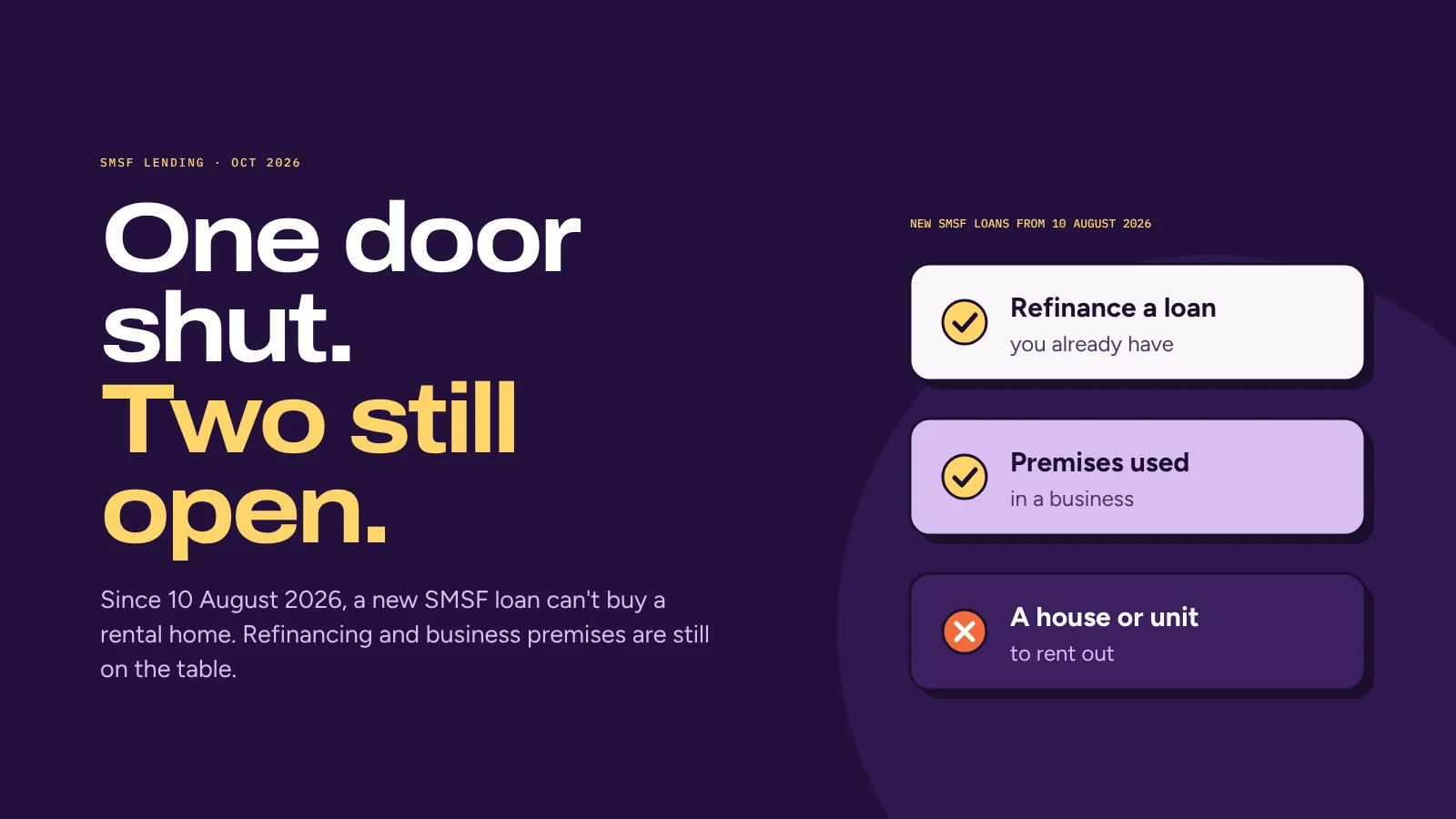
From 10 August 2026, a new SMSF loan can only buy business real property. Loans already in place, refinances of them and contracts exchanged before that date carry on as they were. A fund can still buy a home to rent out with its own money. It just can't borrow for it.
Say your super fund already has a loan on a rental unit, and the fixed rate ends next year. Or your business rents its warehouse, and you've wondered whether your fund could buy it.
Both are still possible after 10 August 2026. What's gone is a new loan for a house or apartment to rent out.
This post covers the lending side: what a fund can still borrow for and what lenders look at. Whether your fund should borrow, or buy property at all, is a decision for a licensed SMSF adviser and your accountant. We're mortgage brokers. We arrange the loan once that decision's made.
What changed on 10 August 2026?
When a self-managed super fund (SMSF) borrows to buy property, it uses a limited recourse borrowing arrangement, or LRBA. The property sits in a separate holding trust, and the lender can only claim that property, not the fund's other assets.
The Treasury Laws Amendment (Tax Reform No. 1) Act 2026 received Royal Assent on 26 June 2026. From 10 August 2026, a new LRBA can only be used to buy real property if it's business real property.
The ATO is clear that LRBAs aren't banned and nothing else about how they work has changed. A fund can also still buy residential property with its own money. It just can't borrow for it under a new LRBA.
What's still possible, and what isn't
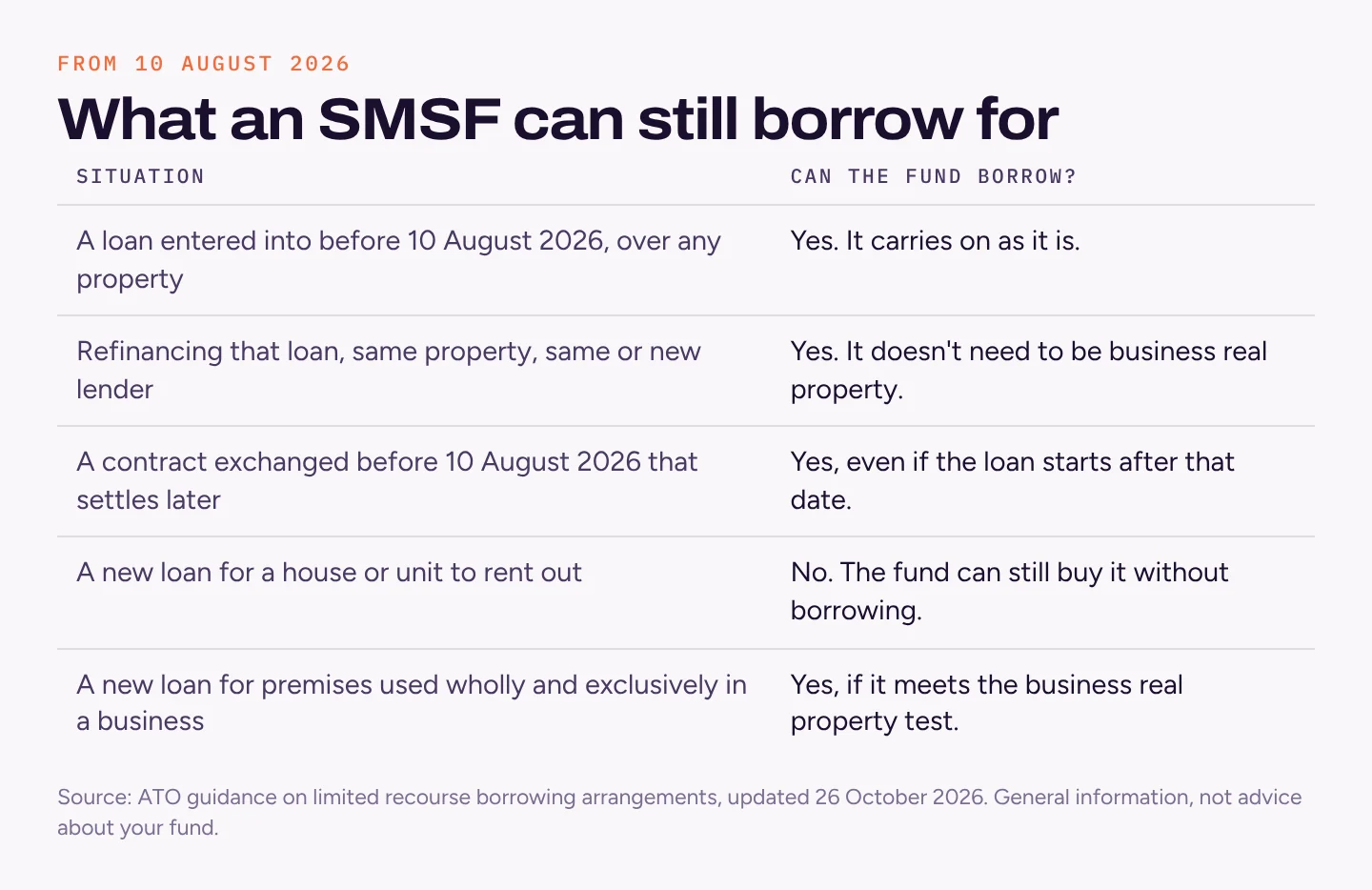
There's a catch on the contract row. The MFAA points out that setting up a fund, lodging a finance application or getting an approval in principle doesn't necessarily count. It's the exchanged contract that matters, and the ATO warns that a significant change to it later can create a new arrangement.
Refinancing an existing SMSF loan
A fund with a loan from before 10 August 2026 can keep it and refinance it. The ATO treats a refinance as a new loan contract for the same asset, with the same lender or a new one. A residential property held under that older loan doesn't have to be business real property.
A refinance isn't a way to pull equity out, though. Under the ATO's guidance, each drawdown on a loan facility counts as a separate borrowing. Extra borrowing can generally be used to maintain or repair the property, but borrowed money can't be used to improve it.
Lender appetite is the other question. The MFAA notes that lender policies on refinancing existing residential SMSF loans may differ, so the fund isn't necessarily stuck with the lender it started with. If a fixed rate is ending, the planning is much like a home loan: here's what happens when you roll off a fixed rate.
Before the fund refinances, ask your adviser or accountant to confirm it's a straight refinance of the same asset. A change big enough to count as a new arrangement would fall under the new rules.
Commercial property used in a business
The ATO describes business real property as land and buildings used wholly and exclusively in a business. The business doesn't have to be yours.
A few points from the ATO and the MFAA matter for lending:
- Zoning isn't enough. Commercial zoning alone doesn't make a property eligible. It's the use that counts.
- It has to stay that way. The property must be business real property when the LRBA starts and for the whole life of the loan. If it stops qualifying, the fund has breached the borrowing rules, and later business use doesn't undo that.
- A vacancy isn't fatal. Premises don't stop qualifying just because the owner is looking for a new tenant. They do if the owner gives up on leasing them.
- New premises need a running business. Where business use can't start straight away, the fund must be able to show the business has started when the LRBA is entered into.
- Mixed use needs care. A mixed-use property doesn't automatically qualify. Farms have a specific rule for a home on 2 hectares or less, where the main use of the whole property isn't domestic or private.
- One loan, one asset. A single LRBA can't buy several property titles unless the collection is treated as a single asset, and that must now be business real property too.
A common question is whether a business owner's fund can buy the premises the business already uses. The ATO's rules have exceptions that can allow a fund to buy business real property from a related party at market value and lease it back. Whether that suits your fund, including the tax and estate planning side, is for your adviser and accountant.
What lenders look for on an SMSF loan
Policies vary across our lender panel. On a commercial SMSF loan, lenders usually look at:
- The deposit. Because the lender can only claim the one property, it generally lends a smaller share of the price than on a personal loan.
- Cash left in the fund. Most want a buffer after settlement for repayments, costs and any pensions.
- How the loan gets repaid. Usually rent from the property plus regular contributions to the fund, tested with a buffer.
- The lease and the tenant. Especially when the tenant is the members' own business.
- The paperwork. A trust deed that allows borrowing, an investment strategy that fits, and a properly set up holding trust.
- Guarantees. Some lenders ask members for personal guarantees, which the ATO allows.
A quick worked example
Example: $900,000 warehouse, lender lends 70% of the price, stamp duty and costs not included.
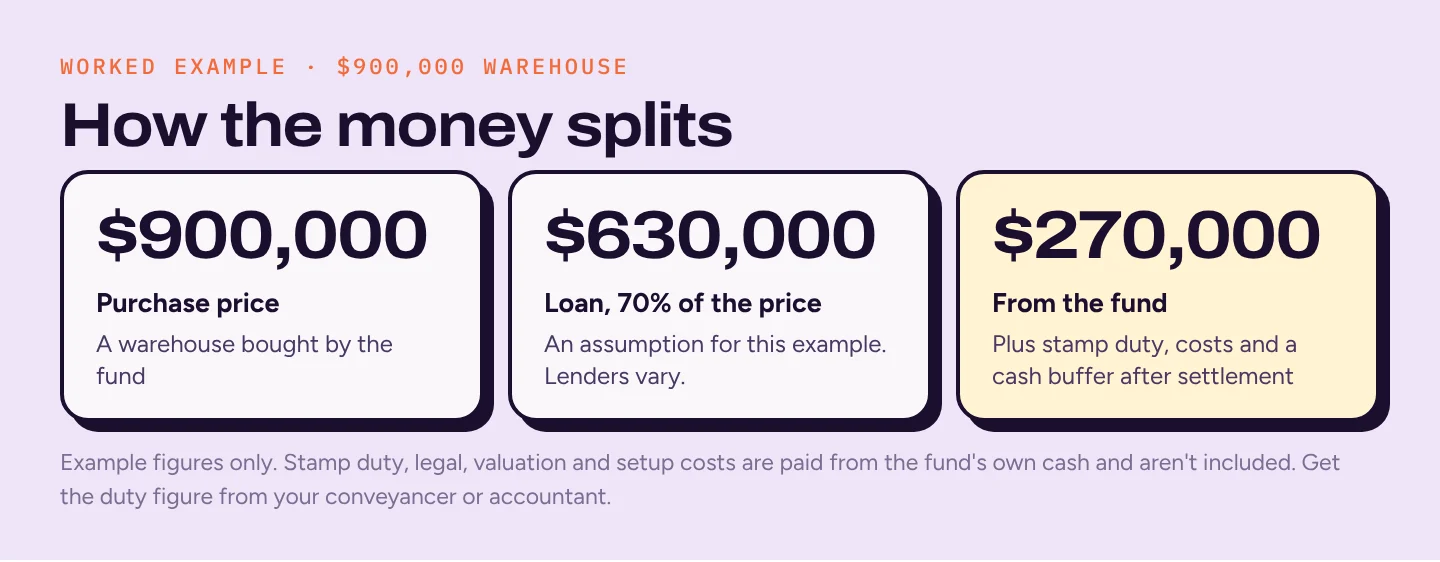
The 70% is an assumption for this example only, and lenders vary. Get the stamp duty figure from your conveyancer or accountant before the fund commits.
There's a trade-off either way. A bigger loan leaves more cash in the fund, but the repayments still fall due if the tenant leaves and the rent stops. A smaller loan means lower repayments, but more of the fund's cash is tied up in one building. You can test the repayment side with our loan repayment calculator.
Questions people ask
Can my SMSF still buy a residential investment property?
Yes, with its own money. From 10 August 2026 it can't borrow for one under a new limited recourse borrowing arrangement.
Can my fund refinance the loan it already has?
Yes. A loan from before 10 August 2026 can be refinanced with the same lender or a new one, and a residential property under that loan doesn't need to be business real property. A refinance can't be used to pull equity out.
Can my fund buy my business's premises?
The ATO's rules have exceptions that can allow a fund to buy business real property from a related party at market value and lease it back. Whether that suits your fund is a question for your SMSF adviser and accountant.
Get the order right before the fund signs
Get advice on whether the fund should buy first. Then talk to us before the fund exchanges contracts, so the finance and holding trust are ready for settlement.
Here's how we arrange SMSF loans. If it's the business itself borrowing for its premises, see our commercial finance page. Buying in your own name instead? See our post on younger property investors.
Talk it through with a broker from our team. Book a time
Sources
- ATO: changes to LRBAs for property from 10 August
- ATO: changes to limited recourse borrowing arrangements
- ATO: limited recourse borrowing arrangement provisions
- Federal Register of Legislation: Treasury Laws Amendment (Tax Reform No. 1) Act 2026
- MFAA: SMSF residential property borrowing ban now in effect, 11 August 2026
Last reviewed 29 October 2026. This is general information only and isn't financial or tax advice. Speak to a licensed SMSF adviser and your accountant about your fund. Cinch Loans is a trading name of Additude Financial Services Pty Ltd (ABN 87 629 633 423), a credit representative (credit representative number 512780) authorised under Australian Credit Licence 389087 held by Australian Finance Group Ltd.
Want this applied to your numbers?
Articles are general information. A 30-minute chat with Suvidh and the team turns it into a plan for your situation: borrowing power, structure and the lender that fits.
Talk to a brokerRun the calculatorsWritten by the Cinch Loans team · Reviewed by Suvidh Arora, Chief solutions officer · About us
Keep reading
More from Cinch Insights.
Plain-English articles on home loans, refinancing, rates and the property market, written for Australian borrowers rather than for lenders.
Business & asset finance
October 29, 2026
SMSF property loans after August 2026: what is still possible | Cinch Loans
The August 2026 change closed one door for SMSF borrowing. Existing loans, refinances and business premises are still open. Here's how the lending side works now.