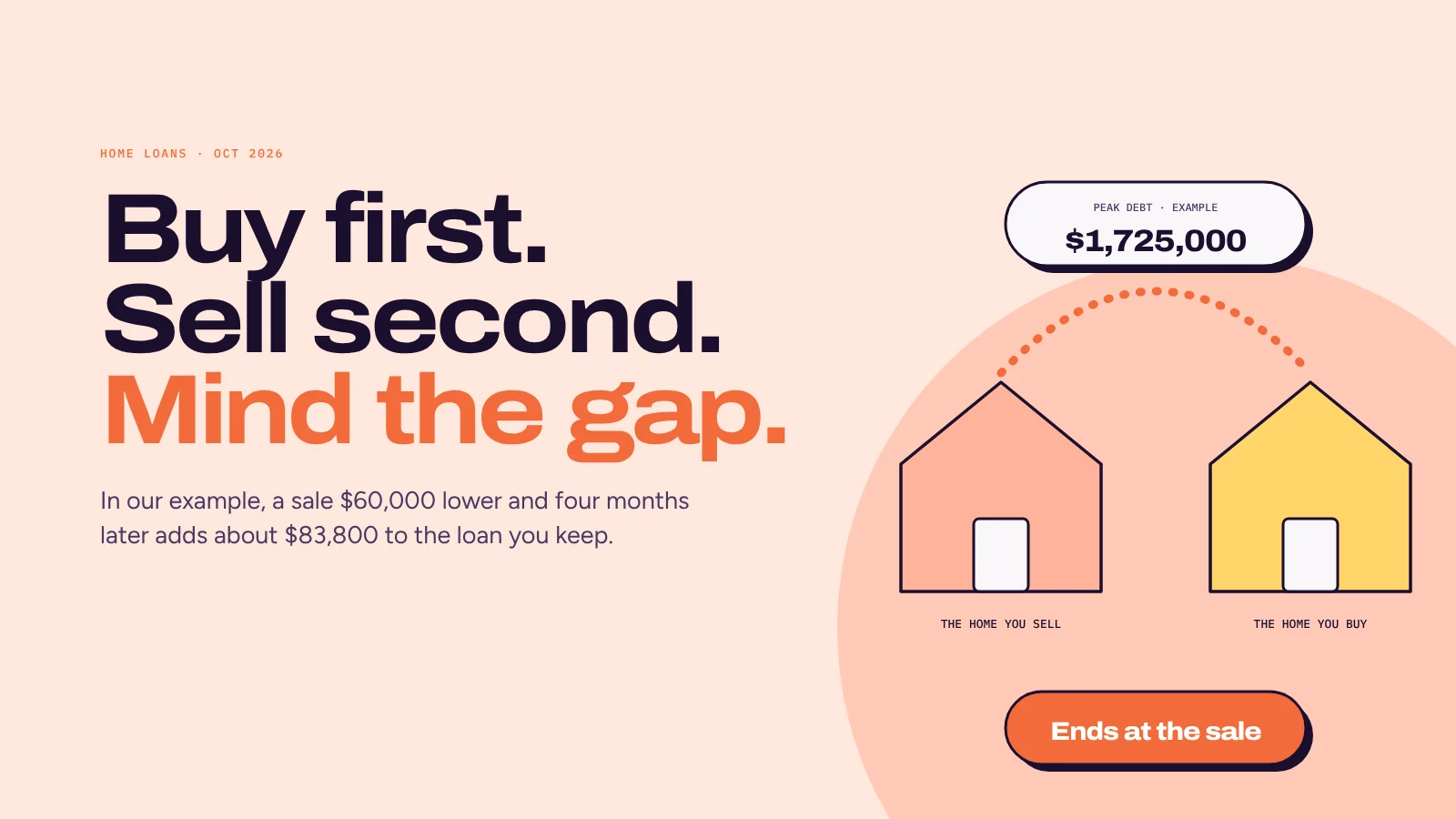
A bridging loan lets you buy your next home before the old one sells. The lender lends against both homes, often adds the interest to the balance, and clears the bridge when your sale settles. What you keep afterwards is the end debt, and a lower or slower sale makes it bigger. Plan on what your home would sell for today.
You've found the next place. It has the extra bedroom and the yard you've been after. Your own home isn't on the market yet.
Or it is, and the last two open inspections were quiet.
That's the upgrader's problem. You can wait to sell and risk losing the house you want, or buy first and carry two properties for a while. A bridging loan is how most people do the second one, and falling prices change the maths.
What is a bridging loan?
Moneysmart describes bridging finance as short-term finance that covers the period between buying a new property and selling your existing one.
In practice the lender lends against both homes at once. Three terms come up on every bridging file:
- Peak debt is the most you'll owe while you own both homes. It's your current loan, plus the price of the new home, plus stamp duty and buying costs.
- End debt is what's left after your old home sells and the proceeds are paid in. That becomes your ordinary home loan.
- Capitalised interest means the interest on the bridging part isn't paid each month. It's added to the balance and cleared when the sale settles.
Not every lender capitalises. Some ask for interest-only repayments on the bridging part instead. Either way, you're paying for time.
How long do you get?
Bridging terms are short. In general terms, expect around 6 months when you're buying an established home and up to 12 months in some cases, such as when you're building. The terms vary across our lender panel, and so does what happens at the end.
Lenders check two things:
- Whether you can afford the end debt on your income, the same way they'd assess any home loan.
- Whether the peak debt, including the interest they expect to add over the full term, fits within a limit based on the combined value of both homes.
That second test is where people get caught. The lender values your current home at the start. If its valuer comes in under your agent's appraisal, the whole plan shrinks.
A worked example
Example: current home expected to sell for $1,000,000 with $350,000 owing; new home $1,300,000; stamp duty and buying costs $75,000; selling costs $25,000; interest on the bridging part capitalised; end debt repaid over 30 years.
- Peak debt: $350,000 + $1,300,000 + $75,000 = $1,725,000
- Planned net sale proceeds: $1,000,000 − $25,000 = $975,000
- Planned end debt before interest: $1,725,000 − $975,000 = $750,000
Now two outcomes. The interest and repayment figures use one illustrative rate for both scenarios. Your own numbers will differ.
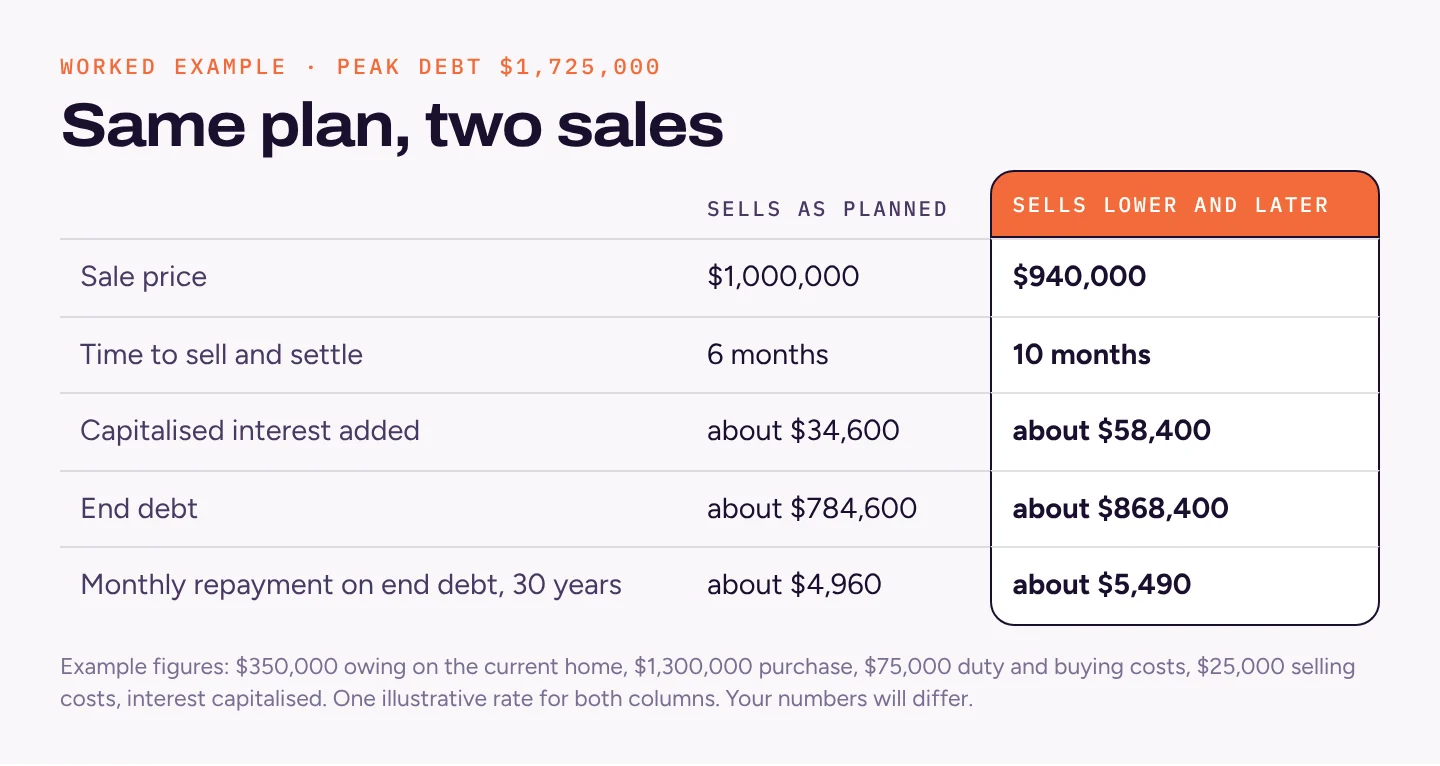
A $60,000 lower price and four extra months add about $83,800 to the loan you keep. That's roughly $530 a month, every month, for the life of the loan.
So the delay costs you twice. The price drop hurts, and the interest keeps compounding on a balance close to a million dollars while you wait.
What a falling market changes
Bridging was easier to plan when prices were rising. Melbourne dwelling values fell 6.2% in the 12 months to September 2026, according to Cotality. Across the capitals, the median time to sell was 39 days, up from 23 a year earlier.
A 6% drop on a $1,000,000 home is the $60,000 in the example above. So the "sells lower and later" column isn't a worst case. It's roughly what the last year looked like.
If your sale runs long:
- The clock keeps running. Interest keeps being added each month the old home sits unsold.
- Extensions aren't automatic. Some lenders will extend, subject to a fresh credit assessment. Others won't.
- The lender can step in. If the bridging loan isn't repaid by the end of the term, lender terms can allow a higher default rate and, in the end, the sale of the property on the lender's terms rather than yours.
The rate rises haven't helped either. The Reserve Bank lifted the cash rate four times between February and September 2026, and bridging interest moves with it.
Plan the bridge on the price your home would sell for today, not the price it would have sold for last year. If the numbers only work at last year's price, that's useful to know before you sign anything. Our post on valuation shortfalls in a falling market explains how valuers set their figure when prices are sliding.
The alternatives to bridging
A bridging loan isn't the only way to upgrade. Each option below trades one risk for another.
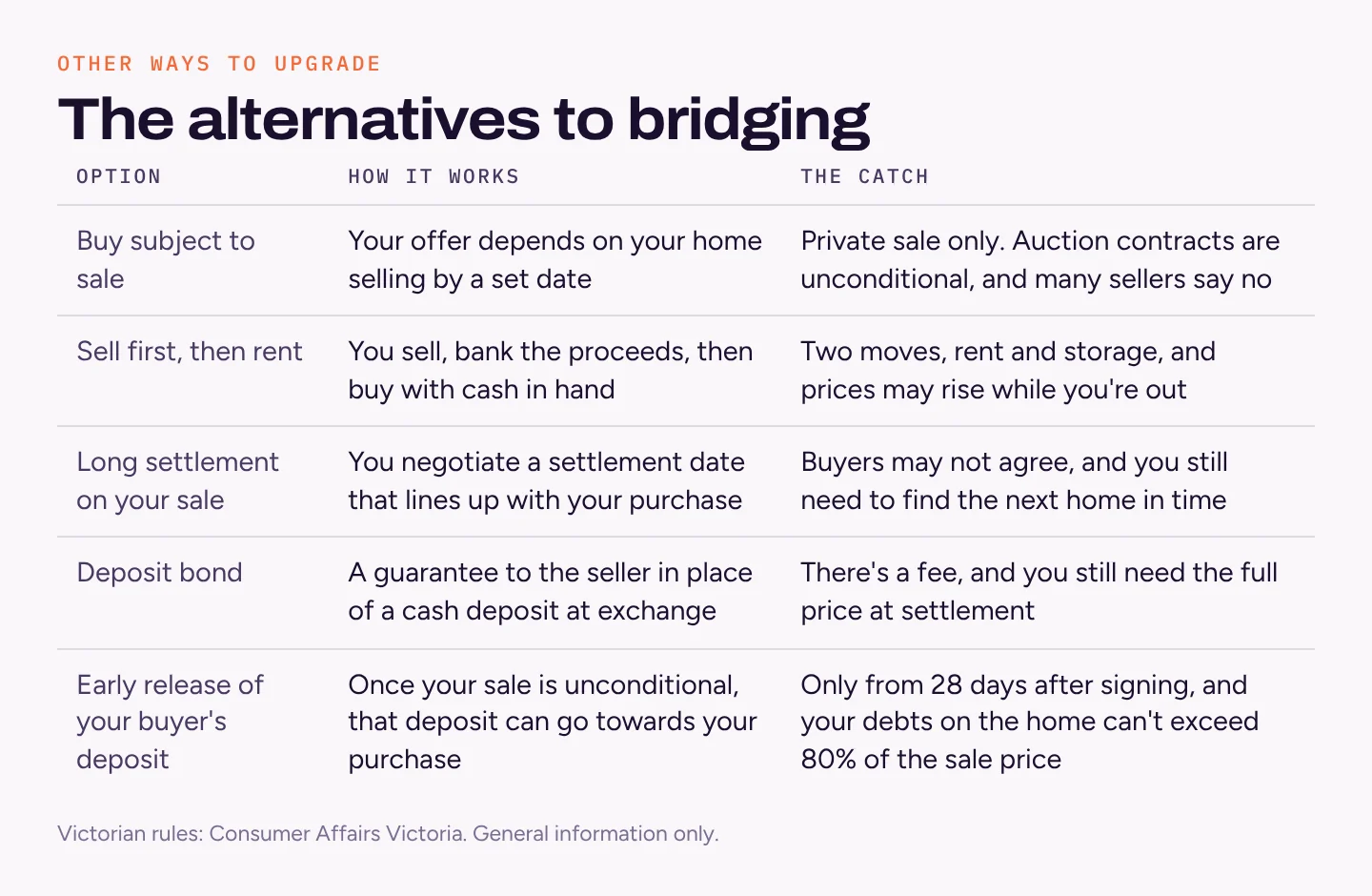
Buying subject to sale has a bit more appeal when homes take longer to sell, because more vendors will take a conditional offer rather than wait. Our post on buying subject to finance covers how conditions work in a Victorian contract.
A deposit bond solves the deposit problem only. If your old home hasn't sold by settlement, you still need the money from somewhere, which usually means bridging anyway.
Before you sign
Get these answered before you make an offer:
- What's the realistic sale price for your home today, based on recent sales in your street?
- What's the peak debt, and does it fit with the interest added for the full term?
- Can you afford the end debt if the sale comes in lower?
- What does your lender do if the term runs out?
A pre-approval that covers the bridging structure as well as the new purchase makes the offer much easier to stand behind.
Questions people ask
How long does a bridging loan last?
Around 6 months is common when you're buying an established home, and up to 12 months in some cases, such as when you're building. Terms vary by lender, and so does what happens at the end.
What's the difference between peak debt and end debt?
Peak debt is the most you owe while you own both homes. End debt is what's left once the old home sells and the proceeds are paid in. It becomes your ordinary home loan.
Do I make repayments on the bridging part?
Not always. Some lenders capitalise the interest, adding it to the balance until the sale settles. Others ask for interest-only repayments on the bridging part instead.
Work out your upgrade numbers
Start with the end debt. Our borrowing power calculator gives you a figure for the loan you'd keep after the sale. Then see how we set up purchase and bridging loans on our home loans page.
Bridging usually means one lender holds security over both homes. If your current lender doesn't offer it, or its terms don't suit, our refinancing team can compare options across our lender panel. Costs you nothing. Lenders pay us, not you.
Talk it through with a broker from our team
Sources
- Moneysmart: bridging finance
- Moneysmart: deposit bond
- Cotality: housing values down for a sixth straight month, September 2026
- RBA: cash rate target
- Consumer Affairs Victoria: buying property by private sale
- Consumer Affairs Victoria: buying property at auction
- Consumer Affairs Victoria: property deposits for sellers
Last reviewed 29 October 2026. This is general information only. It doesn't take your objectives, financial situation or needs into account. All figures are examples. Cinch Loans is a trading name of Additude Financial Services Pty Ltd (ABN 87 629 633 423), a credit representative (credit representative number 512780) authorised under Australian Credit Licence 389087 held by Australian Finance Group Ltd.
Want this applied to your numbers?
Articles are general information. A 30-minute chat with Suvidh and the team turns it into a plan for your situation: borrowing power, structure and the lender that fits.
Talk to a brokerRun the calculatorsWritten by the Cinch Loans team · Reviewed by Suvidh Arora, Chief solutions officer · About us
Keep reading
More from Cinch Insights.
Plain-English articles on home loans, refinancing, rates and the property market, written for Australian borrowers rather than for lenders.
Home loans
October 29, 2026
Bridging loans explained: buying before you sell in Melbourne | Cinch Loans
A bridging loan lets you buy your next home before the old one sells. How peak debt, end debt and capitalised interest work, and what happens if the sale comes in lower or later than planned.