Cinch news
Your broker's panel, and why it matters: what Cinch Loans working through AFG means for you
Cinch Loans works under AFG's credit licence. Existing loans don't change. Here's what an aggregator does, what it means after the 3 November rate rise, and three questions to ask any broker about their lender panel.
9 November 2026
5 min read
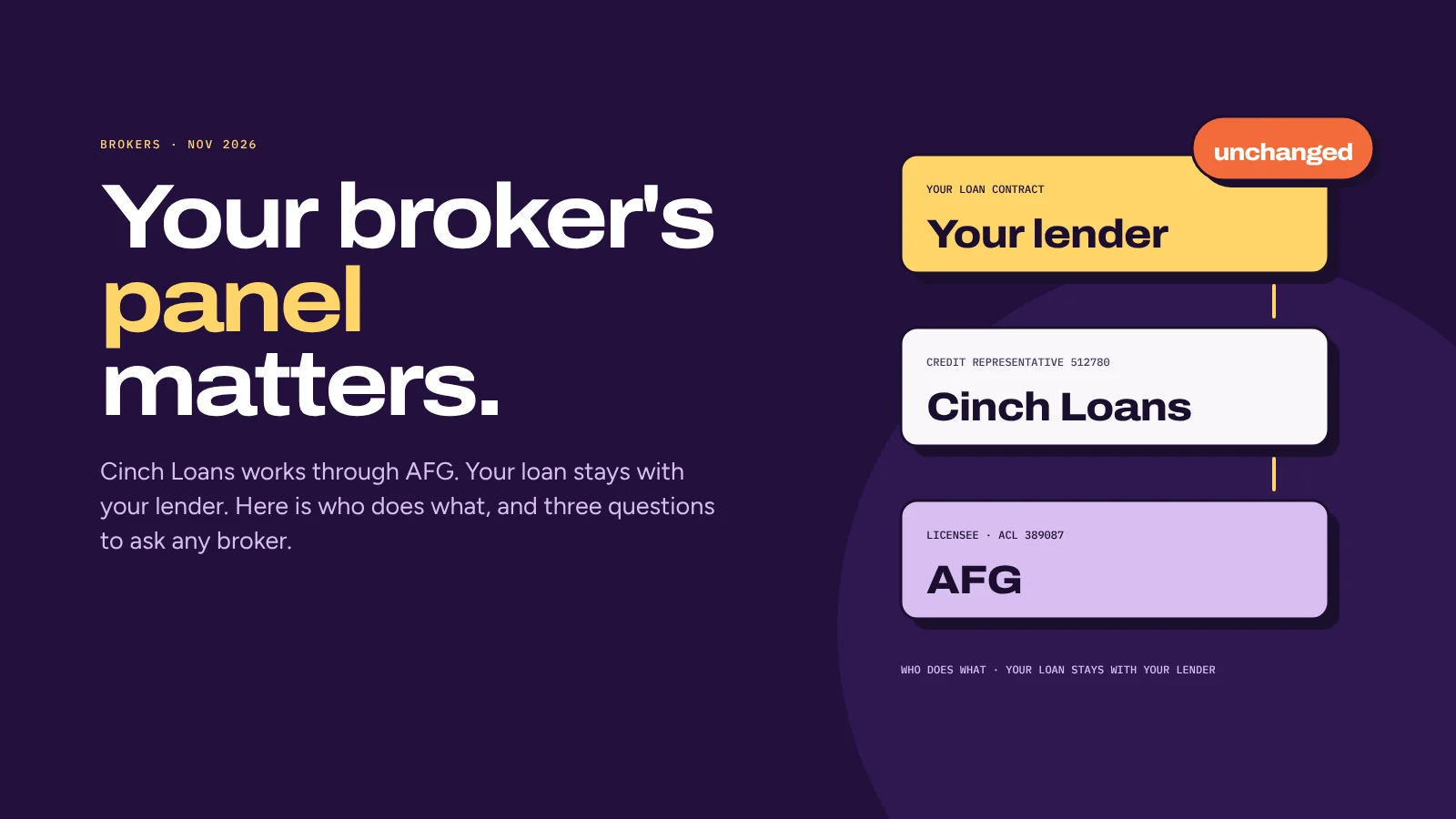
Cinch Loans arranges loans as a credit representative of Australian Finance Group (AFG), an ASX-listed aggregator that holds Australian Credit Licence 389087. If we've already arranged a loan for you, nothing about it changes. Your contract, rate and repayments stay with your lender. What changes is the licence line on our Credit Guide. If you're comparing brokers after the 3 November rate rise, the more useful question is which lenders a broker can use, and which ones they actually compared for you.
Ever wondered who checks your broker's work? Most people never hear the word "aggregator", yet one sits behind almost every broker in Australia.
That matters more than it used to. Brokers arranged a record 81.6% of new home loans in the June quarter, according to MFAA research published on 3 September. So here's what an aggregator is, what working through AFG changes for Cinch Loans clients (very little), and the three questions worth asking any broker.
What an aggregator does
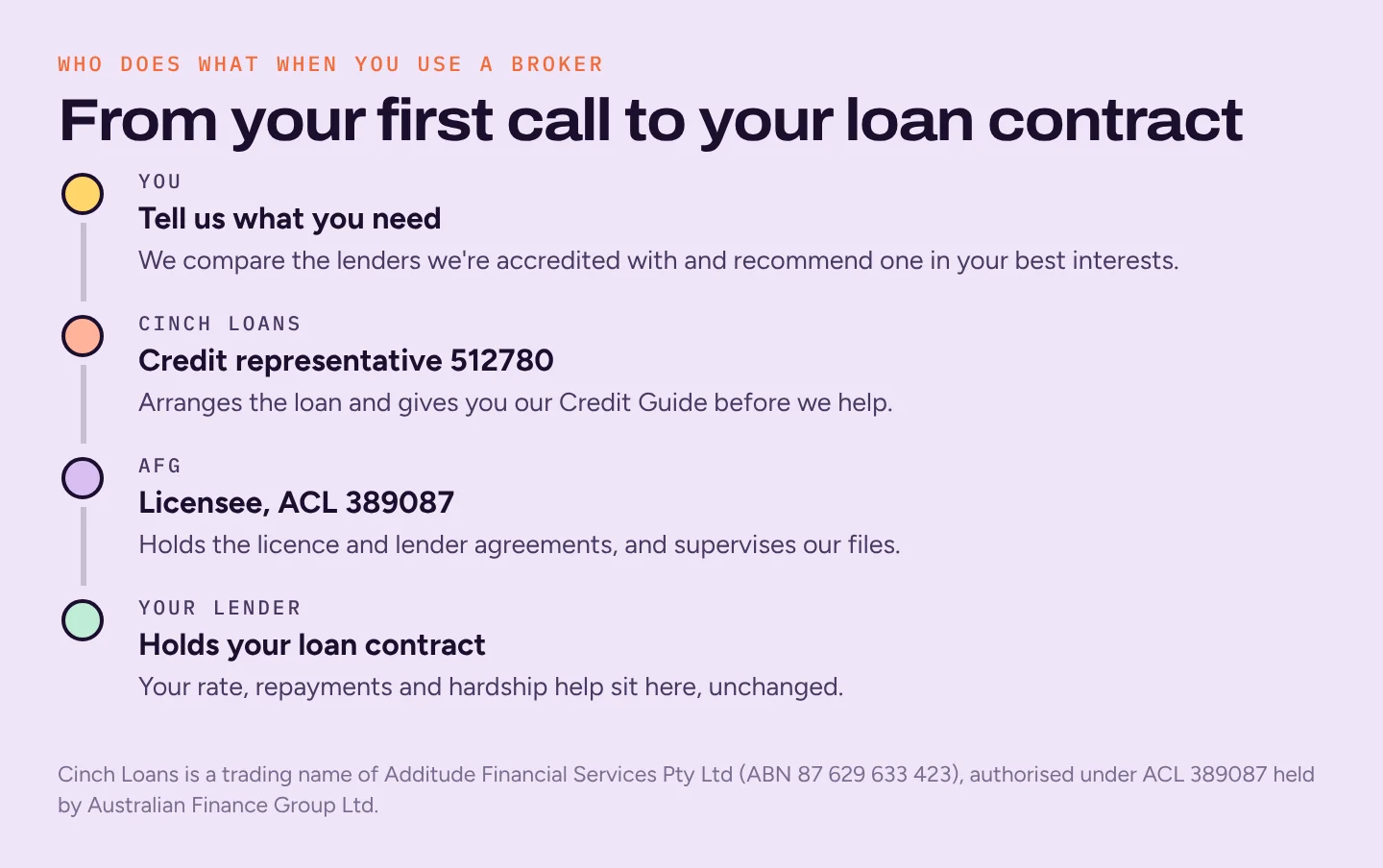
Most brokers don't hold their own credit licence. They work as credit representatives under a business that does, and for most brokers that business is an aggregator. It does four jobs:
- It holds the licence. AFG holds ACL 389087 and answers to ASIC for the credit help its representatives give.
- It holds the lender agreements. Each broker still has to be accredited by each lender separately, so two brokers with the same aggregator can have different lists.
- It runs the checks. A licensee has to supervise its representatives, which means file reviews, training and audits.
- It passes on the pay. Lenders pay commission through the aggregator to the broker. You don't pay it.
AFG has been doing this for 32 years, by its chief executive's count, and publishes a quarterly index of the loans its brokers lodge.
What changes if you're a Cinch Loans client
For an existing loan, nothing. Your contract is with your lender, not with us or AFG. Your rate, repayments, offset account and your lender's hardship team all stay exactly where they are.
The paperwork changes. Our Credit Guide, which you get before we give you credit help, now reads: Cinch Loans is a trading name of Additude Financial Services Pty Ltd (ABN 87 629 633 423), credit representative 512780, authorised under ACL 389087 held by Australian Finance Group Ltd. It also sets out how we're paid and who to talk to if something goes wrong.
If something does go wrong, start with us. If we can't fix it, you can go to the Australian Financial Complaints Authority (AFCA), which doesn't charge consumers. Our AFCA membership number is 67907.
The law that protects you doesn't change either. Since 1 January 2021, brokers have had to act in your best interests and, if they know of a conflict, put your interests ahead of their own. That duty applies whoever holds the licence.
Your broker's panel, and why it matters
No broker can use every lender. The panel is the set of lenders an aggregator has agreements with. Accreditation is which of those a broker is personally approved to use. Ours doesn't cover every bank, and we'll say so up front if the lender you have in mind is one we can't use.
The catch for borrowers is that you can't see a broker's panel from the outside. So ask. These three questions work with any broker:
- Which lenders can you use for a loan like mine, and which did you compare?
- Why this lender over the others you looked at?
- How are you paid on this loan, and are there any fees I'd pay you?
A good broker answers all three without fuss. ASIC's guidance on the best interests duty (RG 273) expects brokers to keep records of the options they gave you, what they recommended and why, so the answers should already exist on your file.
Why it matters this week
The Reserve Bank raised the cash rate to 4.85% on 3 November, its fifth rise of 2026, on a six-to-three vote. The big four banks are passing on the full 0.25 percentage points from 13 November.
Here's a quick example. On a 30-year loan with a variable rate in the mid-6s, a 0.25 point rise adds about $16 a month for every $100,000 owing. On $600,000, that's about $99 a month. These are example figures.
AFG's own numbers show borrowers haven't started moving yet. In the September quarter, refinancing made up 15% of the loans AFG brokers lodged, down from 17% a year earlier, and the average loan hit a record $730,145.
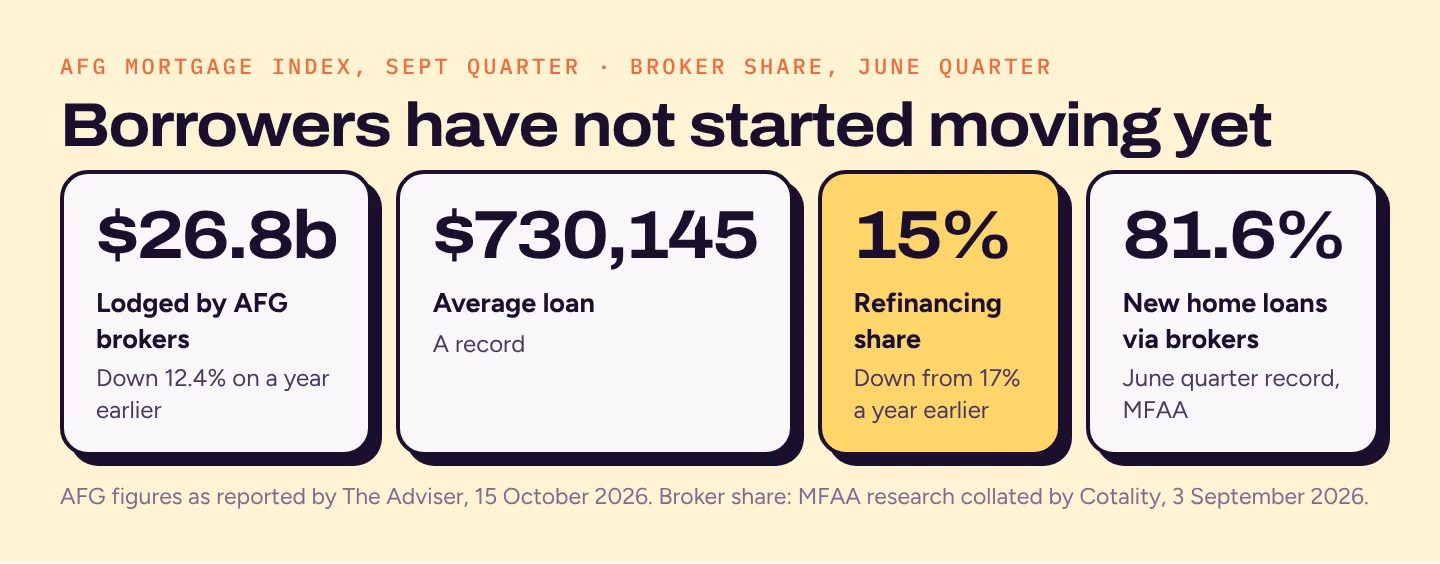
AFG's chief executive, David Bailey, said on 15 October that the lift in refinancing "has yet to materialise". If your rate is rising and you haven't checked it against the market, that's where a broker's panel earns its keep, after the costs of switching. Our pieces on stay or switch and when refinancing pays run the numbers. If a new lender's assessment is the sticking point, start with mortgage prison, 2026 edition.
Questions people ask
Does my existing loan move to AFG?
No. Your loan stays with your lender on the same terms. AFG is the licensee behind us, not a lender to you.
Do I pay more because my broker uses an aggregator?
No. Lenders pay us, not you. If a fee ever applies, for example on some private or commercial lending, it's set out in writing before you go ahead.
Can a broker charge me if I refinance early?
Lenders can take back part of a broker's commission if a loan is paid out in its first two years, but the rules say that cost can't be passed on to you. Any fee a broker does charge has to be set out in their Credit Guide and quote before you go ahead, so check both before you sign.
Where to start
The refinance calculator shows what a different rate would save after costs, and our refinancing page explains how we review a loan. If you want to know which lenders we compared for you, and why, talk it through with a broker from our team. What happens on that call is in what happens in a 30-minute first chat.
Sources
- The Adviser: RBA tightens the reins on cash rate, 3 November 2026
- Australian Broker: Lenders pass on full Reserve Bank hike as refinancing gap widens, 4 November 2026
- The Adviser: Lodgements drop at AFG as majors gain ground, 15 October 2026
- MFAA: Mortgage broker market share reaches record 81.6%, 3 September 2026
- ASIC: Regulatory Guide 273, Mortgage brokers: Obligation to act in the consumer's best interests, June 2020
Last reviewed 9 November 2026. This is general information only. It doesn't take your objectives, financial situation or needs into account. Repayment figures are examples.
Want this applied to your numbers?
Articles are general information. A 30-minute chat with Suvidh and the team turns it into a plan for your situation: borrowing power, structure and the lender that fits.
Talk to a brokerRun the calculatorsWritten by the Cinch Loans team · Reviewed by Suvidh Arora, Chief solutions officer · About us
Keep reading
More from Cinch Insights.
Plain-English articles on home loans, refinancing, rates and the property market, written for Australian borrowers rather than for lenders.
Cinch news
November 9, 2026
Cinch Loans and AFG: what an aggregator does and why your broker's panel matters | Cinch Loans
Cinch Loans works under AFG's credit licence. Existing loans don't change. Here's what an aggregator does, what it means after the 3 November rate rise, and three questions to ask any broker about their lender panel.