Rates & economy
Six said rise, three said stop: have rates peaked, and should you fix now or wait?
The Reserve Bank's November minutes show a six to three split, and markets now lean towards a peak. But inflation stays above 3% until late 2027. What it means in dollars, and how to think through fixing.
23 November 2026
5 min read
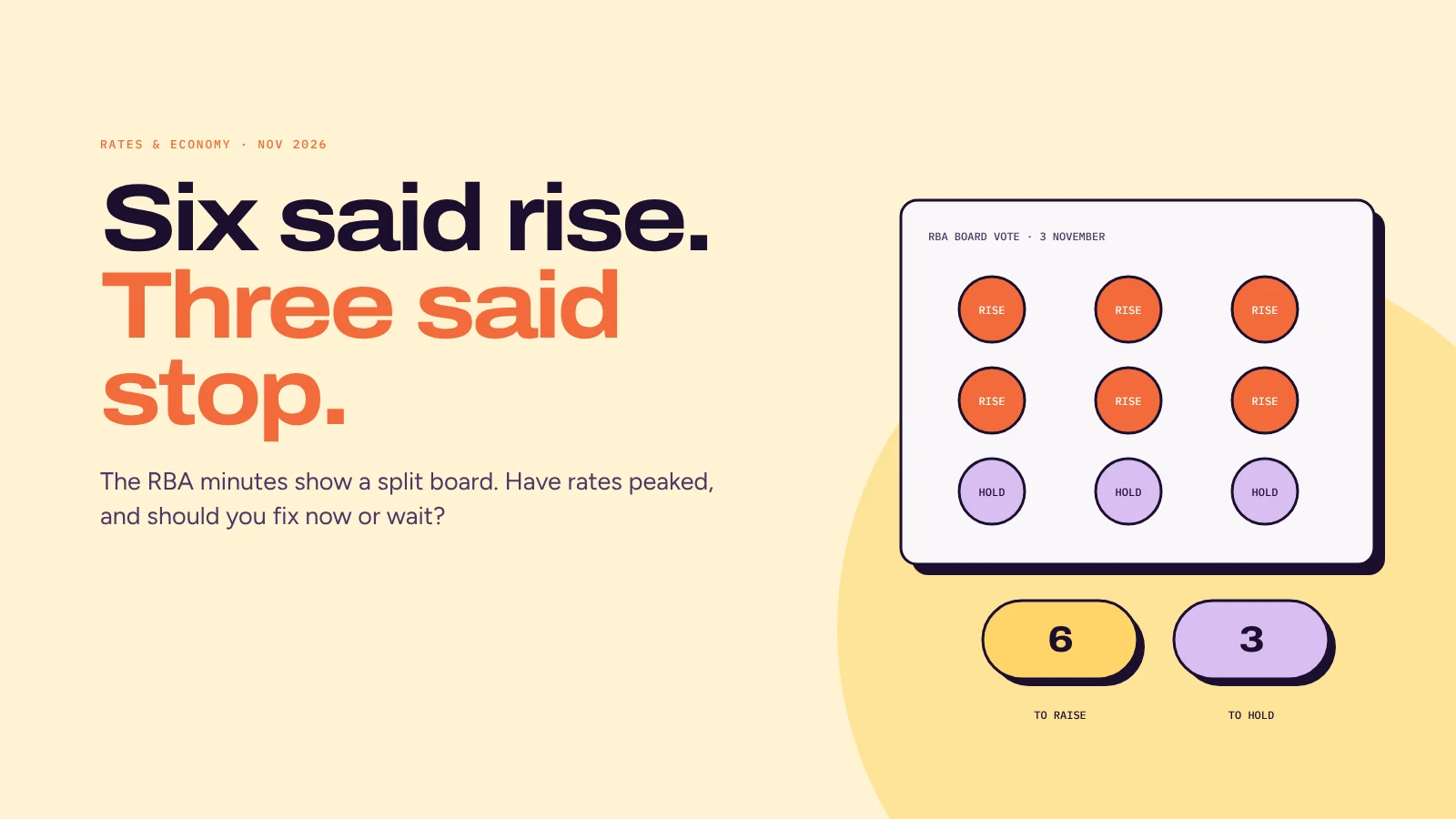
The Reserve Bank's minutes, released on 17 November, show the board split six to three on the 3 November rise. Three members wanted to stop and warned of a sharper downturn. Markets now lean towards rates having peaked, but the minutes have inflation above 3% until late 2027, so relief isn't close. If you're deciding whether to fix, refinance or wait, plan for today's repayment through 2027, keep room for one more rise, and don't count on a cut you can't see yet.
Six said rise. Three said stop.
That's the headline from the minutes of the Reserve Bank's 2 to 3 November meeting, released on 17 November. The board lifted the cash rate to 4.85%, its fifth rise this year. But a third of the board wanted to hold, and that has people asking the question we hear most at the moment: is this the top, and should I fix now or wait?
Here's what the minutes said, what it means in dollars, and how to think the fixing question through.
What the minutes said
The six members who voted to raise judged the cash rate wasn't yet clearly enough to deal with the risk of inflation staying high. They worried more about doing too little than too much, after a long run of inflation above target.
The three who voted to hold wanted more time to see how the earlier 1 percentage point of rises was working. They warned the economy might be close to "a materially sharper downturn", with unemployment the cost.
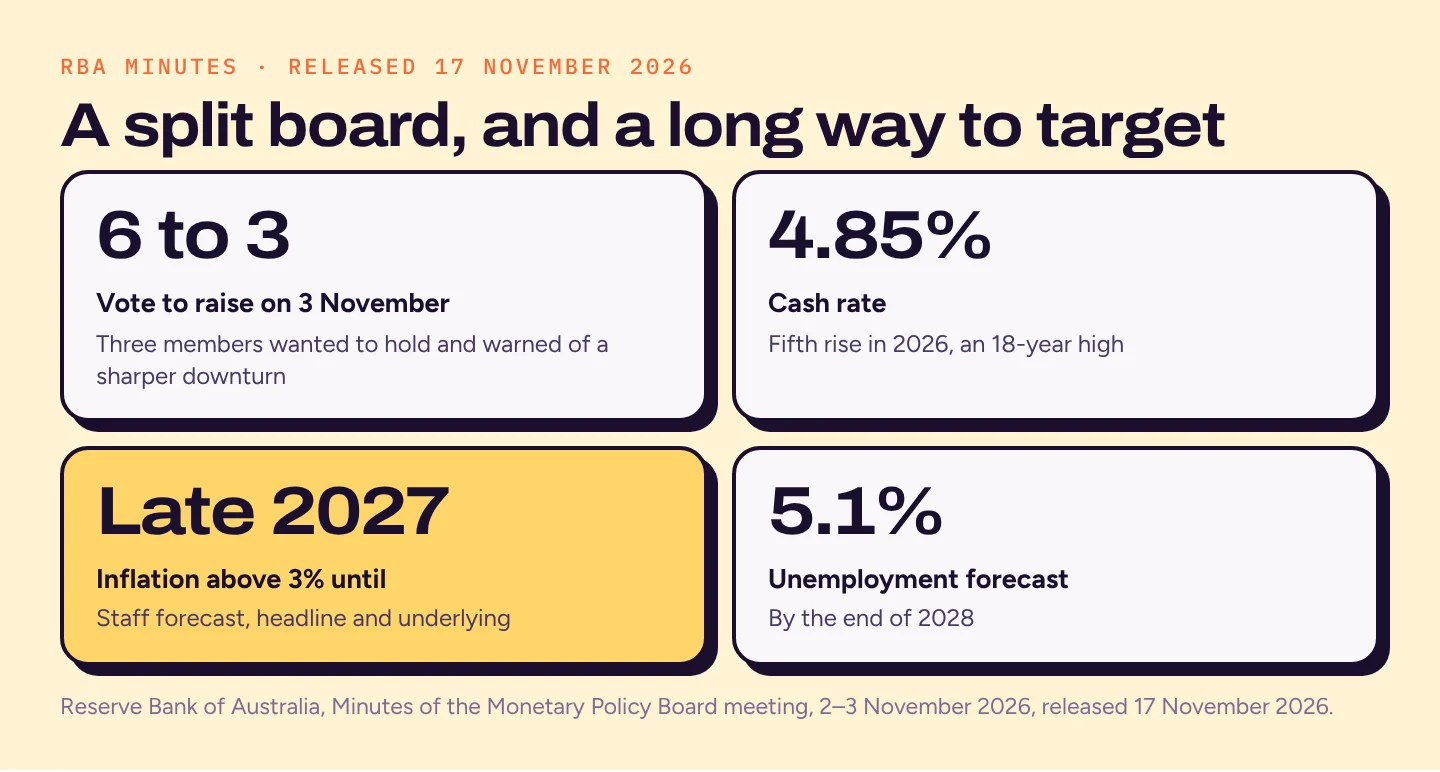
The housing notes are blunt. Prices and new lending have fallen quite sharply, turnover has weakened significantly, and scheduled loan repayments are back around their 2024 peak as a share of household income. Arrears are still low, and households are still adding to offset and redraw, if a bit more slowly than usual.
What the minutes don't give is a promise. There's no guidance on the next move, only that the board will watch the data and do what it considers necessary to bring inflation back to target.
Peaked isn't the same as falling
After a split vote, markets tend to read "done". Reuters reported on 17 November that markets now price about 0.22 percentage points of cuts by the end of 2027. The big four banks' economists all expect a hold at the 8 December meeting, according to Aussie's 9 November round-up. Commonwealth Bank's economists pencil in cuts in August and November 2027, and most of the others see cuts starting in the second half of that year. ANZ and Westpac flag the risk of one more rise as soon as December or February, which would take the cash rate to 5.10%. Commonwealth Bank and NAB also say further rises remain a risk.
On those forecasts, the next 12 months runs from one more rise to no change. The first cut most forecasters can see is in the second half of 2027.
In dollars, for a $600,000 loan with 25 years left at Canstar's average owner-occupier variable rate as at 10 November (an example only):
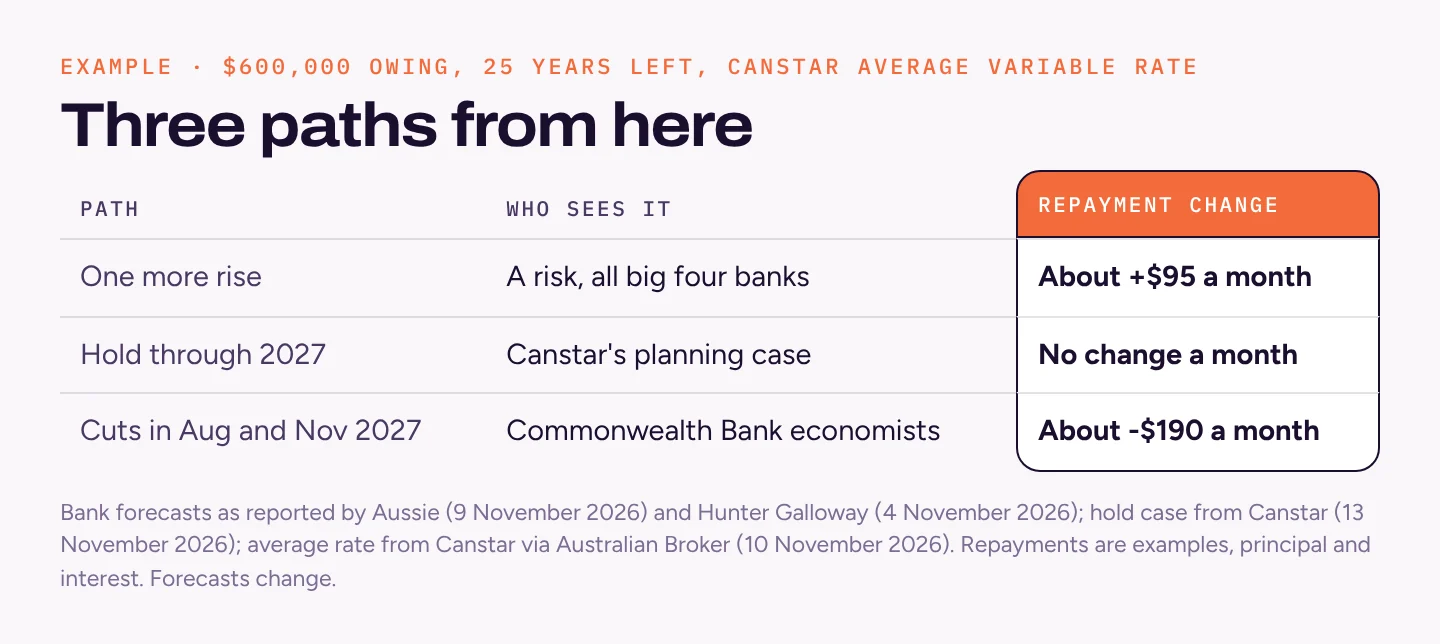
The middle row is the one to budget for. Canstar worked out that if rates simply stay where they are, a $600,000 loan costs about $2,700 more in repayments over 2027 than over 2026. Most lenders also give two or more months' notice before lifting direct debits, so some of this year's rise won't show up until the new year.
Fix now or wait? How to think it through
Fixing is buying certainty. The price of that certainty is set by what lenders expect rates to do, not by what the cash rate is today.
Fixed rates were still going up after the November decision. In the week after the decision, six lenders raised 130 fixed rates by an average of 0.25 percentage points, Australian Broker reported, using Canstar data. So a fixed rate today already prices in the chance of another rise. You aren't getting in early.
Three questions help more than a forecast:
- Could your budget take one more rise of about $95 a month on $600,000? If the answer is no, certainty is worth paying for, whatever the market thinks.
- Would you be annoyed or relieved if rates were cut in late 2027 and you'd fixed for three years? If annoyed, a shorter term or a split may suit you better.
- Do you need flexibility? Fixed loans often cap extra repayments, many have no full offset, and breaking early can cost real money if rates have fallen since you fixed.
A split loan is the usual middle path: part fixed for certainty, part variable so the offset and extra repayments keep working. We went through the trade-offs in should you fix your home loan.
What to do before 8 December
- Check your new repayment. If you pay by direct debit, make sure it has moved, or note when it will.
- Keep your buffer. Offset balances are near a record $340.5 billion on APRA data, yet the big banks' results show 12% to 15% of customers have no buffer at all. Don't spend down an offset on the hope of a cut.
- Ask your lender for a sharper rate before you decide anything. The call shows what your lender will do to keep you, and gives you a benchmark to compare against. The script is in stay or switch.
- If your fixed rate ends in the next year, start now. Rolling off an older fixed rate is where the biggest payment jump lands, and refinancing takes weeks. More in five rate rises in 2026: when refinancing pays.
Questions people ask
Have interest rates peaked in Australia?
Nobody knows yet. The split vote and the board's warning about a sharper downturn have markets leaning towards a peak, but the board gave no guidance and all four big banks still say another rise is a risk. Plan for both.
Should I fix my home loan now?
It depends on how much a rise would hurt your budget and how much flexibility you need. Fixed rates already price in the market's expectations, so fixing is about certainty, not beating the market. A split lets you have some of each.
When will the RBA cut rates?
Not soon, on current forecasts. The minutes have inflation above 3% until late 2027, and the earliest cuts most forecasters pencil in are in the second half of 2027. Forecasts change, so treat any date as a guess.
Where to start
The loan repayment calculator shows what a rise or a cut does to your own repayment. Our refinancing page explains how we review a loan, fixed or variable, Australia-wide. If you're weighing up a fix or a split, talk it through with a broker from our team and bring your latest statement.
Sources
- Reserve Bank of Australia: Minutes of the Monetary Policy Board meeting, 2–3 November 2026, released 17 November 2026
- Reuters (via 93.3 The Drive): RBA board judges fifth rate hike needed to provide policy assurance, 17 November 2026
- Aussie: What experts predict for the RBA's December 2026 decision, updated 9 November 2026
- Hunter Galloway: Will interest rates go down? Bank forecasts, updated 4 November 2026
- Australian Broker: lenders pass on the RBA's November rise, 10 November 2026
- Canstar: Rate rise locks in nearly $3k extra for 2027, 13 November 2026
- Reserve Bank of Australia: 2026 Monetary Policy Board meeting dates
Last reviewed 17 November 2026. This is general information only. It doesn't take your objectives, financial situation or needs into account. Repayment figures are examples.
Want this applied to your numbers?
Articles are general information. A 30-minute chat with Suvidh and the team turns it into a plan for your situation: borrowing power, structure and the lender that fits.
Talk to a brokerRun the calculatorsWritten by the Cinch Loans team · Reviewed by Suvidh Arora, Chief solutions officer · About us
Keep reading
More from Cinch Insights.
Plain-English articles on home loans, refinancing, rates and the property market, written for Australian borrowers rather than for lenders.
Rates & economy
November 23, 2026
Have rates peaked? RBA minutes, and fix or wait | Cinch Loans
The Reserve Bank's November minutes show a six to three split, and markets now lean towards a peak. But inflation stays above 3% until late 2027. What it means in dollars, and how to think through fixing.