Rates & economy
Hold or rise on 3 November? What each one does to your repayment, and how to plan for both
The RBA decides on Tuesday 3 November, and after hot inflation figures a 0.25 point rise is the main expectation. What a hold, a rise and a second rise would mean in dollars, when a rise reaches your repayment, and five things to do this week.
2 November 2026
5 min read
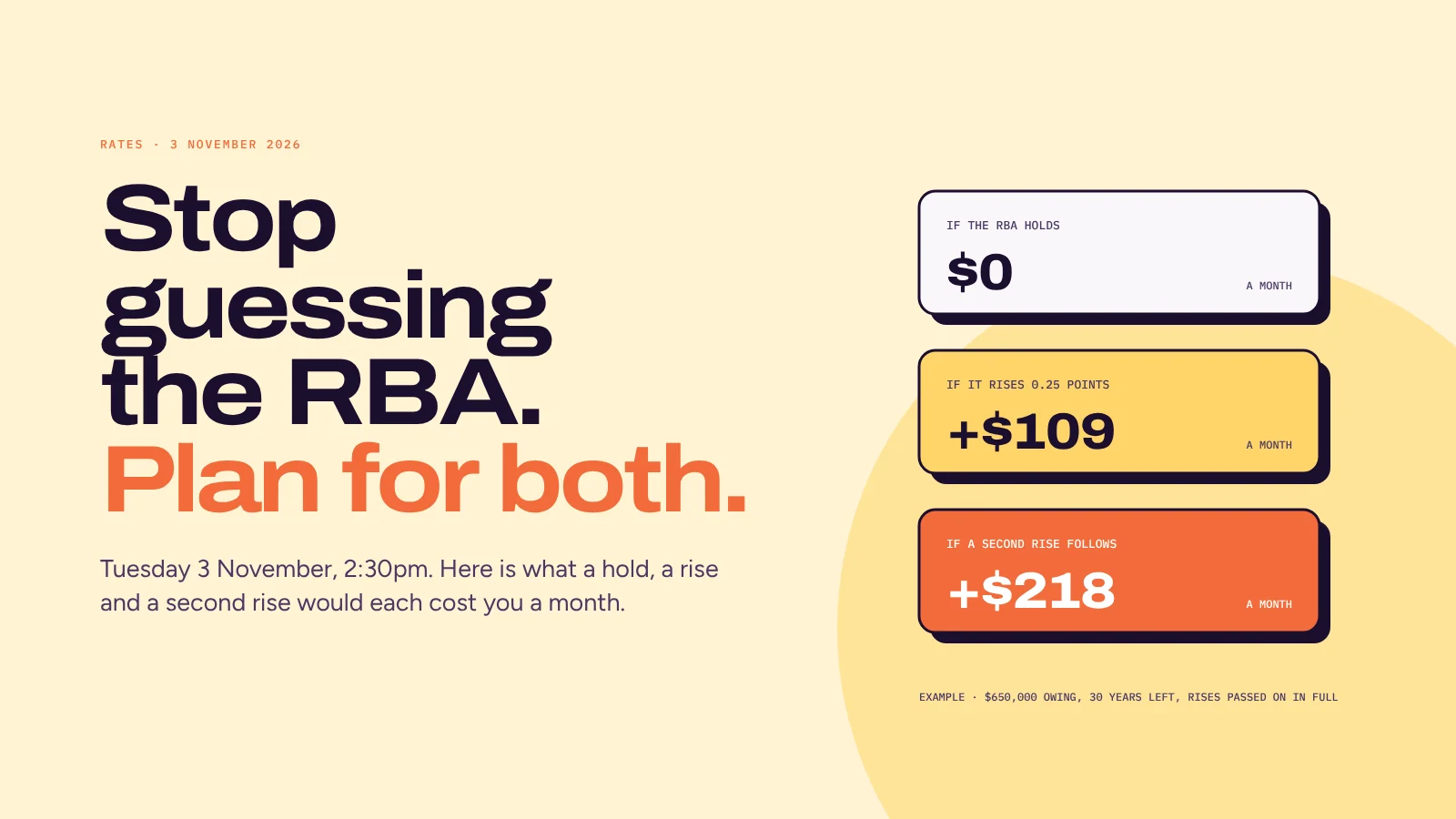
The Reserve Bank announces its next cash rate decision at 2:30pm on Tuesday 3 November. After hotter inflation figures last week, a rise of 0.25 percentage points is now the main expectation, though a hold is still possible. If you have a variable home loan, a rise would add roughly $16 to $17 a month for every $100,000 you owe. Don't bet your budget on a forecast. Work out both numbers this week, and test a second rise too.
Most people have given up guessing what the RBA will do. That's fair. The better question is what each outcome costs you, and whether your budget copes with either.
Here are the numbers for a hold, a rise, and a rise followed by another one, plus what to do before Tuesday afternoon.
Where things stand after last week's inflation figures
The cash rate is 4.60% after four rises this year, in February, March, May and September. The board meets on Monday 2 and Tuesday 3 November, with the decision out at 2:30pm on Tuesday (yes, Melbourne Cup day).
The September inflation figures, released on 28 October, came in hot. Prices rose 4.3% over the year, up from 4.0% in August. Underlying inflation (the trimmed mean, which strips out the biggest price swings) rose 1.0% over the September quarter, above the 0.8% the RBA had forecast. Housing and fuel did most of the damage.
After the release, the economists at all four major banks were expecting a rise to 4.85%. Two of them had expected a hold until that week. Market pricing put the chance of a rise at roughly 80% to 90% in the days that followed.
That's a strong expectation, not a certainty. One economist noted the RBA might feel it has time to wait, given it only moved in September. So plan for both.
Hold, rise, or a rise with another to follow: the dollars
A rise only reaches your repayment if your lender passes it on. After the September rise, the major banks passed it on in full, with variable rates going up from 9 October. These example figures assume the same again.
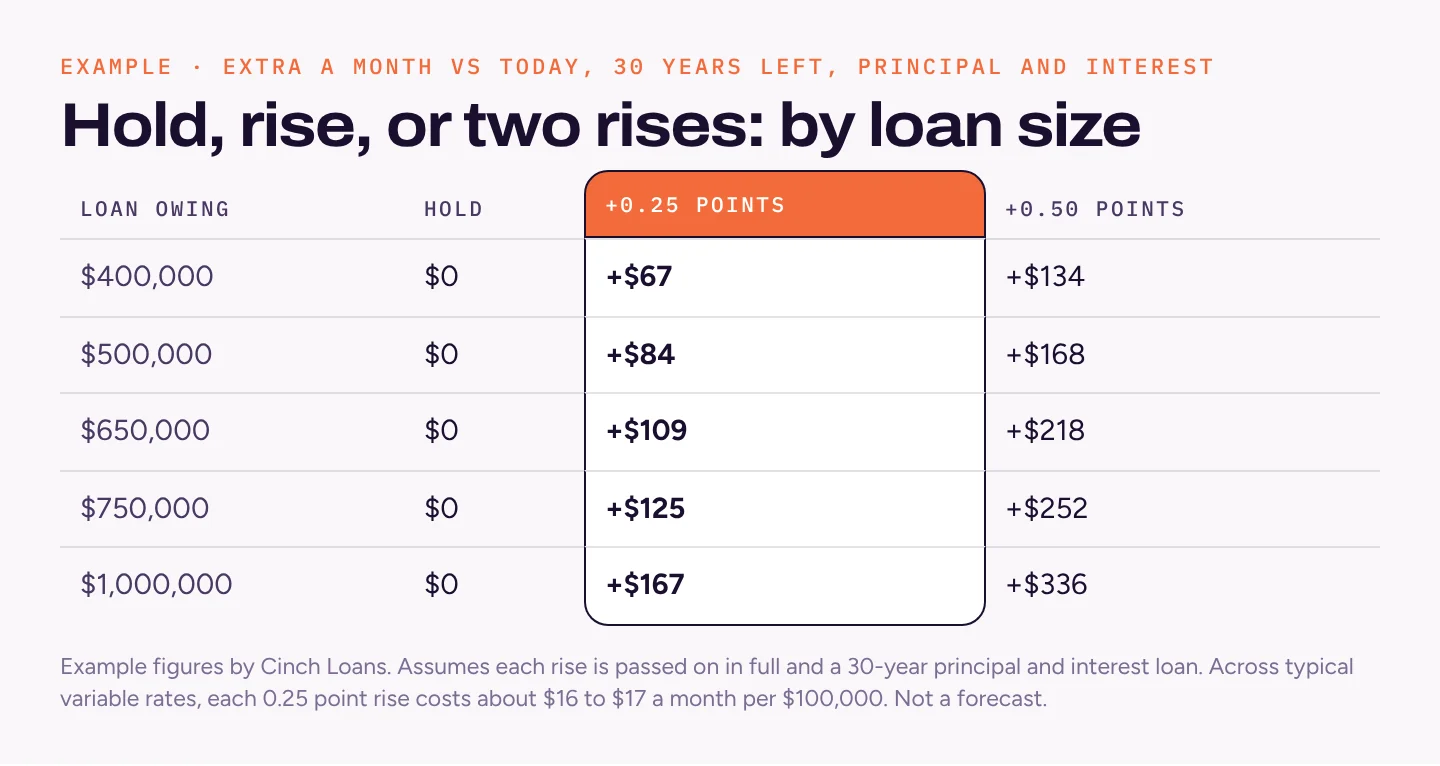
Take an example loan of $650,000 with 30 years left, paying principal and interest. Your starting rate barely changes these numbers: across typical variable rates, each 0.25 point rise costs $16 to $17 a month per $100,000 owed.
- If the RBA holds, the repayment stays where it is.
- If it rises by 0.25 points, the repayment goes up by about $109 a month. That's about $1,300 over a year.
- If a second rise follows in December or February, the increase is about $218 a month, or about $2,620 a year, compared with today.
The second rise isn't a prediction. One of the major banks has flagged a "material risk" of the cash rate reaching 5.10%, and others say the RBA will keep further rises on the table. It's a sensible stress test, not a forecast.
When a rise would reach your repayment
A rise on Tuesday doesn't change your repayment on Wednesday. Lenders usually announce what they're doing within a few days and apply the change from a set date. After the September rise, that date was 9 October for the major banks, ten days after the decision. Your repayment is then reset, usually from a scheduled payment after that date. Your lender will write to you with the new amount.
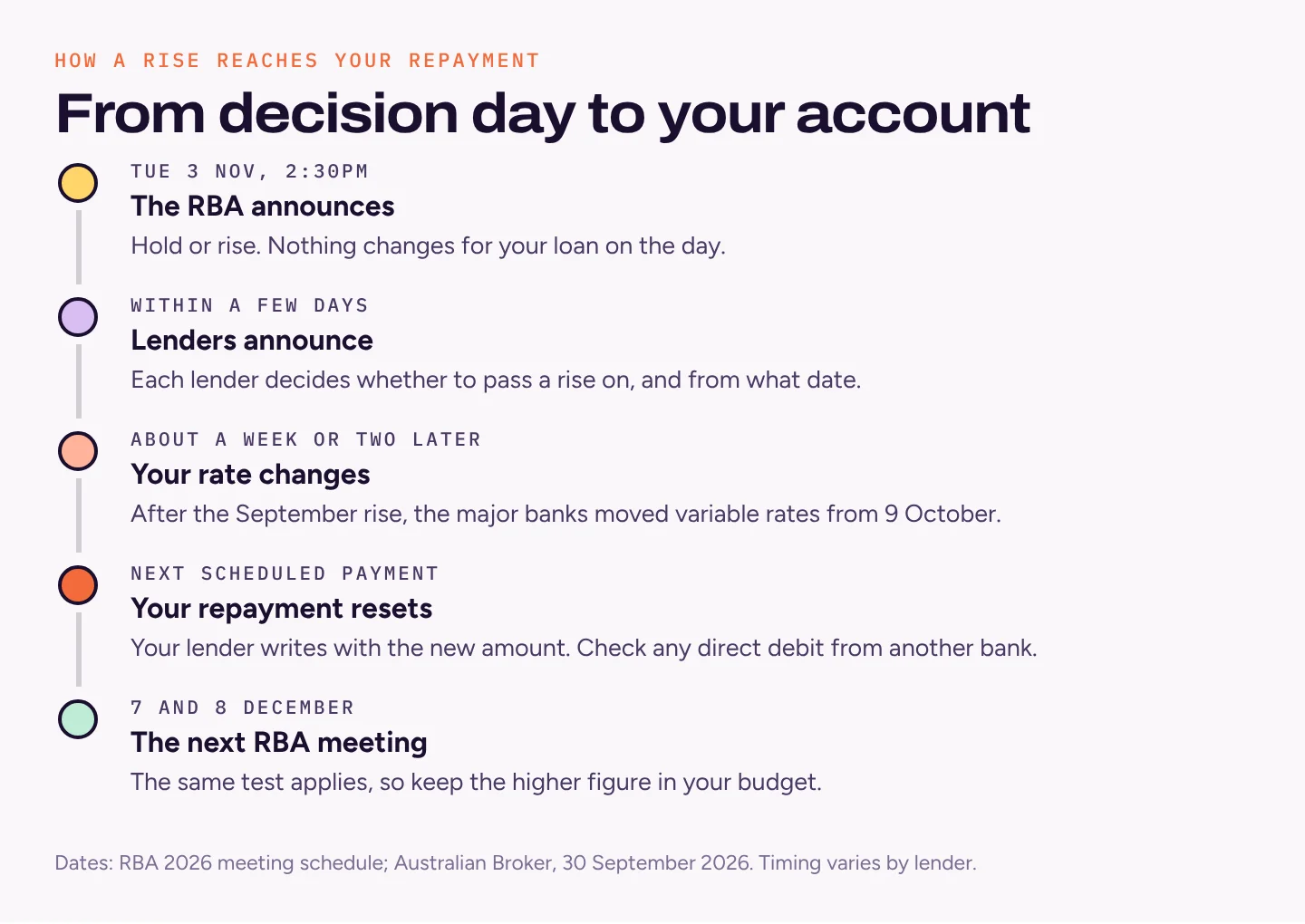
Two things catch people out. If you pay by direct debit from another bank, check the amount updates. And if you've been paying more than the minimum, the minimum may rise without your actual payment changing, which quietly eats into the buffer you thought you had. More on how that works in offset, redraw or extra repayments.
Plan for both: five things to do this week
- Find your balance and your current rate on your latest statement or banking app. Every number above depends on your balance.
- Work out your repayment at a 0.25 and a 0.50 point rise. The loan repayment calculator does this in a minute.
- Put the bigger number into your budget. If it fits, a rise is an inconvenience. If it doesn't, you've found out early, which is when you have the most options.
- Check what your savings are doing. Money sitting in an ordinary account while you owe on a variable loan is costing you more after every rise. An offset account linked to the loan can change that.
- If your rate hasn't been reviewed this year, ask your lender for a better one, and compare it with the market. Our stay or switch guide covers the call.
If the higher repayment won't fit at all, talk to your lender before a payment is missed. Hardship arrangements exist, and asking early keeps more doors open.
Questions people ask
If the RBA raises rates on 3 November, when will my repayment go up?
It depends on your lender. Most announce within a few days and apply the new rate from a date in the following week or two, then reset your repayment. Your lender will tell you the new amount and when it starts.
Should I fix my rate before Tuesday?
Fixed rates already price in where lenders think rates are heading, so fixing isn't a way to dodge a rise that's widely expected. It can still suit people who want certainty. Our fix before 3 November article runs the numbers both ways.
What if the RBA holds?
Then nothing changes this month. The next meeting is 7 and 8 December, and the same budget test still applies, so it's worth keeping the higher figure in your plan.
Where to start
The loan repayment calculator shows your repayment at any rate, and the refinance calculator shows what a different rate would save after costs. For the full picture of this year's rises, see the 2026 rate rises, added up. Our refinancing page explains how we review a loan. If Tuesday's decision leaves you unsure what to do, talk it through with a broker from our team. Bring your latest statement.
Sources
- ABS: CPI rose 4.3% in the year to September 2026, 28 October 2026
- ABC News: Inflation rate rises to 4.3 per cent in September, raising rate hike expectations, 28 October 2026
- CommBank Newsroom: CommBank economists forecast November RBA rate hike, 28 October 2026
- Aussie: What experts predict for the RBA's November 2026 decision, 29 October 2026
- Savings.com.au: RBA November rate hike expected, but will 4.85% be the peak?, 30 October 2026
- Australian Broker: Big four banks pass on RBA hike in full, 30 September 2026
- RBA: 2026 Monetary Policy Board meeting dates
Last reviewed 2 November 2026. This is general information only. It doesn't take your objectives, financial situation or needs into account. Repayment figures are examples.
Want this applied to your numbers?
Articles are general information. A 30-minute chat with Suvidh and the team turns it into a plan for your situation: borrowing power, structure and the lender that fits.
Talk to a brokerRun the calculatorsWritten by the Cinch Loans team · Reviewed by Suvidh Arora, Chief solutions officer · About us
Keep reading
More from Cinch Insights.
Plain-English articles on home loans, refinancing, rates and the property market, written for Australian borrowers rather than for lenders.
Rates & economy
November 2, 2026
RBA 3 November 2026: what a hold or a rate rise means for your repayments | Cinch Loans
The RBA decides on Tuesday 3 November, and after hot inflation figures a 0.25 point rise is the main expectation. What a hold, a rise and a second rise would mean in dollars, when a rise reaches your repayment, and five things to do this week.